This weekend I travelled to Tel Aviv to take part in a major demonstration organised by various Israeli peace and justice organisations and a few left-wing political parties. The police estimated that nine thousand people were marching that night. This alone would have been a good reason for me not to go, as I don’t like crowds and I don’t like noise and I don’t like strangers, and I especially don’t like all three packed into one town square – especially when the square is full of banners reading ‘Two peoples, two states’.
“That is a very segregationist sentiment,” I said disapprovingly to Shai as we passed the first such sign. I support a one-state solution, partly for practical reasons, partly for ethical ones. For the past five years I have watched policymakers dreaming up ways to divide the land, and peace workers dreaming of ways to unite people, and gradually I found myself drifting into the second group. This has brought me face-to-face with injustice and pain that I didn’t even know existed, and which can’t be remedied by land division. In my experience with the Israeli left, too many of its members assume that Palestine’s problems can all be solved by simply parcelling off land for the Palestinians to govern for themselves. They often talk as though these problems began in 1967, as if the occupation is a dark stain on an otherwise bright history. 1948 and the years leading up to the ethnic cleansing constitute the elephant in the room. Obviously this isn’t true for every Israeli left-winger, but I have encountered these attitudes frequently enough for me to have become quite sceptical of the left.
My scepticism was summed up perfectly by another left-wing demo that was held in Jerusalem recently, under the inspired slogan ‘The Territories for them, the chunks for us’ (the ‘chunks’ being the illegal settlement blocs). As my friend David pointed out, they might as well have called it ‘Swiss cheese for them’. On the event’s Facebook page, one person asked, “How is this any different from the occupation?”
The Tel Aviv demo took a firmer line (“Israel says ‘yes’ to a Palestinian state”). I decided that the slogan was wide enough to encompass many views, including my own, so I agreed to go. When I arrived I saw several demonstrators carrying outsize photographs of a zombie-like Benjamin Netanyahu, bearing the caption ‘peace-decliner’, and this stinging critique of Israel’s PM reassured me that I had made the right choice. I was in a radical crowd.
The streets had been shut down for the march. As we wound our way through the city, heading from Rabin Square to the Tel Aviv Museum of Art, Shai translated the remarks from passers-by. “That woman just said, ‘Look, they’ve got the 1967 signs, the shitheads!’.”
Perhaps I should have seized the opportunity to do something practical for peace and run after her, telling her that I am not a fan of ’67 borders either, but I had a funny feeling that she would take even less kindly to me than she did to the ’67 placards. In any case, I was enjoying the atmosphere of the demo too much to want to leave. So long as we kept moving and stayed on the edges, I could tolerate the crowds, and the sense of solidarity was infectious. Busloads of people had travelled up from Beersheva just to participate. By the time we reached the plaza outside the museum, I was happy to admit that the leftist Israeli peace movement might have more spirit than I give it credit for.
But I do wish it could stay sober for longer than five seconds at a time. It seemed to me that half the marchers were up there with the clusters of green Meretz balloons that bobbed along overhead. This is where I began to feel overwhelmed. Acute sensitivity to noise, smell, light, and touch are features of my neuro problems, and when I am in a crowd it becomes painful. It gets hard to walk; I can’t concentrate on moving if I have to process so much numbing sensory information. Speech becomes hesitant. Then I start to want to hide. I coped by draping my scarf over my head and face to block out the world. When I sensed my balance starting to go, I got down on the floor.
I was afraid that I would panic, but I didn’t. Sitting there, clutching a book about reconciliation, I thought about all the different things that coming to Palestine has enabled me to do. Perhaps because the situation here is so extreme, I push myself to extremes. I try things that at home I wouldn’t touch. Back in England it’s sometimes all I can do to ask a waiter in a restaurant for a refill of my tea. Here I go up to heavily armed men and ask them why they are blocking my way. At home I hide upstairs if my parents have guests round whom I don’t know very well. Here I go marching with thousands of people. It isn’t easy, but it does make me feel good afterwards. In a sense, this is part of peace work: pushing personal limits, and finding out things you did not know about yourself.
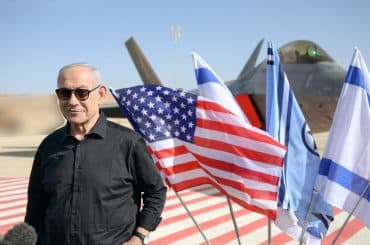
In addition to the Meretz balloons and people high on weed, there were many Israeli flags streaming above my head. It was strange for me to see all the blue and white. Where I live, the flag hangs at the checkpoints. When you have been in a queue for hours and your back aches and you just want to sit down and the soldiers won’t stop screaming, the sight of that flag is like a taunt. Look, this is what we can do to you. We own this land and we own your time and we can make you wait as long as we like. It’s even worse when I’m in Hebron and I see the settlements. There the flag has been splashed brazenly across the water towers – towers that serve only the settlers, while Palestinian residents in south Hebron have to get by on fifteen litres of water per day. (According to the World Health Organisation, seventy litres is the bare minimum needed for each person.) Israel takes 80% of the West Bank’s water supply, the settlements get another 10%, and the entire population of the West Bank makes do with what is left of their own water – which they buy from Israel at inflated prices.
Sometimes I feel as though I can’t bear to look at that flag. It did me good to see it being used positively for once, although I don’t know if the symbol can ever be fully reclaimed after all it’s been made to stand for on this side of the wall. But conflicting emotions aside, I am glad I went on Saturday.
This post first appeared at Vicky’s site, Bethlehem Blogger.