Archive

April 2015

Browsing

Last summer the group “If Not Now” rapidly gained support among left-leaning Jewish activists for protesting Jewish communal organizations’ complicity in the Israeli attack on Gaza. Julia Carmel was an early supporter of the group and writes: “If Not Now has marked what many of us believe to be a substantial and tragically overdue shift in public opinion on Israel. However, there are reasons to be deeply concerned that the movement is wasting a critical opportunity – and, in doing so, inadvertently maintaining Israel’s oppression of Palestinians.”

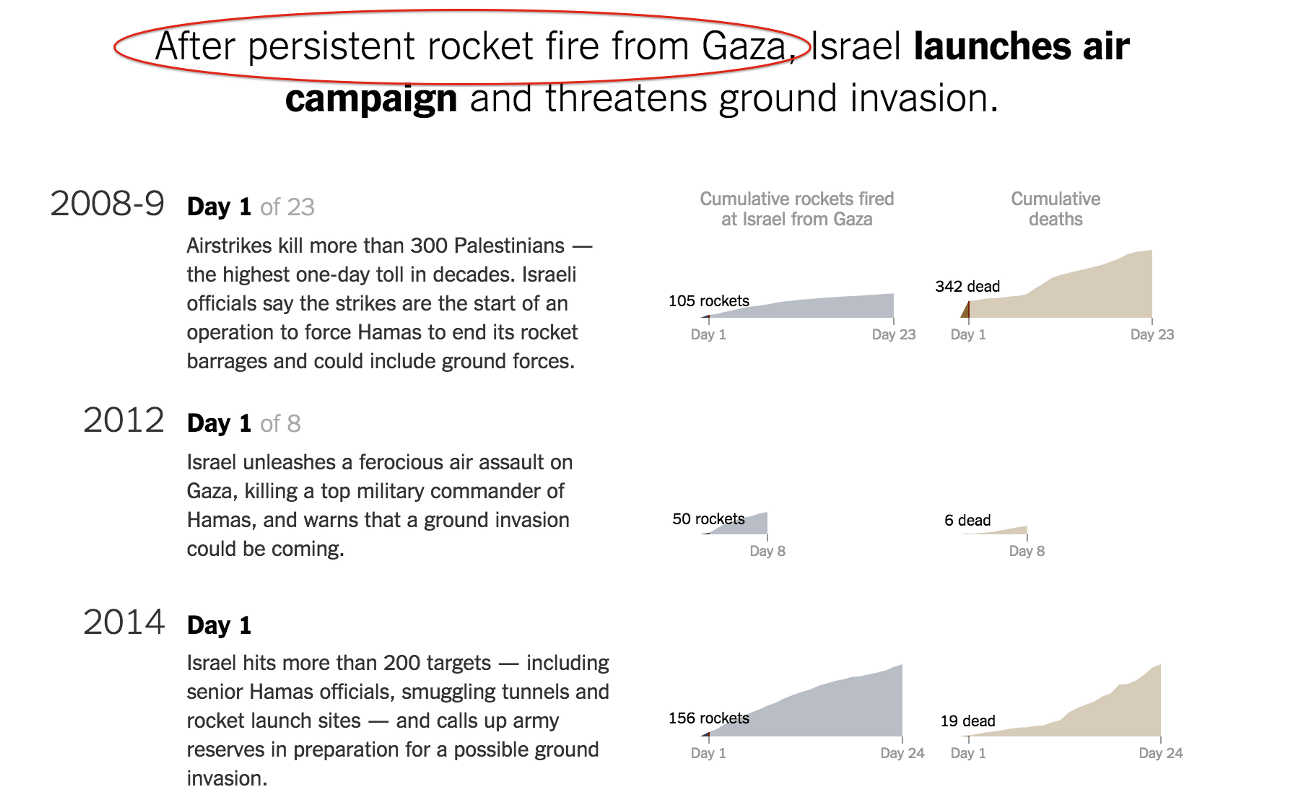
On July 31, 2014, the New York Times published an interactive article about the Israeli assault that was underway in Gaza. In an expertly designed data visualization, the Times guided us through its own version of events, which boils down to: Hamas started it, and Israel responded in self-defense. A common misconception about data journalism is that it’s somehow less biased than traditional print journalism, but Anna Flagg and Moiz Syed breakdown some ways that design can be misused to tell a slanted story. This New York Times article reminds us that design is just as much an editorial tool as it is a tool of aesthetics.

Palestinian terrorism has been largely driven by the just cause of national liberation in part of Palestine rather than the unjust one of the destruction of Israel. By contrast, while there is a strong case that Zionist terrorism was instrumental in the establishment of the state of Israel during the 1940s, since 1967, its primary purpose has been to maintain the occupation. Jerome Slater’s argument, which did not find a home in a journal.

Hiam al-Nawaja dreams to live in what she calls a “normal house.” The 23-year old mother of three small children and sheepherder manages in a cinder block frame insulated with a tarp a typical modest home in Susiya, a pastoral Palestinian village set in the rolling south Hebron Hills in the West Bank. Yet a few short decades ago Susiya’s residents had sturdy stone structures built over ancient caves on a hilltop one kilometer from where their town stands today. The former location, “old Susiya,” is close enough that al-Nawaja can see bulldozed remains from her kitchen window. It was destroyed in 1986 when Israel dismantled the town’s mosque to uncover an ancient Jewish synagogue dating back to the sixth century.

Ayman Odeh of the Arab List and Yariv Oppenheimer or Peace Now are both in a dead end: Odeh’s the dead end of Holocaust remembrance when the Nakba is still unfolding, Oppenheimer the dead end of serving the occupation

When Batya Kahana-Dror tells a NY Jewish audience that she wants “maximal territory with minimal Arab citizens” inside Israeli borders, no one criticizes her. But when a woman in the audience calls on ending US aid to Israel, Rabbi Ayelet Cohen says that she’s being disrespectful.