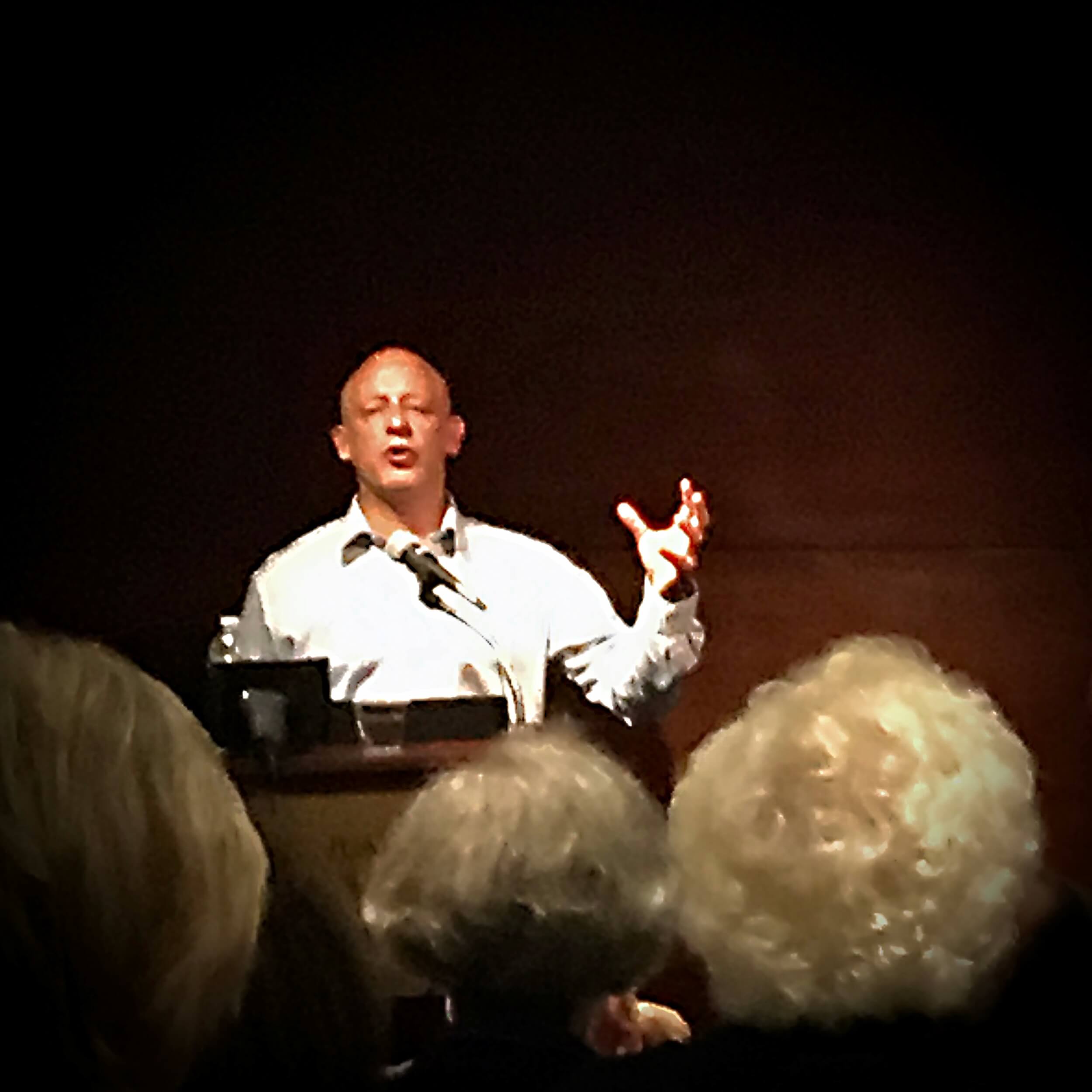
The 100th anniversary of the Balfour Declaration has set the stage for some long overdue historical truth-telling. On November 11 in Cambridge, MA, two dozen speakers will examine how the Zionist project was implemented in historic Palestine, and consider its long-term consequences for Palestinians, world Jewry, the United States, the United Nations and international law during the all-day conference: ‘Balfour’s Legacy: Confronting the Consequences.’
Taking on the Jenin Freedom Theatre’s staging in New York of a dramatized episode in the Second Intifada, the siege of the Church of the Nativity in Bethlehem, NYU’s Taub Center for Israel Studies screened a PBS documentary featuring Israeli colonel Lior Lotan, the chief Israeli negotiator during the siege. And Lotan followed the screening with an hour-long elaboration of events that often felt hackneyed and stale.
Cartoonist Eli Valley lost his job at the Forward after editor in chief Jane Eisner said “she wasn’t comfortable with a Jewish newspaper criticizing Jewish leaders,” he discloses in his new book, Diaspora Boy. And the New York Times runs a puff piece on Eisner and ignores the paper’s crisis over Zionism.
Waleed Riyad al-Dali, 14, and Yazid Akram Humaidan, 15, both residents of the Palestinian village of Biddu, say they were seized by undercover Israeli forces and taken to a settlement, where they were beaten and tortured.
Trump’s confected indignation at Unesco, and his shrugging off of its vital global programs, serve as a reminder that the US is not an “honest broker” of a Middle East peace. Rather it is the biggest obstacle to its realization.
Last month, the case of Palestinian artist Malak Mattar made international news, as the young painter’s well-deserved scholarship to study in Turkey was slipping through her fingers. While Mattar herself is exceptional in myriad ways, her situation is far from the exception. Nada Elia says that Mattar’s challenges are exemplary of the decades-long violation of the Palestinian Right to Education, where increasingly it seems the Palestinian Authority is serving as an accomplice to limit Palestinian educational opportunities.
Dan Freeman-Maloy writes, “The worsening crisis in Palestine reflects more than a local record of colonial crimes, severe as these have been. Responsibility for it is global. Arundhati Roy was right to describe the Palestine tragedy as one of “imperial Britain’s festering, blood-drenched gifts to the modern world.” It is also a product of a history of racism and empire that extended across most of the West. On this centennial of the Balfour Declaration, reflection on this shared culpability should serve as a reminder of the responsibility for the political action that comes with it.”
Following a report released by Danwatch in January, Denmark’s third largest pension fund, Sampension, moved to exclude four publicly traded companies from their portfolio due to their investments in illegal Israeli settlement activities. Ana Sanchez, speaking on behalf of the Palestinian BDS National Committee, welcomed the move, telling Mondoweiss it represents, “the latest indicator of the mounting pressure on businesses that are deeply complicit in Israel’s violations of Palestinian rights to stop profiting from Israel’s military occupation and apartheid.”
Susan Rice repeatedly groveled to the Israel lobby group AIPAC when she was in the Obama administration and trying to get its support for the Iran deal. Now when she is out of power she calls Bullshit on the group. A cynical-making glimpse of the Israel lobby’s power, and of its growing partisan divide.