

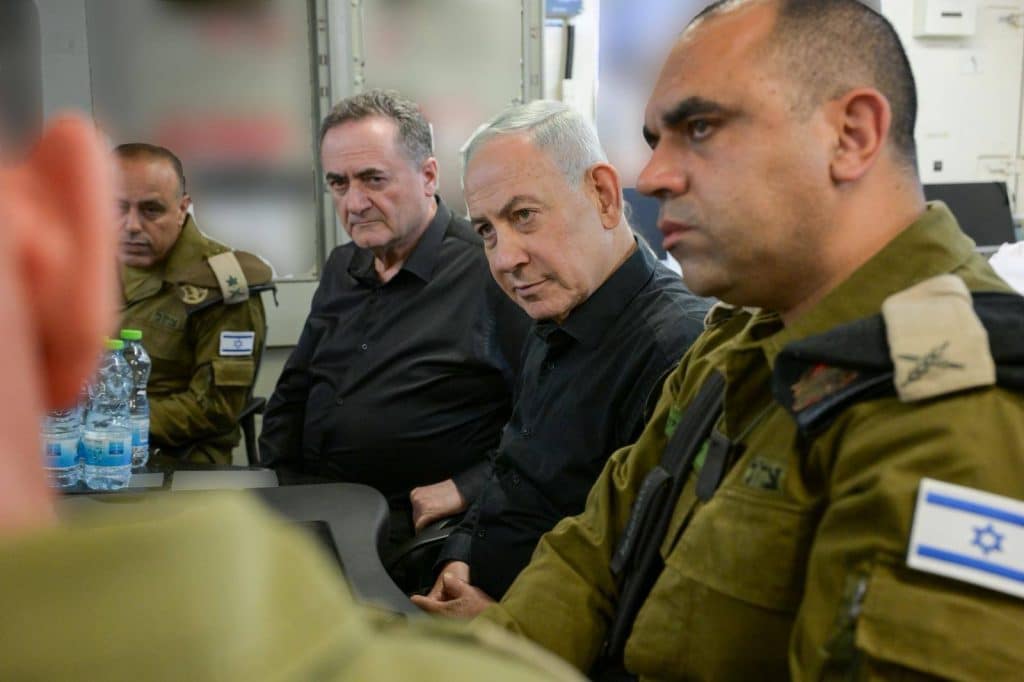
There is a version of the war on Iran that Benjamin Netanyahu would like you to believe is only about centrifuges and the survival of the Jewish state. The other, far less discussed version, is one where Israel’s prize is a railway.
Israel’s ambition, on the evidence of its own Prime Minister’s words, is to become the Mediterranean terminus of trade flowing out of the Gulf and South Asia — the place where Asian containers meet European ports without troubling the Strait of Hormuz. The war, however it ends, is one route to that destination. The irony, and it is not a small one, is that the campaign generating the opportunity is also consuming the means to seize it.
Netanyahu said as much himself twice, three years apart, sparing us the trouble of reading between the lines.
In September 2023, days after India, the U.S., Saudi Arabia, the UAE, and the EU unveiled the India-Middle East-Europe Economic Corridor (IMEC) at the G20 in New Delhi, he called it “the greatest cooperation project in our history” and promised Israel would become “a central junction” within it — its ports and railways forming, in his words, “a new gateway from India through the Middle East to Europe, and back.”
At the UN that same month, he produced two maps, in the manner of a man who has never met a prop he didn’t like: one labeled “The Curse,” depicting Iran’s regional network; the other “The Blessing,” showing Israel wired by rail and pipeline to Jordan, the Gulf, and onward to Europe. He liked the device enough to bring it back a year later, telling the 2024 General Assembly, “This is the map I presented here last year.” Subtlety has never been the point.

By March 2026, with Hormuz effectively closed by Iran’s response to the war of aggression launched against it, the pitch had stopped being a pitch and became something closer to a thesis statement.
At a press conference in Jerusalem on March 19, Netanyahu drew the line from war to railway without being asked twice: “Instead of passing through choke points like the Strait of Hormuz and Bab el-Mandeb, we can build pipelines westward through the Arabian Peninsula to Israel’s Mediterranean ports, and effectively eliminate these choke points.” A closed Hormuz, in other words, is not an unfortunate side-effect of the war. It is the argument for the alternative Israel has been selling investors since before October 2023.
The trouble with selling an alternative is that you have to build it, and building things, it turns out, is hard when your defense budget is eating the country alive. Becoming a logistics hub demands the unglamorous staples of statecraft — port capacity, rail, labor, fiscal headroom — at precisely the moment all four are being requisitioned elsewhere.
Israel’s defense spending has settled at roughly 8% of GDP, a level usually associated with states at existential risk rather than states trying to court sovereign wealth funds. The 2026 budget, raised to NIS 144bn, leaves little room for the transport investment IMEC’s Israeli leg actually needs. External debt has climbed from around 60% of GDP before the war to roughly 70%. Reservists have been pulled out of construction and logistics by the tens of thousands, even as the wartime exclusion of Palestinian labor has left building sites half-staffed and housing starts stalled.
None of this necesarilly proves that Haifa’s port upgrade has specifically slipped its timetable, as that data isn’t public, but it tells you the mechanism: a country fighting a maximalist war on several fronts cannot also be quietly laying track. Sooner or later, the ledger has only one column.
It is also souring the one relationship the corridor was built on: IMEC was conceived, and is largely financed, as an American project. Washington’s backing was always part of its capital structure, just as a central bank’s credibility is part of a currency’s value. That backing is visibly running down, both on account of the U.S.’s own risk-taking wars, and the space of tension opening between the U.S. and Israel as a result of diverging interests in the manner in which to end the war against Iran.
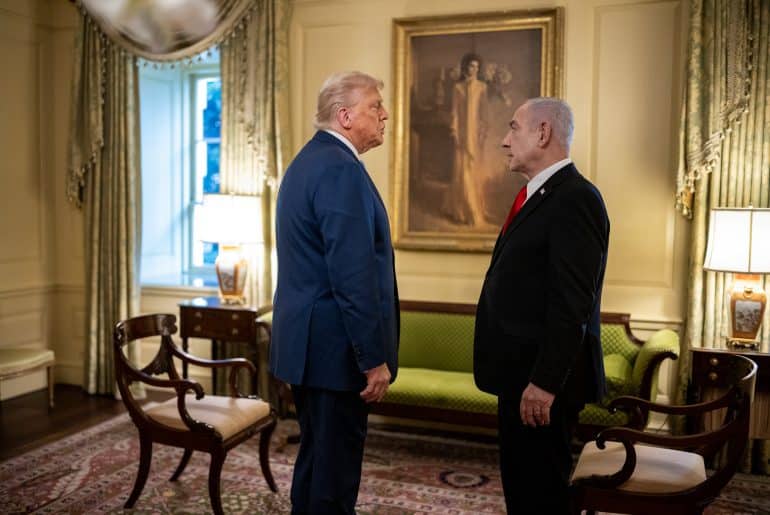
Trump has reportedly told Netanyahu, “You’d be in prison if it weren’t for me,” after Israeli strikes on Beirut threatened to derail his diplomacy with Tehran. This isn’t the language of a man who regards his ally’s war aims as self-evidently aligned with his own. Separately, Trump has told Netanyahu to “work it out” with Erdoğan rather than open a second front with Turkey.
Both episodes point in the same direction: Washington wants an outcome stable enough for capital to move through it, while Israel keeps behaving as though more war is itself the strategy.
In this equation, a patron who has to keep talking you down is a patron whose enthusiasm is depreciating, and the IMEC, like most ambitious infrastructure projects, depends on an enthusiasm that compounds rather than decays.
Then there is the Gulf, whose money the corridor cannot do without, and which is hedging in something close to real time. Saudi Arabia has conspicuously declined to embrace the pipeline plan, not unrelated to its own frosty relations with Netanyahu, even as tankers idled in the Strait and Washington weighed naval escorts. The UAE has gone the other way, leaning harder into the Abraham Accords and benefiting from Israeli missile defense capabilities for the first time as it was pummelled by Iranian drones and missiles.
Riyadh, having initially backed the campaign before discovering what it was doing to its own oil-dependent economy, has instead been drifting toward Turkey and Pakistan. The single largest prospective financier of Israel’s hub ambitions is, in other words, edging toward the very actor the hub was designed to render irrelevant.
That actor has not been idle. Turkey and Iraq have pushed ahead with the Development Road, a rail and highway link from Basra to Mersin via Baghdad, conceived from the outset to move Gulf trade to Europe without going anywhere near Israel. Erdoğan made his objection to the rival project plain on the flight home from the very G20 summit that launched it: “We say that there is no corridor without Turkey,” he told reporters. “Turkey is an important production and trade base. The most convenient line for traffic from east to west has to pass through Turkey.”
Turkish officials have since made the Israel angle explicit rather than incidental. Foreign Minister Hakan Fidan has said that Israel, having exhausted Iran as an adversary, “cannot live without an enemy,” and is now positioning Ankara as the next one. Fidan has even accused Jerusalem of treating regional security pacts, including the Israel-Greece-Cyprus defense framework that abuts the EastMed gas corridor, as a “military alliance against the Muslim countries in the region.”
It is also not merely rhetoric: Polish and German truck drivers have already made the Europe-to-Gulf run via Iraq in as little as ten to twelve days, which is the kind of fact that travels fast in freight-forwarding circles. Every week Hormuz stays shut sharpens both Israel and Turkey’s pitches in equal measure, and only one of the two comes free of Israel’s political baggage.
Tellingly, Israeli politics has started treating Ankara less as an irritant and more as the next adversary. Naftali Bennett, never a man to undersell a threat, has called Turkey part of an axis “similar to the Iranian one.”
Take that with a pinch of salt — the Erdoğan-Netanyahu antagonism long predates any railway and has its own grievances, from Gaza to Syria to a personal dislike now well into its second decade — but the exchange of accusations over corridors, gates, and alliances tells you both sides have started treating logistics as a battlefield of its own.
It would be overreach to claim the war is being fought for a railway. The evidence for that doesn’t stretch so far, and wars rarely have a single author to their logic. What the evidence does support is, I think, narrower and more interesting: Israel’s leadership has explicitly and repeatedly tied its desired economic future to the closure of Hormuz and the dilution of its importance, and has named the war’s disruption of the old maritime order as the condition that makes its alternative viable.
What can be said with confidence is that this leaves Israel in an asymmetrical position. Even in the rosiest scenario where Hormuz stays contested, the pipelines get built, and Haifa expands on schedule, the same campaign will have spent down the three things a hub strategy actually runs on: fiscal space, an American patron whose support doesn’t need constant policing, and Gulf capital willing to overlook the political cost of routing trade through a country at war with half its neighbours, and willing to bomb the Gulf in its pursuit of total victory. Israel may yet get its railway and pipelines. But it is currently financing the tracks and pipes by selling off the things that would make anyone want to ride it.
Abdaljawad Omar
Abdaljawad Omar is a writer and Assistant Professor at Birzeit University, Palestine. Follow him on X @HHamayel2.

Another fascinating article. I knew that Israel is keen to be the end point of a new trade route across Asia. It didn’t occur to me that Israel might actually want the Strait of Hormuz closed to advance that goal. It still seems a bit far-fetched but I can see the “logic” behind it. However, when Israel’s relations with their neighbours are so bad they can’t even play football against them, why do they expect to create something as grand as a trade route?
In case anyone needs proof that even a broken clock is right twice a day, here’s J.D. Vance saying about Israel “You can’t just kill your way out of solving every single national security problem”.
Vance to Israel: “You can’t just kill your way out of solving every…problem that you have.”
“Israel’s defense spending has settled at roughly 8% of GDP, a level usually associated with states at existential risk rather than states trying to court sovereign wealth funds.”
But what about all these snazzy new technological developments like lasers that can shoot drones out of the sky for pennies? That should lower defense spending, right? Well, if you’ve taken Physics 101 you know there are countermeasures for the laser stuff, and if you haven’t taken Physics 101 –
How to Counter a Laser Weapon – by Jared Keller
Wait till the Iranians figure out how to MIRV their warheads.
Sooner or later Israel will have to sit down and negotiate with the Palestinians, Hezbollah and Iran.
The article didn’t mention the rail line through Syria, Jordan to Saudi Arabia is already a done deal. See Times of Israel –Turkey, Saudi Arabia agree on major regional railway line bypassing Israel: Ankara touts deal that would curb Jerusalem’s influence, as lack of Israeli-Saudi normalization stalls progress on an India-Europe trade corridor passing through Jewish state,
Turkey and Saudi Arabia signed landmark agreements Tuesday for a new railway line connecting the countries via Syria and Jordan, aiming to extend it in the future to Oman to serve as an overland trade route bypassing the Strait of Hormuz, a central oil trade route currently blockaded by the US and Iran amid their war.By Michael Bachner, 10 June 2026, 11:41 am
Here are some other stories that run counter to mainstream coverage or might go unnoticed:
China has six different projects using different technologies to create energy at home to replace imported oil. For example: China is actively pioneering power-to-liquid (PtL) processes, utilizing seawater, carbon dioxide, and solar power to synthesize drop-in green jet fuel. This artificial photosynthesis or thermochemical approach mimics natural processes by splitting water into hydrogen using solar energy and combining it with captured carbon to produce liquid hydrocarbons. China Just Achieved The BIGGEST Energy Breakthrough In History — This Changes Everything
China Quietly Built a 10,400km Railway to Iran — The US is Terrified – YouTube
Iran Infrastructure is Unbelievable
Explore these military and infrastructure coverage highlights on YouTube:
I think that the financial elite has dumped Zionism and its Greater Israel project. It is more profitable to have a peaceful, stable middle east and make business then endless wars and throwing over regimes.
One worry I have is that Israel is planning to seize the Gaza gas reserves that belong to the Palestinians.