

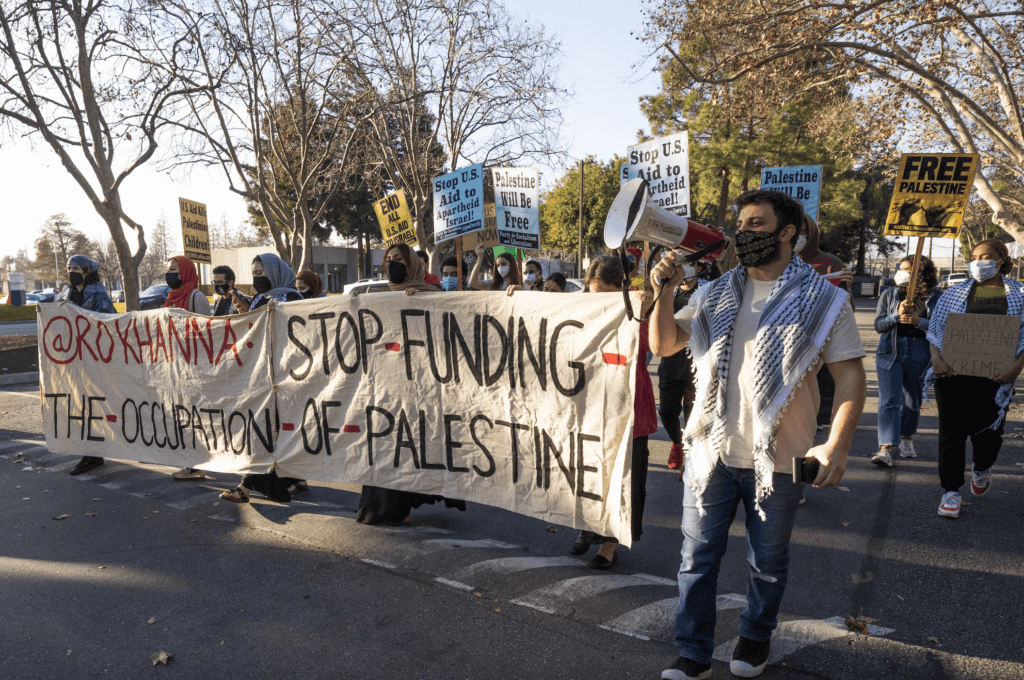
On Jan 28 about 30 activists showed up at the office of Rep. Ro Khanna (D-CA) to protest the congressman’s “lack of support for Palestine.”
The group called on the Khanna to cosponsor Rep. Betty McCollum’s (D-MN) bill promoting the human rights of Palestinian children and reject H.R.2748, a piece of legislation aimed at enhancing the Trump administration’s normalization agreements in the region. The protestors also want Khanna to endorse the BDS movement and work to end house demolitions across Palestine.
Khanna has not signed onto the McCollum and has publicly opposed the BDS movement.
A few of the protestors spoke with Mondoweiss, but asked to remain anonymous. “Palestine is a blind spot for him,” said one. “It’s been quite a while since he’s provided any substantial feedback or support on the matter. When pressed by his constituents, you get met with silence. You’ll see a couple of tweets here and there, but no substantial evidence or real actions that we can actually use to move forward to gain peace or to find any semblance of it.”
Since being elected to represent California’s 17th district in 2016, Khanna has advocated for a progressive foreign policy. “I think that when you look at our founding principles, it was based on America as a nation committed to universal human rights and a nation that was weary of foreign entanglements and foreign alliances that did not keep us safe or promote our interests,” he told CBS News in 2019.
Khanna led a fight to restrict presidential war powers (which was ultimately vetoed by former President Trump) and has made ending the war on Yemen one of his legislative priorities. In 2020, he sent a letter to then-Secretary of State Mike Pompeo opposing home demolitions in Jerusalem and calling for an investigation into whether Israel had violated the Arms Export Control Act. He also opposed Trump’s decision to move the U.S. embassy to Jerusalem, calling it “misguided.”
However, many Palestine activists argue that Khanna’s Israel positions don’t align with his antiwar reputation. In 2019 he cosponsored an anti-BDS resolution in the House and in 2020 he criticized AOC for dropping out of an event honoring the legacy of Yitzhak Rabin. “I think of Israel, at its best, as a fountain for human innovation, for civilizational progress, for contributing to the world of arts and literature and philosophy,” he said in response to the controversy.
Khanna has cited Israel’s relationship with Silicon Valley as one of the reasons why he opposes BDS. “We just find that very contradictory because these are the same companies that are manufacturing the war machines for these wars,” said one activist. “If Ro Khanna really wants to be anti war, why is he concerned about that?”
Last year Khanna signed onto an AIPAC letter condemning any conditions on military aid to Israel. “Congress is committed to maintaining Israel’s qualitative military edge and its ability to defend itself, by itself, against persistent threats,” read the letter. “Our aid to Israel is a vital and cost-effective expenditure which advances important U.S. national security interests in a highly challenging region. For decades, Presidents of both parties have understood the strategic importance of providing Israel with security assistance.”
Most recently Khanna joined nearly every other House Democrat in approving an additional $1 billion for Israel’s Iron Dome system.
The activists identified H.R.2590, the Defending the Human Rights of Palestinian Children and Families Living Under Israeli Military Occupation Act, as the central focus of their protest. The legislation would prohibit Israel from using U.S. taxpayer dollars to detain Palestinian children, destroy Palestinian homes, or annex Palestinian territory.
“U.S. assistance intended for Israel’s security must never be used to violate the human rights of Palestinian children, demolish the homes of Palestinian families, or to permanently annex Palestinian lands,” said Betty McCollum when she introduced the bill in April 2021. “Peace can only be achieved by respecting human rights, especially the rights of children, and this includes the U.S. taking responsibility for how taxpayer-funded aid is used by recipient countries, Israel included. Congress must stop ignoring the unjust and blatantly cruel mistreatment of Palestinian children and families living under Israeli military occupation.”
H.R.2590 currently has 32 cosponsors. In December California Rep. Barbara Lee signed on in response to local pressure from her district. Khanna signed onto McCollum’s original child detention bill back in 2017, but has yet to cosponsor the stronger and more comprehensive version of the legislation.
“It’s just been very frustrating for local activists, especially since for years, but particularly since this May [during the most recent war on Gaza],” a protestor told Mondoweiss. “Hundreds and hundreds of his constituents were flooding his Facebook town halls, which were the only method we could really have interaction with him because of COVID restrictions.”
“So hundreds of us are constantly going to the town halls and demanding either a better stance on Palestine, demanding he sign onto HR2590 and he brushed us off,” they continued. “It was pretty clear looking at the Facebook comments that this was what the majority of his constituents were asking for. We were the only people consistently showing up to his town halls at the time. His response was basically, ‘I will claim to care about it, but I won’t sign onto HR2590. Instead, I want to work on more general sanctions for any country that violates the Leahy Law or violates human rights.’ So he’s not willing to take a stance against Israel. He’s even been willing to side with Trump over other Democrats.”
Mondoweiss reached out to Khanna’s office for comment on the protest and the McCollum bill. “I appreciate the activists’ first amendment rights and participation in the political process,” said Khanna in a statement. “I strongly support human rights in the West Bank, Gaza and around the world. I have always advocated for the strong enforcement of the Leahy Law and the Arms Export Control Act. I have also led a letter to ensure that the U.S.-military equipment in the West Bank is not being used in home demolitions and forced evictions.”
The activists say they will continue applying pressure on the congressman. “We’re going to continue to be protesting his office until he meets our demands,” said one. “And the most basic of those demands is HR2590. We see this as a long term campaign.”

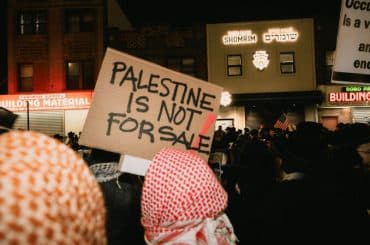
All you have to do is follow the money….Ro Khanna is a huge disappointment, but like other congresspeople, he knows he has to kiss Israel’s large ring, to win his next election. American politicians have a road map to Congress, and pleasing, showing unwavering support, love, and devotion to Israel is part of that journey, even more than showing your loyalty to your own country.
1 of 2
Palestinians under Israeli Occupation face urgent healthcare Crisis in Gaza (juancole.com)
“Palestinians under Israeli Occupation face urgent healthcare Crisis in Gaza” Middle East Monitor, Feb.10/22, by Wafa Aludaini “Eleven-year-old Amal Lubbad was deep in thought when I met her in what has become her second home, Al-Shifa Hospital in Gaza City. It was her third hospital visit this week. Five years ago, Amal was diagnosed with kidney failure, which requires her to have dialysis. A kidney transplant would save her life.
“She greeted me with a smile that masked the considerable pain which defines her past, present & future. The dialysis machine that she is usually connected to for hours on end has broken down. The parts needed to maintain it are not available in the besieged Gaza Strip. The Israeli occupation authorities won’t allow the necessary spare parts & equipment to be imported, so Amal’s health has worsened considerably. The kidney transplant is now needed as a matter of urgency; she can no longer afford to wait.
“Broken dialysis machines & shortages of medicines & suitable treatment threaten the lives of nearly 600 Palestinian kidney patients in the Gaza Strip. Amal is not alone in waiting for a transplant; sitting next to her was Abu Ali, 70, who could barely speak. He too was sitting on a dialysis chair, his hands trembling. The nurse watched the dialysis machine anxiously, fearing that it would malfunction & stop working. An hour passed & it was still running, but everyone’s stress level continued to rise: Abu Ali requires three hours of dialysis a day. His eldest son Ibrahim accompanies him to his Palestinian kidney patients in the Gaza Strip. Amal is not alone in waiting for a transplant; sitting next to her was Abu Ali, 70, who could barely speak. He too was sitting on a dialysis chair, his hands trembling. The nurse watched the dialysis machine anxiously, fearing that it would malfunction & stop working. An hour passed & it was still running, but everyone’s stress level continued to rise: Abu Ali requires three hours of dialysis a day. His eldest son Ibrahim accompanies him to his sessions at Al-Shifa, sometimes offering food or conversation to try to distract his father. Ibrahim told me about a day when the dialysis machine did break down mid-session, causing them to have to wait for a full day until the machine was serviced and repaired. (cont’d)
2 of 2
“All the dialysis machines are old, Ibrahim told me, which makes the treatment more painful for the patients, but there is no other option in Gaza.”