

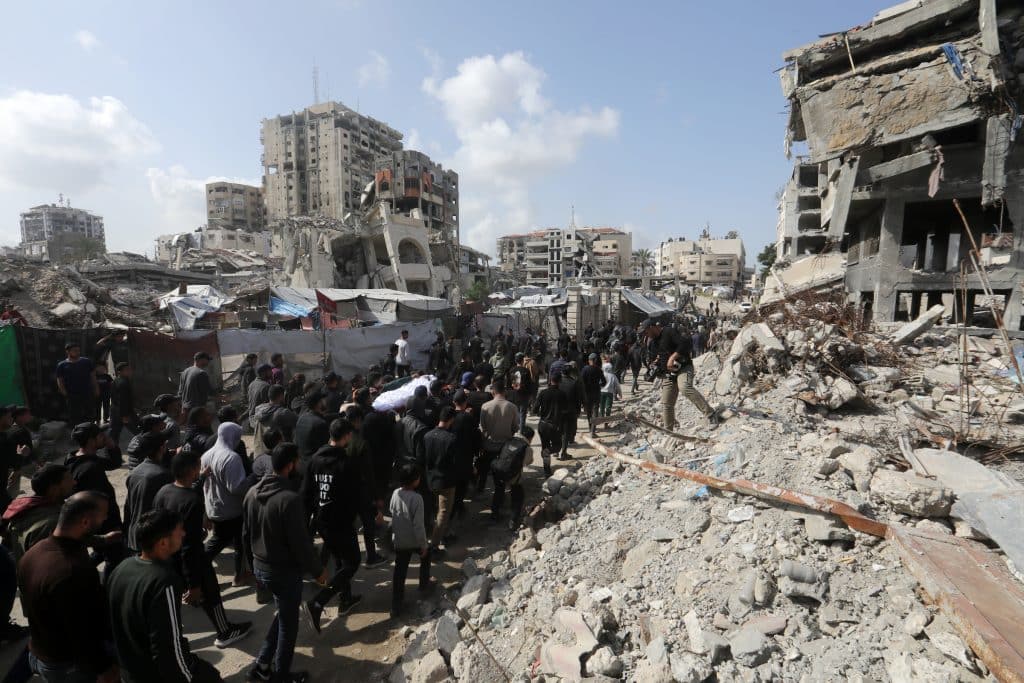
This week, our Gaza Correspondent, Tareq Hajjaj, filed an exclusive story looking at the ongoing fight between Hamas and Israeli-armed opposition groups.
Israel’s strategy is to ensure that no Palestinian governing authority in Gaza can survive, and then argue that the only alternative to Israeli control is chaos. Tareq’s report, based on interviews with Hamas security leaders and police officers inside Gaza, reveals the systematic arming of militia groups designed to fill the security vacuum that Israeli strikes on Palestinian police are deliberately creating.
Tareq has reported on this pattern since last June. Israel targets uniformed security personnel, forcing Hamas’s police forces underground and thinning their ranks through sustained attrition, while simultaneously arming and supporting militia groups operating in the eastern sectors of Gaza under direct Israeli military control. These groups, which carry names like the “Popular Forces” and the “Anti-Terror Strike Force,” exist to manufacture destabilization by looting aid, facilitating forced displacement, and projecting Israeli power into areas where Israeli soldiers cannot operate without attracting international attention. Militias were executing a strategy developed in coordination with the Israeli military when they drove a convoy through Hamas-controlled Khan Younis on April 20, declaring “Hamas is over.”
Understanding this requires placing it alongside everything else Israel has constructed in Gaza since the nominal ceasefire began, including the so-called Board of Peace, the humanitarian aid channels built outside the United Nations infrastructure that has historically governed such operations, and the obliteration or erosion of any institution through which Palestinians might govern themselves. If no Palestinian governing authority is permitted to function, if aid flows only through channels Israel controls, and if the streets are contested by armed groups loyal to the occupation, then Israel’s continued presence in Gaza appears necessary rather than imposed — which is precisely the point. Israel’s ethnic cleansing in Gaza requires the destruction of Palestinian political and civil life and the manufacture of conditions that make permanent occupation look like the only available option.
Tareq has reported on this story previously for Mondoweiss: the Hamas unit established to fight the gangs in June, the announced crackdowns in October, and the killing of militia leader Yasser Abu Shabab in December. His reporting is essential for anyone who wants to understand what is actually happening in Gaza beneath the headlines found in mainstream media.
As many of you know, this year marks Mondoweiss’s 20th anniversary. For two decades, this publication has existed to tell the stories that require sustained access and institutional trust across Palestine. That work depends entirely on readers who believe it matters. If you are not yet a donor, this is a meaningful time to become one. If you already contribute, an additional gift this year would make a real difference. Monthly donations are especially valuable to us because they allow us to plan and grow on a stable, predictable financial foundation. Scroll down below this article to make a secure online donation!
🇵🇸 Gaza and the West Bank
Israel’s effort to destroy Palestinian civil and political life is advancing on every front, through armed militias, settler violence, and the assault on Palestinian self-governance.
READ MORE → Exclusive: Inside Hamas’s fight against the armed militias that Israel is using to sow chaos in Gaza — Tareq S. Hajjaj
READ MORE → Palestinians are holding local elections, but hardly anyone is running. Here’s why that matters. — Qassam Muaddi
READ MORE → The Palestinian farmers whose livelihoods have been destroyed by Israeli settlers — Qassam Muaddi
READ MORE → ‘The night guards’: Inside the grassroots network fighting back against Israeli settler attacks — Majd Jawad
READ MORE → Checkpoints, radio shows, and Fairouz — Qassam Muaddi
📉 Israel’s isolation
As Israel’s pariah status deepens, the political and diplomatic consequences are becoming harder to ignore, from collapsing public support in the United States to growing international pressure on governments that continue to shield Israel from accountability.
READ MORE → United in Apartheid: What the Bennett-Lapid unity ticket tells us about the future of Zionism in Israel’s pariah era — Jonathan Ofir
READ MORE → Latest polling paints dire picture for Israel in U.S. politics — Alison Glick
READ MORE → New death penalty law should force Starmer government to reevaluate UK policy toward Israel — Iqbal Mohamed
READ MORE → Why the United Arab Emirates is leaving OPEC and what it means for the future of the Middle East — Mitchell Plitnick
READ MORE → The mainstream media is ignoring Israel’s role in the killing of journalist Amal Khalil — James North
🇺🇸 United States
Palestine is a wedge issue in American politics, surfacing in Democratic primaries, in the belated shift of mainstream media coverage, and in deeper ideological questions about what the United States has always been.
READ MORE → Despite his public bravado, Trump is desperate for a deal with Iran — Michael Arria
READ MORE → Palestine emerges as central issue in a key Pennsylvania Democratic primary — Michael Arria
READ MORE → The lessons from the Gaza student encampments, two years on — Ethan Eblaghie
READ MORE → The mainstream media is finally beginning to echo Americans’ outrage at Israeli slaughter — Philip Weiss
READ MORE → Understanding the shared ideology behind settler colonialism in Native America and Palestine — Eric Cheyfitz
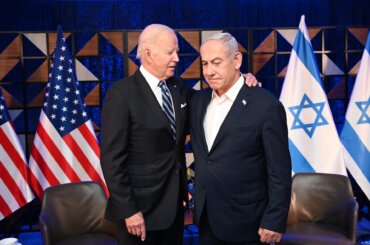
This is a bit of news that seems to be under the radar – the U.S. is going to ‘sell’ Israel at least 25 more F-15s; as many have commented, Israel sees a narrow window in which it can cement military superiority over everyone else in the region:
America Is Selling Israel Another 25 F-15IA Fighter Jets. Not Everyone Is Happy.
America Is Selling Israel Another 25 F-15IA Fighter Jets. Not Everyone Is Happy. – The National Interest
Gideon Levy’s insights may be of interest to some at MW.
Note especially 16:30 to 20:40
https://www.youtube.com/watch?v=jfUnnMYT6xQ
According to Times Of Israel reporting on Netanyahu and Huckabee meeting the Board of Peace: Hamas has largely refused the demands to give up all of its weapons.
“Instead, the terror group submitted a counteroffer to the Board of Peace, insisting that the issue of its weapons only be addressed as part of a framework culminating in the establishment of a Palestinian state.”
This is the only way some people can listen to White House Iran War updates. YMMV
“Israel’s ethnic cleansing in Gaza requires the destruction of Palestinian political and civil life and the manufacture of conditions that make permanent occupation look like the only available option.”
______________________________________________________
If a Palestinian led campaign for equal citizenship in one state resonated with American public opinion to the point sanctions were being considered, Israelis may reconsider a viable 2SS.