

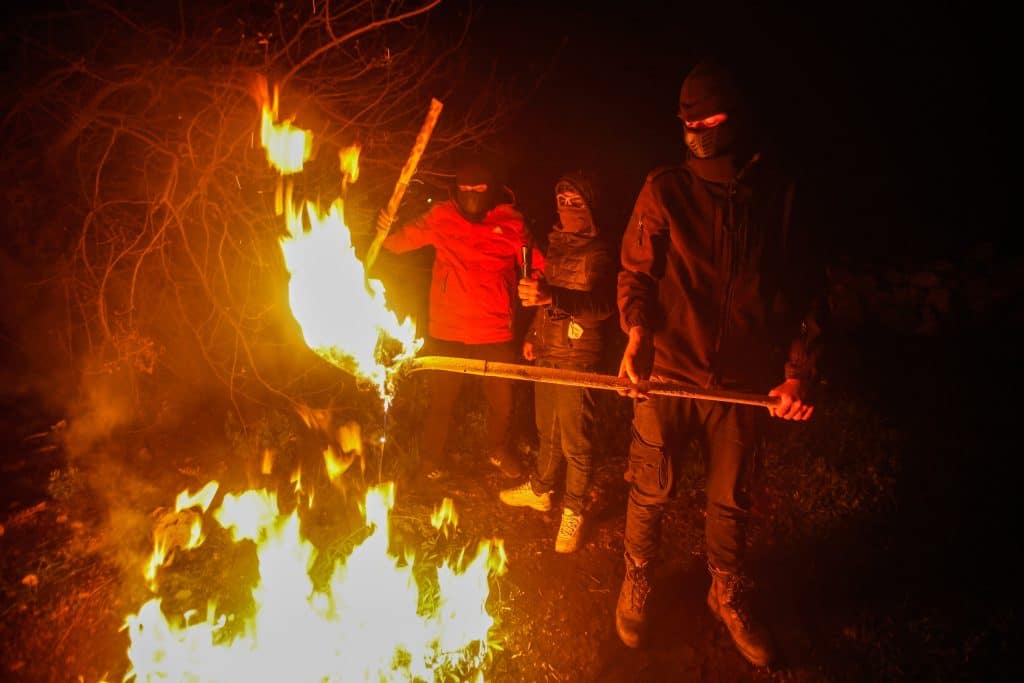
Under the midnight moon atop the mountain in the town of Sinjil, residents carry flashlights, signaling to the hills across the valley. The beams, along with the lights surrounding a small watch tent, usually used as decoration for Ramadan, serve as an early warning system. The signal that the village is awake and watching.
“Do you see that light?” one of the young men asks quietly, pointing toward a flicker across the opposite hill. I nod. For a moment, no one speaks. The wind is sharp at this height, and below us, the village is completely dark.
“That means they’re there,” he says. “Watching, like us.”
As the pace of settler attacks on Palestinian communities reaches unprecedented levels, and amid a weak official response to escalating risks across the occupied West Bank, community-based volunteer groups known locally as protection committees or “night guards” have emerged as a primary line of defense against near-daily violence. The group of youth organizing night patrols in Sinjil is one of them.
The tent itself is a modest, thin fabric stretched over metal poles, its edges weighed down by stones to resist the wind. Yet it has become the village’s front line.
Plastic chairs line its sides, and a shared phone charger hangs from a makeshift electricity connection, powering the devices that keep the village connected through the night. Like others who gather here, the men move between fatigue and alertness, balancing daytime work with the obligation to remain awake until dawn.
“Since the beginning of last year, and as a result of the escalating attacks on Sinjil, we found it necessary to form a committee primarily of volunteers,” says R.M., a regular participant from the village. “We needed to organize the guard duty more effectively and move from a faz’a model to a more organized system.”
What R.M. calls “faz’a” is a Palestinian colloquialism denoting when a collective of people rushes to the aid of other members of the community, representing the organic and spontaneous expression of mutual aid among Palestinians. In the context of escalating settler pogroms, fellow members of the community are about the only protection that Palestinians have from violent Jewish Israeli settlers, who continue to kill Palestinians across West Bank towns.
Since the start of the year, over 260 Palestinians have been injured in attacks by Israeli settlers, according to the UN Office for the Coordination of Humanitarian Affairs (OCHA), a threefold increase compared to the monthly average of 30 to 105 injuries per month during 2023.
R.M. says that in Sinjil, these attacks have become almost daily. “It was no longer logical to continue with the same old approach in defending our people and lands,” he explains.
In July 2025, a large-scale settler attack near the town left two Palestinians dead and at least 58 others injured. Since then, local accounts indicate a dramatic shift in the frequency of attacks from roughly one incident per month before October 7 to near-daily assaults on the village.
“How often does it happen now?” I ask.
R.M. lets out a short laugh. “You don’t count like that anymore,” he says. “You count the quiet nights.” He pauses. “And there aren’t many.”
Previously, volunteers relied on an individual faz’a whenever an attack occurred, informing neighbors and acquaintances. But as attacks grew more violent and frequent, it became essential to establish committees focused on early warning, monitoring, and observation, enabling the village to gather and defend its unarmed residents.
“As soon as we spot the attacking settlers, we notify the residents via WhatsApp or makhshir (walkie-talkies),” R.M. says, explaining that the protection mechanism was simply about safety in numbers. “The tent’s primary mission isn’t to attack; we do not possess tools or weapons comparable to what the settlers have. Instead, we ensure our bodies are always present in areas likely to be targeted, to deter an attack before it even begins.”
A sudden notification sound cuts through the silence. One of the men picks up the phone, reads quickly, then looks up.
“Movement,” he says.
No one panics, but the atmosphere shifts. Two of them grab flashlights and step outside into the darkness.
They return and talk at length about the difficulties and dangers surrounding them. “The attacks always come unexpectedly,” R.M. adds. “Palestinians are often asleep, usually after midnight or away at work, either outside the village or away farming. The attackers are usually heavily armed, and our reaction is entirely spontaneous.”
On the first night of Ramadan, the committee in Sinjil was blindsided by an attack of about 20 settlers, resulting in the injury of one member and the arrest of others for a week, during which they were severely beaten. At the same time, the army dismantled and confiscated the committee’s tent, according to R.M.’s account.
In the aftermath, the volunteers continued their work through nightly shifts in the open air for several months, exposed to the cold and darkness, until residents of the village collectively donated and helped rebuild another tent to resume their watch. Their work is still ongoing, and so are the settler attacks.
A tradition renewed
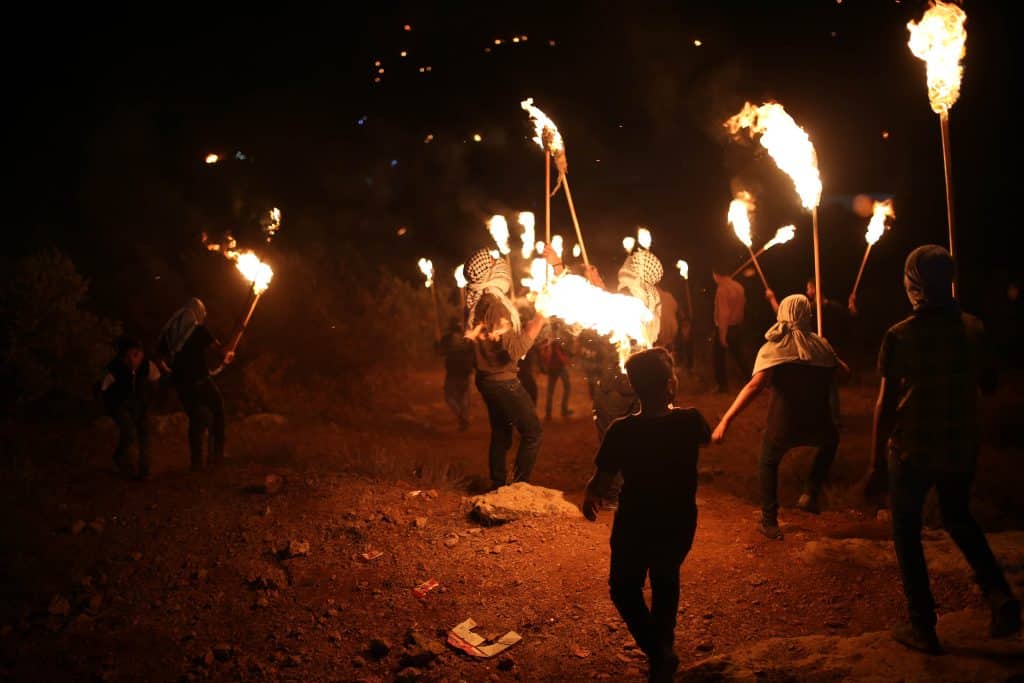
The emergence of grassroots protection committees in Palestinian villages reflects not merely a resemblance to past forms of collective action but a continuation of a deeply rooted tradition of community self-organization that dates back to the First Intifada, albeit under profoundly different political conditions.
“Despite the different political context, our historical experience in the First Intifada is similar to the experience of the committees today,” R.S., a female member of a popular committee from Jenin refugee camp, told Mondoweiss. She now lives in the al-Jabriyat neighborhood in Jenin, after the refugee camp’s residents were forcibly expelled and have not been allowed back.
Between 1987 and 1993, the First Intifada was fought in everyday life. Under curfews, closures, and the constant threat of arrest, Palestinians built their own systems to survive. Local committees emerged in neighborhoods, villages, and refugee camps, organizing food distribution, running underground classes when schools were shut down, and providing basic medical support when access to care was blocked.
R.S expanded on the memory. “It provided many models of community work and steadfastness. No one was hungry then; anyone in need would find someone to help and lend a hand. Many residents offered their homes, mosques, and clubs to those displaced from the camp. No one slept in the open.”
“It’s different now,” she added quietly. “But also the same.”
According to the Colonization & Wall Resistance Commission, an official body aligned with the Palestinian Authority that documents Israeli settlement activity, the origins of the latest incarnation of the protection committees can be traced back to 2015, largely in the wake of the devastating Duma arson attack. Killed in the attack were members of the Dawabsheh family, including 18-month-old Ali and his two parents.
“The need for night guards became clear as a means to prevent settler attacks,” Amir Daoud, Director of Documentation at the Commission, told Mondoweiss. “At that stage, coordination took place with local and student forces, and a limited number of committees were formed in the villages most vulnerable to attack, with simple logistical support such as communication tools.”
One popular example was the “night confusion” units in places like the village of Beita and the battle over Jabal Sabih. The model, however, remained limited until October 7, when Daoud said settler violence escalated sharply across the West Bank, reshaping the role of these committees. What had been localized night-guard initiatives turned into a wider system of community protection, particularly against repeated nighttime arson attempts targeting homes. “This has contributed to the spread of the committee model across many communities,” he added.
But their role, Daoud stressed, extends beyond immediate protection. In a context where violence is often underreported or contested, these committees have become a form of ground-level documentation and public accountability. “These committees convey the situation as it is, moment by moment, from within villages and threatened areas, which gives us the ability to act legally and in the media with speed and effectiveness. Without this popular presence, many violations would remain invisible or difficult to prove. For us, they are an essential part of the system of steadfastness, not merely an organizational tool.”
Their structure, he noted, is deliberately uneven and locally adapted rather than centralized. Each village organizes itself according to geography and the specific threats it faces — whether from settler roads, proximity to outposts, or patterns of raiding. While some communities operate with external support and more advanced coordination tools, others rely on minimal resources, reflecting a fragmented but adaptive system of protection.
Yet while the ethos of collective care and “sumud” remains intact, the tools have fundamentally evolved. What was once organized through leaflets, strikes, and face-to-face mobilization has now shifted toward digital infrastructures that enable real-time coordination and immediate documentation. This transformation has introduced a critical new dimension: the ability to translate local experiences of violence into globally visible narratives.
“Social media has reshaped the nature of collective work within the protection committees,” R.S. from the Jenin committee said. “It relies heavily on applications like WhatsApp and Telegram for instant coordination, whether to report settler movements or organize night guards.” This type of instant communication gives the committees a high capacity for rapid response and reduces the need for complex organizational structures. “Any individual can be part of the network,” she added.
Working with less and sharing the burden
Even though they leverage digital technologies, the local protection committees remain hamstrung by limited resources and an unpredictable terrain.
A study by a local NGO, the Palestinian Initiative for the Promotion of Global Dialogue and Democracy Foundation, highlights the challenges facing youth clubs, grassroots organizations, and neighborhood and volunteer committees, including a lack of logistical resources, personal protective gear, and advanced equipment, which places volunteers at a significant disadvantage.
The groups have also faced harassment and attacks by settlers and the army, including incidents of direct gunfire targeting night patrol volunteers. In the village of Beit Lid, east of Tulkarem, which has faced repeated settler attacks, the committees faced an unexpected form of disruption. Young men in the village reported receiving sudden messages in their WhatsApp groups that appeared to come from the phone of a fellow volunteer who had been detained earlier that night by Israeli forces. The messages warned against gathering or attempting to mobilize in response to the attack.
“The messages created a moment of confusion and hesitation among the groups, as members tried to determine whether they were genuine or sent under duress,” says A.S, a member of the committees. “It later became evident to those involved that the phone had been used while he was in custody, turning a tool of coordination into a channel of intimidation.”
Despite this disruption, the committees gradually resumed their coordination, adapting their communication practices with greater caution and verification. The episode highlighted not only the physical risks volunteers face, but also the evolving methods used to interfere with and delay the collective response.
Mutual aid
Another way in which the committees operate is to engage in mutual aid efforts to deal with the aftermath of a settler attack. Rather than leaving affected households to bear the full burden of damage individually, the committee distributes responsibility across the wider community, treating loss as a shared social and economic burden.
One example of this is the town of Qaryut, which established a community compensation fund for those affected by settler attacks. “We established a committee of eight individuals and divided the tasks among them,” says S.A., a member of the committee. “Some members are responsible for monitoring and organization, others for assessing the damage caused by attacks to facilitate compensation, and others for the early warning system for the village residents.”
The compensation mechanism, he explains, was created to ensure that losses are not borne solely by victims. “The idea was that no one should feel that what happened concerns them alone,” he says, explaining that the entirely self-funded initiative is designed to provide financial support for damaged property, burned farmland, and affected families.
This system has been activated in response to repeated settler attacks in Qaryut, including a September 2024 raid in which two Palestinians were injured, and a March 2026 attack in nearby villages that left three people wounded and several vehicles and municipal property burned. Residents say settler violence has repeatedly combined physical assaults with large-scale agricultural and property damage. Alongside financial compensation, the fund also provides medical and basic health supplies for those injured in ongoing attacks, reinforcing a broader system of communal resilience in the face of repeated settler violence.
Across the West Bank, each community has improvised its own version of this system, using different tools, in different terrain, and carrying different risks. But the logic is the same everywhere: in the absence of any protection from above, the only thing standing between a Palestinian village and the next attack is the village itself. The compensation fund in Qaryut, the WhatsApp networks in Beit Lid, the night patrols in Sinjil — each village has found its own answer to the same question: how do you protect what is yours when no one else will?
As I leave the site in Sinjil, one shift is ending as another arrives. A small group gathers inside the tent for a brief handover, during which a young man passes on the duty log and updates the incoming team on what was observed over the previous hours. The outgoing group steps aside as the new shift settles in, some of them arriving with bottles of energy drinks and cigarettes, which they place on the table. The night, like every night, is not over.
Majd Jawad
Majd Jawad is a Journalist and researcher from Jenin, Palestine, holding a Master’s degree in Democracy and Human Rights from Birzeit University and a Bachelor’s degree in Journalism.
Palestinians, and those defending them should be armed.
Unfortunately the settlers may be ‘winning’ –
West Bank activists aiding Palestinians are increasingly targets themselves…. For three decades, Rabbi Arik Ascherman has devoted himself largely to helping Palestinian civilians in the occupied West Bank. He heads Torat Zedek, which means Torah of Justice — a group that is out in the field trying to protect them from one of the most intensive waves of settler violence since 1967.
Judging from what he sees, hears and documents during his daily forays, things are going very badly for those in the way of Israel and its massive settlement project, which includes proliferating outposts and sheep farms that serve, he says, as staging grounds for violence against Palestinians….“The settlers are winning now,” Ascherman says, driving past outposts southeast of Nablus that are illegal according to both international and Israeli law “Outposts are expanding and Palestinian communities are disappearing.”…Fifty-nine Palestinian communities have been displaced by settler violence since Oct. 7, 2023, with another 16 communities losing about half of their residents, according to the human rights organization B’tselem. About 170 new outposts have been established during that period, it says….But he views the start of the Iran war as an inflection point similar to Oct. 7, which too was followed by a major surge of settler attacks. In both cases, settlers “cynically exploited” the distraction from the West Bank caused by wars to act more violently, he says….Thirteen Palestinians have been killed during settler incursions since March 1, according to Haaretz, the latest being 29-year-old Odeh Awawdeh near Ramallah on Wednesday a day after 14-year old Aws Hamdi al-Nassan and Marzouq Abu Naim, 32, were killed, also in the Ramallah vicinity.
West Bank activists aiding Palestinians have become targets – The Forward