

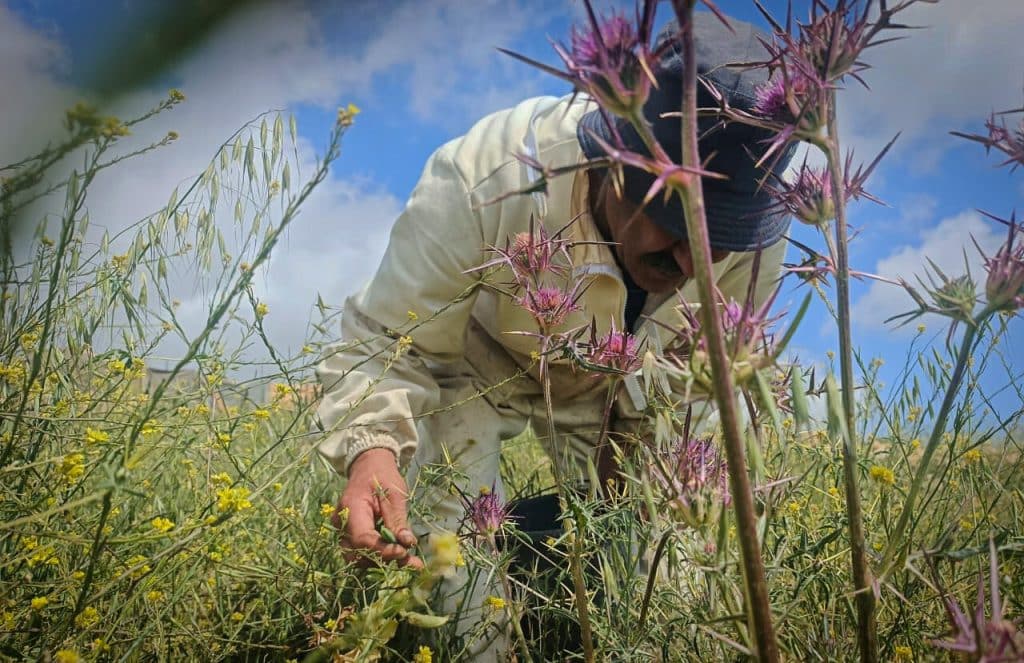
Slowly, amidst the high green weeds of April, Eyad Yousef moves forward in a white bee-keeping suit, inclined forward and looking toward the ground. I trail behind him as he goes about his work, picking the peas he and his brother planted earlier in March. “If the price for plowing a dunam of land is around 100 shekels these days, how expensive do you think a jerrycan of olive oil would be? Who would even buy it?” he exclaims.
Eyad Yousef is a Palestinian farmer in the village of Taybeh, east of Ramallah. He is also a car mechanic and a father of three. Every spring, he and his brothers plant peas, lentils, cucumbers, onions, and other seasonal crops. But this year is different.
Yousef is not working his own land anymore, because it has been made inaccessible by the threat of Israeli settlers, who permanently patrol the plain on the eastern edge of the village. All residents who own land in Taybeh are unable to reach it.
“I rented someone else’s land this year, but it’s not really a written contract or anything, it’s a verbal agreement,” Yousef explains. “If at any time the owner decides to sell the land, I will lose my investment.”
Despite this, Yousef still needs to keep up his seasonal farming. “It’s my oxygen,” he says.
Since October 2023, attacks from Israeli settler groups on Palestinian farmers in the West Bank have increased exponentially, both in numbers and in levels of violence.
For many farmers, this has represented a severe blow to their livelihood and way of life, but the impact goes beyond farmers themselves: a substantial part of the Palestinian economy and a mainstay of rural families is being disfigured and decimated. At a time when settler pogroms in the countryside have terrorized Palestinians, farmers have been on the frontlines, enduring escalating Israeli violence.
According to the Palestine Information Center, Israeli settler groups have carried out more than 8,000 attacks on Palestinians since October 2023. The UN Office for the Coordination of Humanitarian Affairs (OCHA) says that Israeli forces have demolished more than 1,000 Palestinian farming structures in the West Bank in 2025 alone. But even those who haven’t still feel the cumulative effect of this assault, reflected in the rising price of agricultural produce.
It was not always this way. Farmers were once the backbone of the Palestinian economy. A historically agrarian society, the British traveler Lawrence Oliphant described Palestine in 1887 as “a green lake of waving wheat.” But today, most of the wheat used to make bread consumed by Palestinians is imported. This transformation has been the life story of multiple generations of Palestinian farmers under the pressure of Israeli colonialism.
“I have been a farmer all my life,” Yousef says. “I started working on my father’s land near the Rimunim settlement, southeast of the village, and we used to plant wheat and barley. My mother made our home bread from it, and my brothers and I grew up on bread from the land.”
“That land became inaccessible after the year 2000,” he recalls. “When Israeli settlers began to patrol the land, which is located right next to the settlement.” He looks up as if remembering something. “Actually, I remember when the settlement itself was built, as a very young boy in 1979,” he continues. “I remember that our family lost up to 20 dunams, including the lands that were taken by the settlement and the surrounding lands that gradually became inaccessible to us.”
Eight years ago, Yousef began to give his land near the settlement to a Bedouin family, who lived on it and grazed their flock there, under the increasing harassment of Israeli settlers. Then came October 2023, and even the Bedouin families were forced out. Yousef didn’t think, at the time, that he would find himself in the same place as the Bedouins who had used his land.
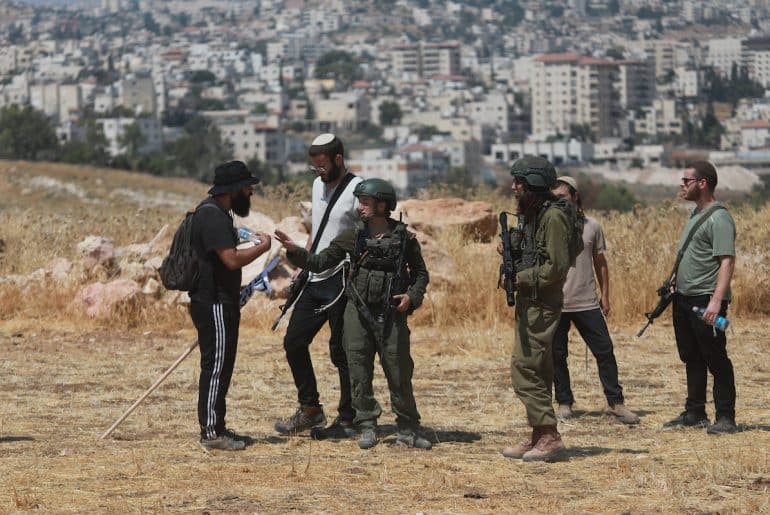
“Last year, Israeli settlers began to come much closer to Taybeh’s urban area, making our nearest farming lands more risky to go to and work,” says Yousef. When I ask Yousef what happened the last time he tried to go to his land, he pauses. “The last time I went there was six months ago. Three Israeli settlers arrived in a car, one of them armed, and he told me to go away. He said this land is no longer part of Taybeh.”
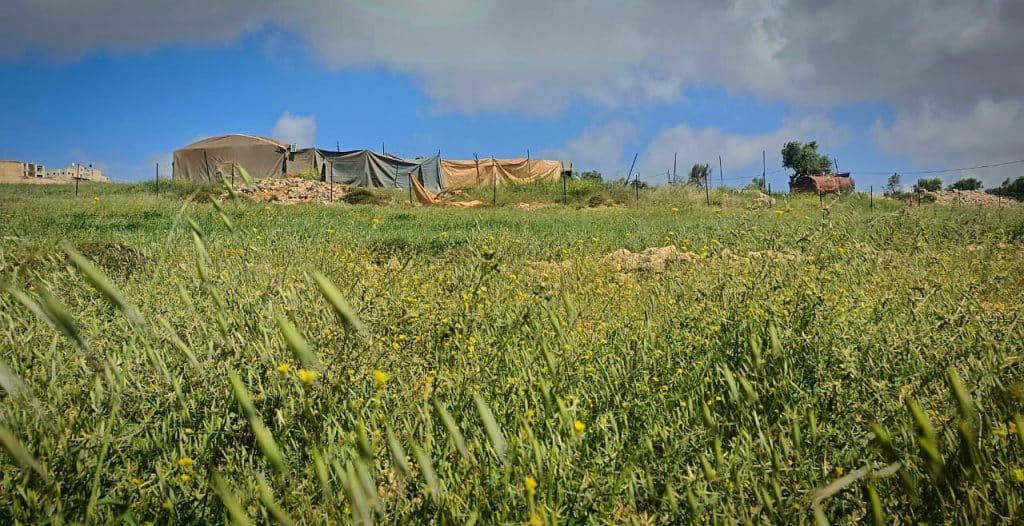
When spring approached, Yousef and his brothers had to find a solution for their farming season, and decided to rent the same land where the same Bedouin family had been staying since Israeli settlers expelled them from Yousef’s land two years ago. “We spoke to the Bedouins first, and then with the owner, and we split the land, where the Bedouins planted barley for their livestock on half of the plot, and we used the other half.”
On nearly two dunams of land, two Palestinian families now practice their seasonal farming and grazing. The entire agricultural life of the area has been confined to one small location, from which Israeli settler outposts can be seen on the distant hills, the same ones where Yousef once plowed his land alongside the Bedouins who grazed them.
An assault on Palestinian subsistence
Beyond Taybeh, the same dynamic has been taking place across the West Bank. Jamal Jumaa, head of the grassroots Stop The Wall campaign, told Mondoweiss that “the dynamic of Israeli settlement expansion since October 2023 has been the same everywhere, and it follows a clear model.”
That model, Jumaa said, is “trying to accomplish the same thing with the West Bank that it did in Gaza during the 1990s.” In the years that followed the Oslo Accords, the Israeli army turned most of Gaza’s farmland, located at the edges of the Strip, into military zones. Eventually, Palestinians in Gaza were hemmed into exclusively urban areas. After Israel’s withdrawal in 2005, Gaza was sealed off, turning it into an open-air prison with no means of subsistence.
“In the West Bank, the first victim of this violent settlement expansion has been livestock rearing,” Jumaa explained. “Bedouin families and villagers who raise livestock have either already lost their grazing lands or are now losing them.”
The effect is already being felt in local markets, Jumaa said, as the price of fresh meat has doubled since 2023. “The next thing that’s being ruined is the olive production,” he added.
Olive and olive oil production is the most important agricultural sector in Palestine, supporting the livelihood of approximately 100,000 families. The annual harvest season before October 7 yielded 23,000 tons of olive oil during the 2022 season, a number that dropped precipitously to 10,000 tons in October 2023, coinciding with the harvest season. Last year, that number dwindled even further to 8,000 tons. The sharp decline is attributed, according to the UN, to a combination of systemic land confiscation, settler violence, Israeli military restrictions, and climate stressors.
“This is why the maintenance of olive groves has become so expensive,” Yousef explains. “Plowing an olive grove while settlers are about is risky work now.”
The activities of the settlers are done in concert with the Israeli army, which has used the uprooting of olive groves as a tool of “deterrence” and wholesale collective punishment in response to attacks against settlers and soldiers. In August 2025, following reports that an Israeli settler had been attacked by a Palestinian near the village of al-Mughayyir, the Israeli army bulldozed over 10,000 olive trees in the village as an act of reprisal and “deterrence” against residents.
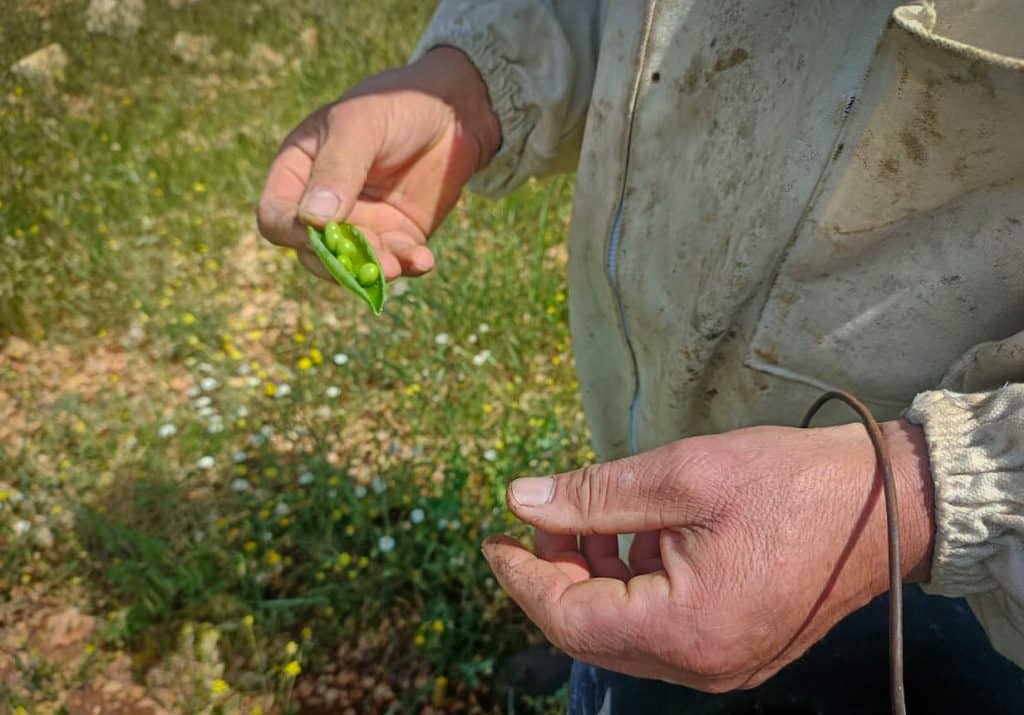
As Yousef continues to pick peas, he dumps the last of the harvested pods into his bucket. He falls silent for a moment, clearly affected by his own testimony. “If things continue this way, we will end up importing olive oil from Spain,” he adds, grabbing a handful of peas in his hand and raising them up in a sigh. “The seeds alone for producing these peas cost 250 shekels. I need to sell 25 kilos worth of peas to make up for.”
He begins to walk out of the plot, done with work for the day. As he reaches the edge, he turns and reflects on what he’s been doing. “Do you know what I get from this pea season? About thirty to forty meals for my family. Because I might save more by not buying peas than actually selling these,” he remarks sarcastically.
As the midday sun is at its height, Yousef returns to his car repair shop — his version of every Palestinian farmer’s second job. I thank him for speaking to me and take my leave, hitching a ride on a mini-bus heading toward Ramallah, the commercial center of the West Bank, where the smell of the settler-battered Palestinian countryside is supposedly invisible.
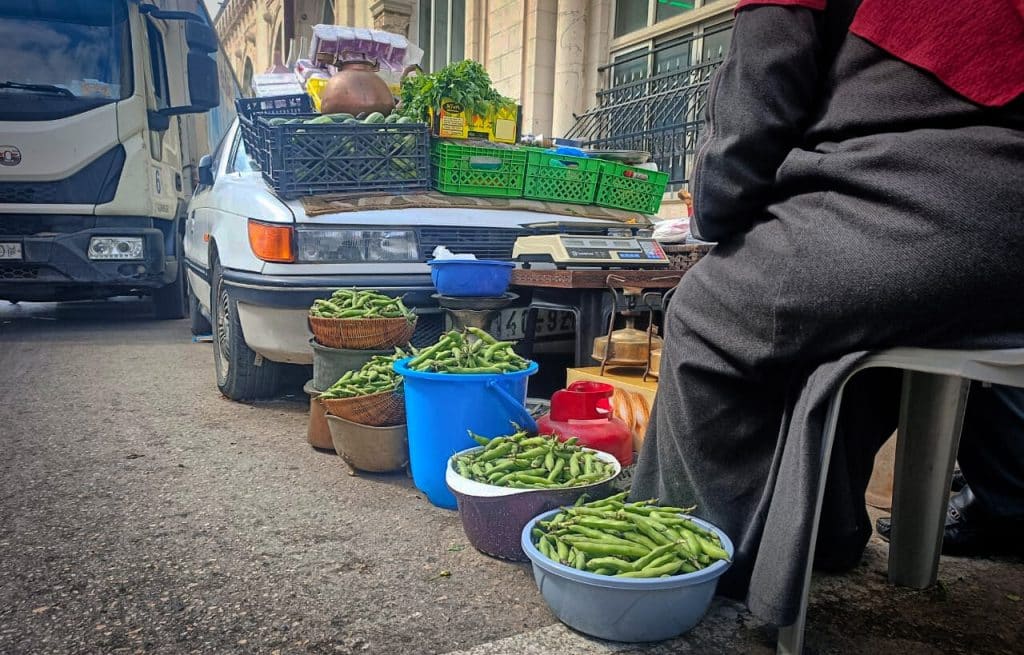
As I arrive in the city center, I step outside the public transportation parking lot and spy an elderly couple camped out on the edge of a sidewalk. They’re sitting on low chairs, and multiple plastic buckets are laid out in front of them, filled with freshly picked green fava beans, still in the pod. I head over to them and ask them about their produce and where it’s from.
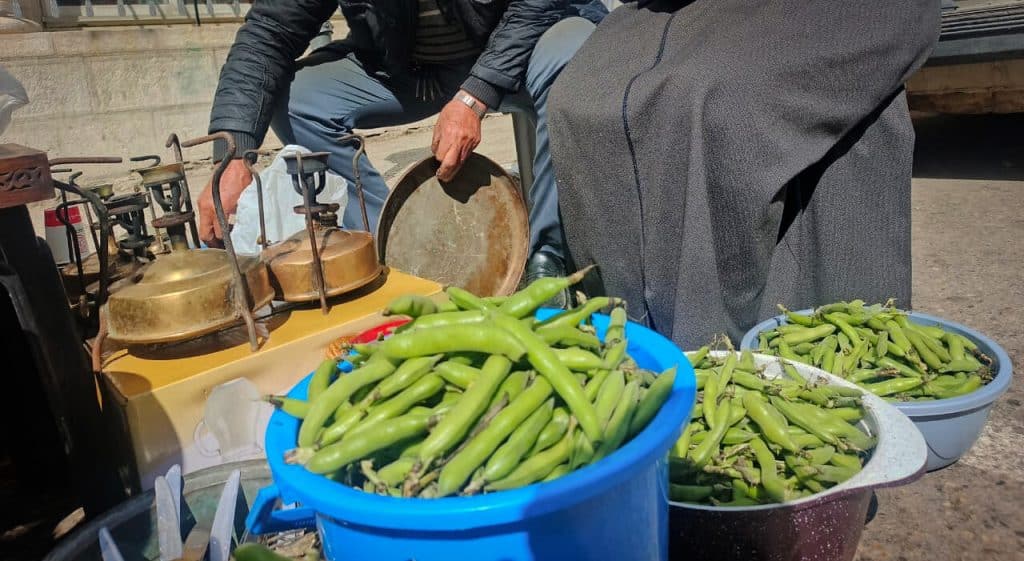
“We are from Sinjil, the town that the Israeli army completely surrounded with barbed wire,” the man responds. Then his wife chimes in, “The peas are 10 shekels a kilo, a bit more expensive than last year.” She’s almost apologetic, but not enough to hide her exasperation. “But this year we have to pay rent for the land.”
The woman then turns to her husband as if just remembering something, and comments, “By the way, do you know how expensive a gallon of olive oil will be this year? And who would even buy it?”
Qassam Muaddi
Qassam Muaddi is the Palestine Staff Writer for Mondoweiss. Follow him on Twitter/X at @QassaMMuaddi.

This is from the publication of the American Geophysical Union from last Decmber:
98% of Gaza’s Tree Cropland Destroyed During More than Two Years of Conflict….A recent analysis has tracked the destruction of tree cropland and greenhouses in Gaza since the start of the war. The analysis revealed that 70% of tree cropland and 58% of greenhouses were damaged or destroyed in the first year of the conflict. By the end of October 2025, 98% of Gaza’s tree cropland had been destroyed. Ninety percent of greenhouses were damaged, and 75% were destroyed….“This is unprecedented damage,” said He Yin, a geographer and remote sensing researcher at Kent State University in Ohio and lead researcher on the project. “I have never seen anything like this,” said Yin, who previously studied other areas of armed conflict, including Syria and the northern Caucasus. Gaza, he said, has “become like a barren land.”
98% of Gaza’s Tree Cropland Destroyed During More than Two Years of Conflict – Eos
One of the defining features of genocide is the deliberate destruction of a groups means of survival.
JNF to Cut Back Most of Its Funding of Programs at West Bank Settler
Farm Outposts:
Under a decision approved earlier this month, two groups tasked with
providing vocational training to at-risk youth placed in outpost farms
will lose millions of shekels in funding. JNF’s new leader says
organization’s money was used to help dispossess Palestinians — Haaretz
This report brought to my mind the enclosure of common land in England.
A Canadian First Nations elder said that to destroy a people it’s not necessary to kill them. You can do it by depriving them of the means of making a living.
More on Ramon Air Force Base, 20 miles from Gaza:
+ U.S. QUIETLY EXPANDS SECRET MILITARY BASE IN ISRAEL Government documents pointing to construction at a classified U.S. base offer rare hints about a little noted U.S. military presence near Gaza.
Ken Klippenstein, Daniel Boguslaw
October 27 2023,
https://theintercept.com/2023/10/27/secret-military-base-israel-gaza-site-512/
tidbits:
TWO MONTHS BEFORE Hamas attacked Israel, the Pentagon awarded a multimillion-dollar contract to build U.S. troop facilities for a secret base it maintains deep within Israel’s Negev desert, just 20 miles from Gaza. Code-named “Site 512,” the longstanding U.S. base is a radar facility that monitors the skies for missile attacks on Israel.
The $35.8 million U.S. troop facility, not publicly announced or previously reported, was obliquely referenced in an August 2 contract announcementby the Pentagon. Though the Defense Department has taken pains to obscure the site’s true nature — describing it in other records merely as a “classified worldwide” project — (The Pentagon did not immediately respond to a request for comment.)
“Sometimes something is treated as an official secret not in the hope that an adversary would never find out about it but rather [because] the U.S. government, for diplomatic or political reasons, does not want to officially acknowledge it,” Paul Pillar, a former chief analyst at the CIA’s counterterrorism center
Back to cotton shocks and lynching>>> “One notable statistical finding from Tolnay and Beck is the correlation between cotton prices and lynching rates. In years when cotton prices fell –squeezing poor white farmers – lynching rates rose.” Cornelius Christian
There’s a similar corollary working against the Palestinian farmer reflected in the olive oil market, destruction of trees, violence and land theft that needs to stop.