


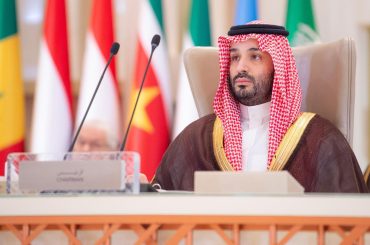
Observers are puzzled — and disturbed — at why the Atlantic just published a long article that tries to rehabilitate Saudi Arabia’s de facto leader, the murderous crown prince Mohammed bin Salman. The magazine’s top editor, Jeffrey Goldberg, was present in Saudi Arabia for the two interviews with the crown prince that are a major part of the piece.
Goldberg’s participation, unusual for an editor-in-chief, is a clue as to what may have been part of what motivated the Atlantic. His long-standing pro-Israel views are well known; he even volunteered and served as a prison guard there during the second intifada. Israel hopes to extend to Saudi Arabia the so-called “Abraham Accords,” which have already led to mutual diplomatic recognition between Israel and the United Arab Emirates, Bahrain, and other Arab nations.
Goldberg, and Israel, recognize that the crown prince could soon succeed his ailing father, King Salman — and stay in power for decades. Is the long Atlantic article designed to help prepare U.S. public opinion to accept Prince Mohammed?
The Atlantic article — the main writer is Graeme Wood — is a disgrace to genuine journalism. Here are the key prevaricating lines. Wood writes:
I’ve been traveling to Saudi Arabia over the past three years, trying to understand if the crown prince is a killer, a reformer, or both — and if both, whether he can be one without the other.
This sentence is dishonest. There is no doubt that Prince Mohammed ordered the murder and dismemberment of the dissident Saudi journalist, Jamal Khashoggi, in the kingdom’s embassy in Istanbul on October 2, 2018. Spy agencies actually have recordings of Khashoggi’s excruciating last moments alive. Khashoggi was not an obscure figure, but a regular columnist at the Washington Post. Raising doubts about who is responsible for his death is willful obfuscation.
What’s more, the rest of the long Atlantic article continues in the same spirit: Prince Mohammed may be responsible for some bad things, but he’s also done good things; who knows for sure; you decide. Meanwhile, let’s keep doing business with him.
Israel is far from alone in wanting to rehabilitate Prince Mohammed. Ben Hubbard’s excellent 2020 book, MBS: The Rise to Power of Mohammed Bin Salman, explains how Western businessmen fawned over him before the Khashoggi murder, eager for deals. What’s more, journalists, think-tankers and celebrities flocked to the Kingdom, often on paid-for junkets, designed to shape public opinion in the U.S. and Europe.
But Israel’s stake in Prince Mohammed is among the largest. Links between the two countries exists already, but official recognition by the wealthiest Arab state would be a diplomatic coup. Saudi experts believe that King Salman stands in the way, but he is 86 years old.
Meanwhile, how will the Washington Post respond to the Atlantic article? Another mainstream U.S. media outlet is rehabilitating the man who ordered the murder of their columnist. Will the paper, and its international affairs columnists, say nothing?

I just read the piece and it doesn’t rehabilitate MBS— it portrays him as someone who is loosening the religious restrictions, which is good, but who is also a narcissistic self-pitying murderer who will likely be an even more terrifying tyrant once he is king.
What the article does do which is bad is two things—
It downplays the severity of Saudi war crimes in Yemen and makes it sound like the US is doing its best to keep him in check. In reality they might ask him not to bomb civilians but they keep supporting the war and more importantly, they don’t criticize the blockade which is causing most of the deaths. So the article whitewashes our complicity in the Yemen War.
It also treats good relations with as an obvious Good Thing. I am not sure why it is good that one awful government now says nice things about another. But Goldberg probably likes that.
ALSO RECALL GOLDBERG’S FAWNING ARTICLE FROM 2018:
“Saudi Crown Prince: Iran’s Supreme Leader ‘Makes Hitler Look Good'” | By Jeffrey Goldberg | theatlantic.com | April 2, 2018
[EXCERPTS] This much, at least, can be said for Mohammed bin Salman, the putatively reformist crown prince of Saudi Arabia: He has made all the right enemies. Among those who would celebrate his end are the leaders of ISIS, al-Qaeda, Hezbollah, and Hamas, as well as Yemen’s Houthi rebels, and the entire clerical and military leadership of the Islamic Republic of Iran. As a bonus, there are members of his own family, the sprawling, sclerotic, self-dealing House of Saud, who would like to see him gone—or at the very least, warehoused at the Ritz-Carlton in Riyadh, where the 32-year-old prince recently imprisoned many of his enemies and cousins during an anti-corruption sweep of the kingdom.
The well-protected Prince Mohammed does not seem particularly worried about mortal threats, however. He was jovial to the point of ebullience when I met him at his brother’s compound outside Washington (his brother, Prince Khalid bin Salman, is the Saudi ambassador to the U.S.). Prince Mohammed (who is known widely by his initials, MbS) seemed eager to download his heterodoxical, contentious views on a number of subjects—on women’s rights (he appears doubtful about the laws that force Saudi women to travel with male relatives); on Iran’s supreme leader, Ayatollah Khamenei, who is, in the prince’s mind, worse than Hitler; and on Israel. He told me he recognizes the right of the Jewish people to have a nation-state of their own next to a Palestinian state; no Arab leader has ever acknowledged such a right. . .
. . . The prince, in my conversation with him, divided the Middle East into two warring camps: what he called the “triangle of evil,” consisting of Iran, the Muslim Brotherhood, and Sunni terror groups; and an alliance of self-described moderate states that includes Jordan, Egypt, the United Arab Emirates, Bahrain, and Oman. About his bête noir, the Iranian supreme leader, Ayatollah Ali Khamenei, Prince Mohammed said, “I believe the Iranian supreme leader makes Hitler look good. Hitler didn’t do what the supreme leader is trying to do. Hitler tried to conquer Europe. … The supreme leader is trying to conquer the world.” . . .
ENTIRE ARTICLE – https://www.theatlantic.com/international/archive/2018/04/mohammed-bin-salman-iran-israel/557036/
A brief behind the scenes look at Saudi Crown Prince Mohammed bin Salman, a not very bright cruel man child and accused murderer of Jamal Khashoggi:
The prince personally purchased a painting by Leonardo Da Vinci for $450 million (US) , the ‘most expensive painting ever sold at auction.’
(http://www.businessinsider.com/saudi-arabia-crown-prince-mohammed-bin-salman-da-vinci-painting-2017-12)
The prince also bought the world’s most expensive home – $300 million (US) New York Times, December 16/17 https://www.nytimes.com/2017/12/16/world/middleeast/saudi-prince-chateau.html
EXCERPT:
“LOUVECIENNES, France — “When the Chateau Louis XIV sold for over $300 million two years ago, Fortune magazine called it ‘the world’s most expensive home,’ and Town & Country swooned over its gold-leafed fountain, marble statues and hedged labyrinth set in a 57-acre landscaped park. But for all the lavish details, one fact was missing: the identity of the buyer.
Now, it turns out that the paper trail leads to Crown Prince Mohammed bin Salman, heir to the Saudi throne.”
“The 2015 purchase appears to be one of several extravagant acquisitions, including a $500 million yacht and a $450 million Leonardo da Vinci painting — by a prince who is leading a sweeping crackdown on corruption and self-enrichment by the Saudi elite and preaching fiscal austerity at home.” (We’re talking about $one billion, 250 million (US) that this man-child prince has blown on himself.)
I didn’t read the article, but i trust donald Johnson’s summary. Israel’s relationships in various parts of the world: vis s vis russia or saudi arabia , are not guided by morality but by convenience aka security aka survival of the fittest aka survival. Would it be better if israel would have a different frame of mind, better for its generals contemplating a war room scenario. I doubt it. Show me a country whose concern is morality? Supporting Ukraine stirs my sense of righteousness. But it also stirs my sense of trepidation. This Putin decision makes the world a more dangerous place. The advent of trump and January 6th makes me far less secure regarding the future of america. The move by putin makes me far less secure regarding the velt. (I have to add climate change as a more long range threat to “security” to the planet: specifically the flow of refugee populations as drought and coastal changes wreak havoc with economies.) If one views Israel’s survival as iffy, an exaggeration, then its history of alliances is in the realm of necessity. Personally i fantasize about moshe sharrett making peace in the 50’s and a different more modest role of israel in the world, tolerated, but smaller, less of a world player, not anonymous, but not the constant headlines of the post 67 years. 1967. The turning point. The mindset of ben gurion, warmaker, was much more “traditional” (human rather than humane) than the mindset of sharrett, diplomat, in tune with the diasporic Jewish habits of negotiation, not in synch with the machinations of a nation building an army as an ideal for an innovation after hundreds of years of military disarmament.
I hate those in israel who wish to go slow in condemning putin. I hate those in israel who seek friendship with this saudi murderer, but as hyman roth said, this is the business that we have chosen. (A stupid move like building settlements in the west bank seems to me stupid to the generals in the war room. That’s where doing what’s right and smart go together.)