
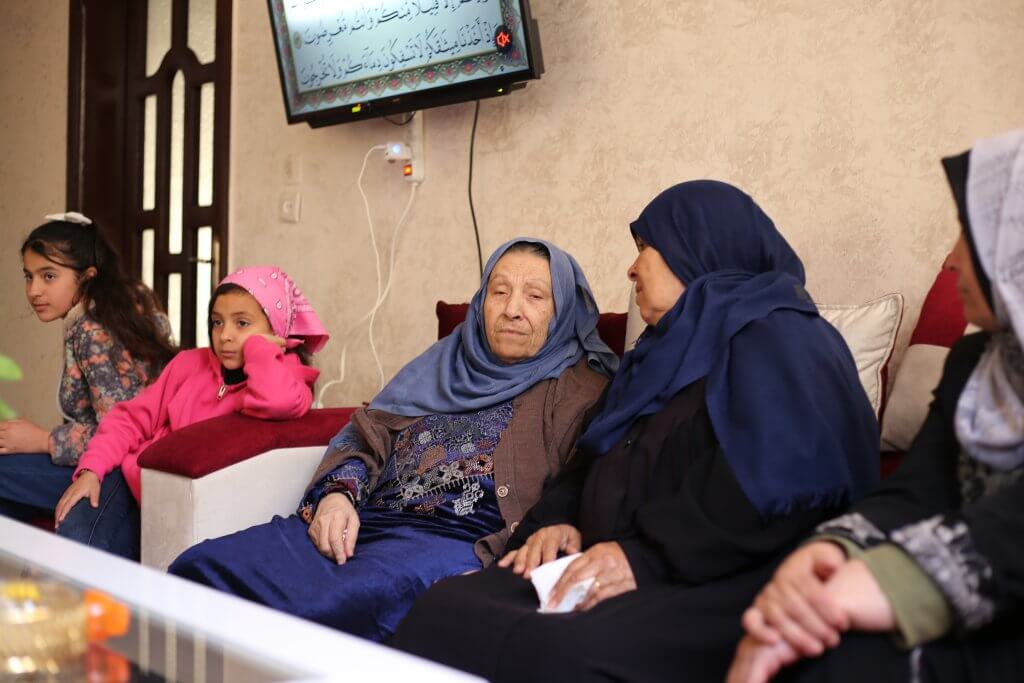
The old woman sits on her bed next to the window. Although she cannot see it, the warm sun of her homeland drenches her in light. She places her head in her hands, thinking out loud about how she spent her entire life trying to escape Israel’s bombs. In the background, the same window that brings in the light also lets in the constant buzzing of the warplanes and drones, punctuated by shelling and bombing. Though she cannot see them, she hears every boom, and feels the ground every time it shakes.
That old woman by the window was my mother.
For the past five years, I was her primary caretaker, as she suffered from blindness and a host of other medical conditions, including heart disease and a broken hip. I spent almost every night for the past five years lying awake at night, worried that she might need me.
She always used to say “forgive me,” out of guilt, but I always responded by telling her that she was my treasure, that she was the reason for every blessed and good thing in my life.
My family and I have been displaced five times so far during the ongoing war against Palestinian existence in Gaza. We are a family of eight siblings, and I am the youngest. Everyone is married, and some of my nieces and nephews are even older than me.
We all used to live in the same building in our home in al-Shuja’iyya, Gaza City. There were 23 of us in that building, and 22 more living in the surrounding neighborhood. The war separated all of us in October. By November, the entire building had been destroyed. Throughout everything, my elderly mother stayed with me, close in my arms, as she had done my entire life.
Our fourth displacement was to Rafah, where we stayed alongside 1.7 million other Palestinians. My mother, myself, my 1-year-old son Qais, and my wife Timaa arrived at an abandoned house in Rafah with my father-in-law’s family of four. The rest of my extended family, my siblings, nieces, and nephews — everyone who used to see my mother every day for our entire lives — were scattered across Gaza.
In February, two months after we arrived in Rafah, my mother fell ill. By a stroke of luck and tenacity, I was able to get her seen by a doctor amid the bombings and the ground invasion and the overwhelmed hospitals. The doctor prescribed her medications that were nowhere to be found in all of Rafah. As I carted her between hospitals and medical centers, none of which were equipped to take her in as a patient, her situation continued to deteriorate. They gave me some available medications, but nothing was working. Eventually, she stopped sleeping at night. Then she was no longer able to walk by herself.
I called my brother Osama for help. He came from Khan Younis immediately.
We took her to the European Hospital, just on the border of Khan Younis and Rafah. It was the closest hospital and the only major functioning hospital in the south. When the doctors examined her, they ordered her to be admitted.
In a situation unique to Gaza, and unimaginable to other people, it was because of her worsened health condition and her admittance to the European Hospital that she was finally able to reunite with my nieces and nephews — her grandchildren — who she hadn’t seen in months due to the fact that we were in Rafah while they had been sheltering on the hospital grounds.
When she arrived at the hospital, my family saw her for the first time since the war broke out. They ran to her and hugged her.
Despite the circumstances, it was a joyous moment. At the time, she did not know that my eldest brother had been injured after the home they were in was bombed, trapping him and his family under the rubble for an entire night before they were rescued. She didn’t know that her brother, my uncle, had been killed, or that our family home had been destroyed. These are the things I had to keep from her for fear of what the news might do to her. For months, I believed that all of her fears, all the terrifying moments she had lived through, the displacement, the constant terror of the bombs — all of that would be too much for her tired heart.
And that day in the European Hospital, I think I was right. When someone told her about my brother’s injury, her sadness was inconsolable.
By the end of that day in the hospital, I had to make an impossible choice — either stay at the hospital and leave my wife and son behind in Rafah, or rejoin them and abandon my mother in Khan Younis. I tried to strike a balance and left my mother with my brother Osama. Every morning for the next several weeks, I left my family in Rafah in the mornings, and before the evening, I left my other family at the hospital in Khan Younis and went back to my family in Rafah.
For one month I lived through that agony, every time saying goodbye to my son like it was the last time. And every night, I lived that same agony when I said goodbye to my mother. Would I survive the night and see her again tomorrow?
As the days went on, the hospital was not a hospital anymore. It was flooded with displaced families who had taken over all the unoccupied patient rooms and beds. Even the corridors were full of people, sleeping on blankets and whatever they could find. It was not a healthy environment for anyone, let alone patients. The floors were dirty, and kids who had spent months in hospital corridors with nothing to play with now made toys out of medical waste and ran barefoot in the hospital and its grounds. All the while, my mother couldn’t see any of these things, but she could hear the commotion, the sound of the bombs raining down in the distance, and the din of the crowds and the cries and screams of the injured around her.
A group of doctors were able to give her minimal medications, and I began to feel that it was a mistake to move her to the hospital. But then again, I feared that I would regret it even more if she died at home, helpless and with no medical care. She needs the care, I told myself. This is the only option we have.
Three weeks in, her kidneys started to fail. Doctors said they would try their best to avoid reaching the point of needing dialysis, “because there is no chance she will be able to handle kidney dialysis,” one doctor told me. Her body was too weak to endure the process. It was the same reason a doctor gave us many years ago when we sought treatment to try and save her eyesight.
The first couple of days after they put her on medications for her kidneys, she did not get any better, but she didn’t get worse either. I started to come to the realization that she could not stay here anymore. I considered her psychological health first and the toll it was taking on her physical health. I told her dozens of times that we should go back to Rafah, to the house where our family was, but she said no.
“As long as they treat me, I will stay. I may get better and will be able to walk again, I’m very sick and tired,” she said when I insisted that we return to Rafah. “I will not forgive you if you take me out without finishing my treatment.”
And so she stayed there.
And I kept going back and forth between the European Hospital and my family in Rafah. I didn’t consider the fact that the army was shelling Salah al-Din road and slowly encroaching upon Khan Younis.
She was my mother. I couldn’t leave her, even for a single day. She is the only person who loves me more than herself. In Islam, we believe that our mothers are our keys to heaven, and that paradise lies at their feet. I know this to be true. My mother was the key to my prayers being answered, the gate between myself and God. She was and always will be the reason I have had good fortune in my life.
And even though she is my mother, sometimes I feel like she is my little daughter. I knew that she was getting older and sicker, and so I wanted to give her the best moments I could, even in this horrible war.
So I did not miss any opportunity to see her, not a single day — except for one. It was a dreadful day when I had to stand in lines for hours to access an ATM in Rafah, where there were only three ATMs and practically no cash for 1.7 million people.
That was the one time I didn’t see my mother — not just during the month she spent at the hospital, not just during the war, but during my entire life in Gaza. I missed her that day.
The day after, she went into a coma.
Alongside her kidney problems, she suffered from a stroke, the second in just a few years. She needed to be intubated and given special nutrition that had to be administered through a feeding tube which the hospital did not have. The doctor wrote the prescription for the supplement — Ensure Plus — and asked me to go out and find it. I hoped that my search through Rafah’s pharmacies would not leave me empty-handed. I was disappointed.
When it became hopeless, I went back to the doctor in frustration and asked him how a hospital so large could not secure nutrition for its patients and how he expected me to find it. The doctor understood my anger. He knew what I was losing, and he knew that it didn’t have to be this way.
Day by day, with no proper food or treatment, her body stopped responding to medications. Doctors started saying that there was nothing they could do. She spent 10 days in a coma, breathing, opening her eyes, sometimes not responding to anything. But even though she was not responsive, her body was shaking every second with the sound of every bomb, every scream of every person in the hospital. Once again, the fear that put her here was still taking its toll.
I started to say goodbye to her for 10 days. Every day I took every moment to keep her in my arms. I wanted to feel her warm face next to mine before it got cold. I was storing her smile in my mind and the feeling of her gray hair between my fingertips. I felt every day of my entire life pass before me, as I held her hands all day and lay next to her in her hospital bed.
I know that death is coming for all of us. We do not know how and when, but sometimes we can see the signs. I witnessed the death of my father two years ago. I thought after that that I would get to spend more time with my mom, but every day in that hospital, I grew more devastated with time. When I started to give up hope that she would live, I started to at least hope that I could bury her next to my father in the cemetery in Gaza. But I knew this was even more unlikely than her making a full recovery.
My mother, my beautiful, sweet beloved mother, the one who makes me believe that good deeds will always come back to me in different and more generous forms — I wished she would never die. But these days in Gaza wishes rarely come true.
At 2 a.m. on March 4, my nephew called me from Khan Younis. I was sleeping in Rafah.
“My condolences,” he said. I asked, “for whom?” He told me that she had passed away. I couldn’t believe it. How could she die without me holding her hand?
“How?” I demanded of my nephew. I was trying to tell him that I was there all day. I kept asking him, “You’re not serious, right?”
Then my brother Osama called me. He confirmed her death and tried hard to make me believe that she was in a better place.
Oh, Mom, I tried my best. I tried so hard to get you out of Gaza, to get you to any hospital in Egypt, but I couldn’t. I tried to get you the medication and the supplements you needed, but I wasn’t able to. Oh Mom, even dying in a decent grave is impossible. Cemeteries are full and now people bury their loved ones in temporary cemeteries near the hospital. Some people bury their loved ones in the medians between the highway, or on the side of the road. Will that be us? Will I have to put you inside a plastic bag and bury you under the ground on the roadside, in a makeshift grave built of stones and covered in cement?
My thoughts tortured me the rest of the night.
Everybody around me was sleeping. It’s three in the morning, and I can’t move from Rafah to Khan Younis. It’s not safe. I will find no one to drive me, and it is too far and dangerous.
As the sun slowly started to creep in through the window, the reality of losing my mother began to settle in. I slowly lay down on my mattress, covering my head with my blanket, and I couldn’t hold my tears any longer. Every moment in my life with my mom began to fill my mind.
I recall how hard my mother worked her entire life to have her big family and give us a good life. I recall every moment as a child when I would lie down next to her head on her pillow and she hugged every part of my body. I recall that year when I tried my best to teach her how to write her name. She never got the chance to receive an education, but she taught me how to be a human. She taught me how to have mercy in my heart and how to forgive. And she taught me how to be a good son.
The last week of her life, when she wasn’t responding to anything around her, I was talking to her as usual, and I told her, “If you are listening, please just move your finger.” And she did.
So I told her everything I wanted her to know. I told her that I prayed that she would survive, even if it meant I would spend my entire life serving her and taking care of her. I told her how I was lucky to be her son and how much I loved her. I told her that I registered her name on a list to go to Egypt and that we were waiting our turn.
Today, I sit in Egypt with my wife and son. I thought my mom would be with us. I never imagined she would choose a different destination.
Rest in peace, my beloved. I am so sorry I couldn’t save you.

Tareq S. Hajjaj
Tareq S. Hajjaj is a journalist and a member of the Palestinian Writers Union. Follow him on Twitter at @Tareqshajjaj.

Some 10 years ago I spent the last few days of my Mothers life by her bedside.My siblings live in other countries so I was alone there.I was away from home when my Father passed away and only arrived in time for the burial services.
I consider it a blessing to have been there and to be holding her hand when she passed.She was there when I took my first breath and I was there when she took her last.
I very much understand the Author,s feelings and especially the horrible conditions he had to endure
this most saddest of losses.
I wish him peace and better days to come and an end to this most cruel treatment by Israel and it,s vile leaders.
Heart felt condolences. Sorry to hear about the loss of your beloved mother. Surely she is in a better place … a safer place and where there are no bombs … and no 2,000 pound bombs.
Your beloved mother has joined the thousands upon thousands of Palestinian mothers and grandmothers who have died and have been killed in the last 7 plus months.
They have died/killed at the bloody hands of a merciless apartheid Israel and its IDF killers.
Devastating.
Not much moves me to tears, but this did.
Dear dear Tareq
My heart bleeds for you. As a mother I can tell you , you were the best son your mother could ever have wished for. I am so relieved that you and your wife and son are safe in Egypt. May Allah comfort and sustain you.