

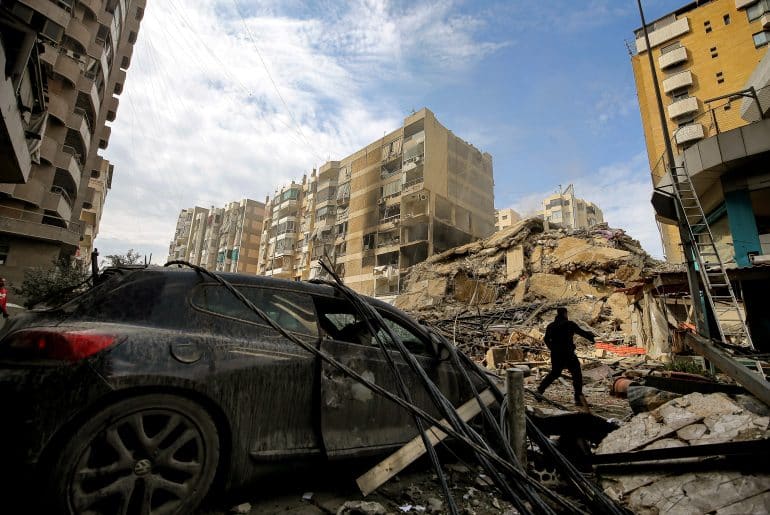
Ishaaq al-Daour, 32, was sheltering with his family at the UN-run Abu Hussein School in Jabalia refugee camp when the Israeli army stormed the shelter on October 20, forcing over 700 hundred people out of the school and leading them into a large ditch that had been dug in advance by the military.
“They made all of the men go down into the ditch first,” al-Daour told Mondoweiss from the Remal neighborhood in Gaza City. “Then they ordered us to climb out of the ditch one by one and stood each of us in front of a camera that had been installed nearby.”
The army made the men stand in front of the “camera” for at least three minutes per person, al-Daour said, long enough for the cameras to scan their faces and reveal personal data seemingly already stored in the Israeli military’s system. After the scans, al-Daour said the soldiers would reveal information about each individual, including their “name, age, work, family members and names, place of residence, and even their personal activities.”
“When they suspected someone, they took him away [to an unknown location],” al-Daour said. As for those who had relatives who belonged to Palestinian resistance movements or who personally belonged to resistance factions, al-Daour speculated that “their fate was immediate death,” citing stories he had heard from others in Gaza, whose friends and relatives were taken at checkpoints and had not been seen again, or who returned to Gaza in body bags.
Al-Daour is one of the thousands of people who were expelled from the Jabalia refugee camp in northern Gaza and ordered to move south at gunpoint by the Israeli army. The forced exodus of thousands out of Jabalia is part of an Israeli offensive on northern Gaza that started on October 5. Its objective is to implement a proposal put forward by a group of senior Israeli generals that aims to empty northern Gaza of its inhabitants through starvation and bombardment, the so-called “Generals’ Plan.”
Survivors from Jabalia, like al-Daour, report that the Israeli army is using facial recognition technology to screen residents in the ongoing assault, often identifying people from long distances and picking them out from a crowd.
Witnesses say that the Israeli army has set up security checkpoints throughout northern Gaza where the facial recognition technology is being deployed. The military is also reportedly using this technology when it storms shelters for the displaced. Witnesses report that in these cases Israeli forces will corral people in enclosed places, usually ditches dug by military bulldozers, and process them individually.

Mondoweiss spoke to several survivors from Jabalia, who said that the Israeli army is using quadcopter drones to “identify people immediately from a distance,” and that soldiers are stopping people at checkpoints to conduct “camera scans” that last for several minutes. Witnesses say these were particularly unnerving as they stood awaiting an uncertain fate. Witnesses also report that the army picked people out of a crowd at checkpoints using what they described as a “red laser pointer” that was either mounted on a tank or on a soldier’s rifle.
After the army scans people’s faces, most people are detained for field interrogations, witnesses said. During these encounters, soldiers use what Ishaaq al-Daour describes as “psychological tactics” to unsettle the people being questioned, claiming that they know everything about their lives and that if they lie in their answers, “they will be killed.”
The questions are typically wide-ranging, al-Daour said. “They ask us about our relatives, our neighbors, the movements of the resistance fighters on the ground, who we know from them, and who they are. They convince us that they already know everything about us by mentioning intimate details about our lives, and then they threaten us with killing if we lie.”
Israel’s use of facial recognition throughout the war
While Mondoweiss could not independently verify the nature of the “cameras” being described by witnesses, the use of facial scanning and facial recognition technology by the Israeli army has been well documented.
Facial recognition technology used by Israel pulls from a database of information about Palestinians that has been built up over the years, including on Palestinians in the West Bank. One of those databases is called Wolf Pack, which according to Amnesty International, contains extensive information on Palestinians in the West Bank and Gaza, “including where they live, who their family members are, and whether they are wanted for questioning by Israeli authorities.”
In the old city of Hebron in the southern West Bank, Israeli surveillance cameras use a facial recognition system called Red Wolf on Palestinians who pass through checkpoints in the city. “Their face is scanned, without their knowledge or consent, and compared with biometric entries in databases which exclusively contain information about Palestinians,” Amnesty described in a May 2023 report.
It is unclear whether the facial recognition technology used throughout the ongoing assault on northern Gaza is the Red Wolf system or the other systems that the Israeli army has been reported to have used throughout the war on Gaza. In March, the New York Times reported that Israel’s cyber-intelligence division Unit 8200 used facial recognition technology developed by Corsight, an Israeli company, in combination with Google Photos. Together, these technologies enabled “Israel to pick faces out of crowds and grainy drone footage,” the Times said.
Likewise, it’s unclear whether these facial recognition systems are drawing upon data from Wolf Pack or another Israeli database, but media attention has recently focused on how that data is being processed and generated through a number of controversial AI programs to identify potential targets. Programs like “Lavender,” “The Gospel,” and “Where’s Daddy” have pushed Human Rights Watch to warn against their use of “faulty data and inexact approximations to inform military actions.” Several media exposés have also shown how some of these AI systems loosely identify civilians as targets for assassination or alert the Israeli army to target members of Hamas when they are with their families.
Testimonies gathered by Mondoweiss for this report and in previous reporting confirm that the brutal Israeli invasion in northern Gaza is utilizing these technologies as a means of organizing how it conducts mass arrests, field executions, and ethnic cleansing.
‘It was the most terrifying moment in my life’
Hiba al-Fram is one of the displaced people who passed through the army’s checkpoints during the Jabalia invasion. She says she was subjected to a facial and retinal scan, an experience she described as terrifying.
“Everyone was standing in the line, men and women, and everyone held up their IDs in their hands,” she said.
Al-Fram said that the army picked people out of the queue using a “laser” pointer affixed to a tank. “Soldiers were using lasers to check our ID cards from a distance before we reached them,” she said, explaining that soldiers would call on people to advance towards the checkpoint, where they had set up a camera. Mondoweiss could not confirm what lasers the military was using.
“The soldiers arrested over 100 men in front of my eyes; they arrested them in front of their wives, and they were beating them, cursing them, and threatening to kill them and their families. Many wives saw their husbands in this situation,” al-Fram recounted.
“The soldiers were telling the women: ‘We will kill you by a sniper bullet, we will run over your skulls with tanks, we will stone you to death, we will make you bleed to death,’” al-Fram continued. “The women were terrified and thought they would be killed.”
Then, the soldiers would gather five women at a time and walk them to a security check or a scan of the face or eye. “They arrested two women in front of me from the crowd based on their facial scans. People later said they were relatives of people known to be members of armed factions, but they were women. They were carrying children.”
“The soldiers ordered them to give their children to other women. The mothers started to panic like crazy. They looked around frantically for any woman they knew to give their children to,” al-Fram continued.
“We would walk towards the face-scanning point with utter terror in our hearts, walking between dozens of tanks and soldiers pointing their weapons at us. And we would stand there for 3 or 5 minutes. They were the worst minutes of my life. A person’s fate was decided based on that scan: either arrest, beating, humiliation, or release and being forced to leave towards the south.”
After the soldiers take the face scan, the questions about neighbors and relatives begin. “They asked us where they are, where we can find them, when we last saw them. We did not know anything about these details, so we did not lie when we said we did not know. They would threaten us that if we lied, they would uncover the lie and shoot us immediately.”
Of all the terrifying moments experienced by residents of northern Gaza, many say that they experienced the greatest terror when stopped at an Israeli checkpoint.
“The most terrifying and frightening moments were the moments when you stand in front of the camera to get your face scanned,” Abdul Karim al-Zuwaidi, a journalist in northern Gaza, told Mondoweiss.
Before al-Zuwaidi reached the facial recognition point on his way toward Gaza City from the north, he saw many young men being arrested by the army. As a Palestinian journalist working in the Gaza Strip, he, like many of his colleagues, is at particular risk of being targeted.
“The minutes we stand in front of the camera feel like years,” al-Zuwaidi said. “As a journalist conveying our message to the world, I was terrified.”
Al-Zuwaidi said that during their march south, many Jabalia residents would attempt to avoid upcoming checkpoints, often to no avail. “We had heard the stories about the checkpoints and how they were arresting people, so we tried in whatever way possible to avoid passing through them, but there was no way of escaping.”
“When we are examined, and the scan shows that one of us will be arrested, the soldiers start beating and cursing them before they take them away and they disappear. We saw this scene play out in front of us for dozens of young men.” Al-Zuwaidi did not see himself what information was revealed to the soldiers by the scans, but he said the soldiers would repeat aloud what details they saw on their screens, including people’s personal information, names, relatives, and more.
While people were waiting for the scan, al-Zuwaidi said that soldiers would curse at and beat the young men. The army severely beat al-Zuwaidi while he was standing and waiting for his turn. “They were dirty in their treatment of us,” he said. “But what can we say in response to a military armed with all these weapons and ready to kill?”
“They used every humiliating method against ordinary people,” he added.
Tareq S. Hajjaj
Tareq S. Hajjaj is a journalist and a member of the Palestinian Writers Union. Follow him on Twitter at @Tareqshajjaj.
“Ishaaq al-Daour, 32, was sheltering with his family at the UN-run Abu Hussein School in Jabalia refugee camp when the Israeli army stormed the shelter on October 20, forcing over 700 hundred people out of the school and leading them into a large ditch that had been dug in advance by the military.”
Gee whiz, why can’t the Palestinians educate their children, why do they need UNWRA?
That’s what happens when you have a captive population with no rights to experiment upon. All power tends to corrupt and absolute power corrupts absolutely.
A Palestinian family goes to pick up olives. It ends in an execution by Israeli soldiers
Around 10:30 A.M. the military pickup truck reappeared, four soldiers came out, one knelt down and started shooting. A witness says that even the trees were shaking from the shooting
Gideon Levy
Oct 30, 2024
“Hanan Abu Salameh, 59, was gathering olives with her family in their own grove near the West Bank village of Faqqua, near Jenin, when an Israeli military truck pulled over and a soldier opened gunfire, says her son Fares, 40. His father waved at the man to stop shooting but he went on. Trying to escape, the family ran to their tractor. Hanan fell down on her back. When Fares and Hossam hurried to pick her up, they saw a wound in her chest. They rushed her to the hospital, but it was too late.
This is the family’s account of how their first harvest day ended last week. Although occupation authorities had explicitly permitted Faqqua farmers to pick olives, this harvest ended in bloodshed, killing a mother of seven and grandmother of 14.
Hanan’s murderer is still walking free and might not even be held to account for her death.”
https://www.bundle.app/en/breakingNews/a-palestinian-family-goes-to-pick-up-olives.-it-ends-in-an-execution-by-israeli-soldiers-7f055c3d-84de-44a7-be74-0abcc704a970
I’m fully in favor of having the Israelis use facial recognition. It helps them recognize the real terrorist murderers and lets them spare innocent civilians. There is no rational reason to object to it, unless one cynically wishes to follow the logic of “the worse, the better,” i.e., aim for maximum civilian casualties in the hope that anti-Israeli sentiment will thereby be increased.
Sounds like this facial recognition is doing its job well. Non-combatants are more easily recognized as non-combatants, which is difficult given the fighters dressing as civilians.