

On Sunday afternoon, hours after the ceasefire took effect in the Gaza Strip, hundreds of Palestinians gathered in a suburb of Ramallah in the occupied West Bank, for the first day of the highly-anticipated prisoner exchange.
As part of the ceasefire agreement, the first exchange would see the release of 90 Palestinian prisoners, most of them women and minors, 78 of whom were from the West Bank. In total, Israel will release 735 Palestinians over six weeks, in exchange for Hamas releasing 33 Israeli captives being held in Gaza since October 7, 2023. The first three women were released on Sunday.
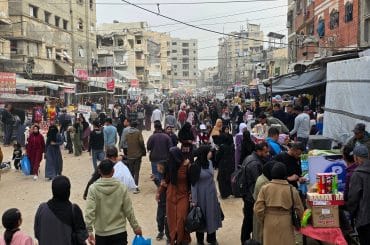
Around 4:30 p.m. local time, the Israeli prison services transported the Palestinian detainees slated for release to their final stop before freedom, the Ofer prison just outside Ramallah. In Beitunia, the closest Palestinian town to the prison, the impatience among the crowd was palpable.
The implementation of the prisoner exchange officially began at 4:00 pm local time, with the release of the Israeli captives and the transfer of the Palestinian detainees from different prisons to the Ofer detention center near Ramallah. However, their release continued to be delayed for hours. “It’s already 6:30 p.m., if they don’t arrive soon I’ll go to Ofer and get them myself,” a young man exclaimed, as he blew out smoke from his cigarette.
Despite people’s anxieties, the atmosphere was not lacking in festivity. Palestinian national and factions’ flags fluttered from the windows of cars and from the arms of teenagers, while women displayed portraits of their imprisoned relatives. In the background, the sound of patriotic songs coming from the vehicles and stores in the vicinity were on a constant loop.
“I am here to wait for my wife, Zahra Khudroj, who has been detained for a year,” a man in the crowd told Mondoweiss. “We did not know until the day before yesterday that her name was among those [to be] released. It was a surprise, I am the only one to receive her because my children are abroad, and we haven’t had any news of her since her detention,” he continued.
An hour later, dozens gathered in a sweets shop on the main street seeking some rest. In a crowded corner, a family sat around a table; a middle-aged man and a man in his sixties, and an elderly woman and a young woman. “We are the family of detainee Israa Berri,” said the man. “We came all the way from Jenin to be here on time for the release, but now we don’t know until what hour we will have to wait,” he added. “Israa is a writer and poet, and the occupation arrested her for charges of “incitement” during this war, and for months we have had no news of her,” he went on.
As the sweets shop became more crowded with anxious families, the man announced to the crowd: “The way back home will be very difficult. The [Israeli] occupation closed main roads and settlers are attacking cars everywhere.”
Outside, a woman in traditional dress walks by, holding a poster of her sister, Roula Hasanein, from the Jalazoun refugee camp north of Ramallah.
“She has been under administrative detention since March 2024, and she has a two-year-old girl who she hasn’t been allowed to see for almost a year,” the woman said.
“I, on the other hand, have no relatives to receive today, but I consider all prisoners my children,” another woman said, flanked by her two young daughters proudly waving a Palestinian flag.
After hours of no news, the moment everyone was waiting for finally arrived at 2:00 a.m., when the large white buses marked with the Red cross logo finally appeared in Beitunia, making their way slowly through the town amidst a sea of celebrating crowds.

As the buses approached at a distance, Palestinian police and local volunteers formed human barriers to clear the route in front of them, while an endless stream of people continued to pour in from up the town center towards the buses. Family members ran desperately along the main street, with their eyes fixated on the buses, some calling the names of their beloved ones.
One by one, the released prisoners left the buses to embrace their families- a long awaited end of the first day of what Palestinians hope to be the end of the war. Mothers embraced their children after months in prison, sons embraced their parents, and school girls embraced their friends.
Out of the 95 Palestinian prisoners released on Sunday, 68 were women. Only seven of the 68 women actually had prison sentences ordered against them. Twenty-two were under administrative detention orders (detained without charges for renewable detention terms), while the 39 remaining were arrested without any status at all. According to reports, there are three girls, all minors, set to be released in the coming weeks as part of upcoming prisoner exchanges.
Out of the 27 men released, two were minors, eight were 18-years-old, and the rest were older than 18. Three of them had sentences, nine were under administrative detention, and 15 were arrested without any status.
In stark contrast to the celebration in the West Bank, which persisted despite the efforts of Israel to curtail any expressions of joy, Palestinian prisoners from Jerusalem were released back home under heavy surveillance from armed Israeli police. Video footage showed released prisoners being escorted into their homes with police outside in order to ensure that no one would be allowed to celebrate their release.
Tensions high as ceasefire begins to take hold
Tensions in the West Bank have been rising since before the ceasefire was announced, especially with the rise of incitement by Israeli politicians. In early January, Israeli Finance Minister Bezalel Smotrich, who is effectively in charge of the West Bank, said that “Nablus and Jenin should resemble Jabalia,” the Palestinian city north of the Gaza Strip that Israel completely destroyed in the final months of the war.
In the days leading up to the ceasefire going into effect, Israel intensified its control measures in the West Bank, erecting new metal gates and barriers between villages, and imposing new checkpoints on the roads. In the east of Ramallah alone, the Israeli army imposed five new metal gates, isolating six villages in a space of less than 12 kilometers, in less than 24 hours.
On Sunday night, as Palestinians waited for the arrival of the liberated prisoners in Beitunia, Israeli settlers launched attacks on Palestinian cars and homes in eastern Ramallah, setting fire to property in the village of Sinjil, and pelting cars with stones on the main road connecting the northern and southern West Bank.
As the Israeli far right threats to annex the West Bank gain traction, Palestinians fear that the temporary calm being felt in Gaza will not be shared in the West Bank, with many speculating that Netanyahu may grant extended powers and control for the settlers in the West Bank as “compensation” for settler leaders like Smotrich agreeing to a ceasefire deal in Gaza.
On the Palestinian side, things remain uncertain, as it is still unclear who will be in charge of the administration of the Gaza Strip after the end of the war. Palestinian factions had agreed, back in December, to form an independent committee of technocrats to run the strip and administrate reconstruction. The Palestinian Authority, however, backed out earlier this month, once again calling into question what the future of governance in Gaza looks like.
Meanwhile, after a few days of calm in the West Bank city of Jenin, PA security forces and the local resistance in the Jenin camp went back to fighting on Sunday. At the same time, Israel has been announcing military preparations to “widen operations in the West Bank,” according to Israel’s war minister, Yizrael Katz, predicting more violence against Palestinian cities and refugee camps.
Despite all the uncertainties that lie ahead, many Palestinians are ceasing the moment to reunite with their beloved ones released from Israeli jails, and celebrate the current halt of the genocide in Gaza.

I see there’s an ad for Mohammed El-Kurd’s new book, “Perfect Victims: And the Politics of Appeal”.Let me point out another recent book on Gaza and Israel:
“Deluge: Gaza and Israel from Crisis to Cataclysm”,, – you can read the introduction by Avi Shlaim in the preview on Amazon. Here’s a review from the Middle East Eye:
‘Deluge’ sweeps away western myths about Gaza, Hamas and Israel in essential collection…Essays by 13 writers methodically expose the distortions continuously peddled by Israel and western media to justify the slaughter of Palestinians…Arafat renounced violence in 1988 and recognised the state of Israel in 1993 as part of the Oslo Peace Accords. In return he received nothing. The Israelis accelerated the construction of illegal settlements on the West Bank and it now appears quite possible Arafat himself was murdered….Two facts are repeated ad nauseam in western media and serve above all others to justify the slaughter in the Gaza Strip. Neither is ever challenged and both are untrue….The first is that Hamas coerces the civilian population into acting as human shields. As Talal Hangari, a London-based writer, points out in his chapter on the Palestinian solidarity movement in the UK, human rights investigators rejected this….On the contrary, they found strong evidence it’s a practice regularly employed by the Israelis….The second is that Hamas is firmly and irrevocably committed to the destruction of Israel, leaving the Israelis with no space for compromise. In fact, since 2005, as Hroub argues, Hamas has repeatedly signalled its readiness to accept a Palestinian state based on the 1967 borders, at least on a temporary basis….
https://www.middleeasteye.net/opinion/gaza-israel-essays-sweep-away-western-myths-gaza-hamas-israel
I erred by calling the returning women Israeli soldiers, they were civilians.
Leave it to Mondoweiss to ignore altogether the anguish of the Israeli hostages’ families; in fact, it belittles their plight by euphemistically and misleadingly calling them “captives,” as if they were POWs captured on the battlefield, whereas they were in fact innocent and helpless civilians, including little children and elderly people, brutally violated in their homes and torn away from their loved ones at gunpoint for no other reason than being Jewish. And Mondiweiss has the gall to advertise its “honest reporting” about Palestine.
The handover of the israeli soldiers in the midst of a mob summarizes succinctly the image of Hamas for someone like me. you can call them resistance. but open your eyes, you see a mob.
this does not negate the necessity of freedom and reconciliation. but it summarizes one aspect of where we are.