

On March 18th, Israeli warplanes resumed their ferocious bombardment of Gaza—killing more than 800 Palestinians in a matter of days. After nine days of the renewed assault on Gaza, protesters in Beit Lahia took to the streets. Holding signs that read “No to genocide,” some among them also directed blame at Palestinian armed factions, particularly Hamas. In Israeli media, this footage was instantly seized upon and repackaged: proof, it claimed, that Israel’s campaign was working, driving a wedge between the population and resistance groups. This image of Palestinian protest—fragmented, desperate, and ambiguously positioned—has become central to Israel’s war strategy. It sustains a dual narrative: that military onslaught is necessary, and that Palestinians themselves have come to recognize the violence as of their own making. The war in Gaza is no longer only a campaign of destruction; it is a psychological operation, aimed at producing the image of surrender, of Palestinians claiming responsibility for their death.
This image also serves another function: it legitimizes Israel’s internal consolidation of power. The headlines in Israel now speak of a government reconfiguring itself, pursuing a dual strategy—the reordering of its institutional architecture and the continuation of its perpetual war. These aims are not distinct; each sustains the other. The genocidal campaign in Gaza is not merely a military exercise—it presents the possibility of ethnic cleansing, ensures a volatile regional environment, and opens the space for confrontation with Iran. Internally, the right-wing project—marked by judicial overhauls and the redrawing of civic boundaries—rests on the maintenance of emergency. The war, in turn, is rationalized by the need for national cohesion, a narrative of unity forged under siege, and signs of Palestinian capitulation only serve this larger right-wing narrative. Together, these dynamics form a closed loop: self-reinforcing and mutually dependent. Today, these are the headlines in Israel: the dismissal of Shin Bet head Ronen Bar (not in effect yet), the firing of the State Attorney General (not in effect yet), and the passing of a judicial overhaul bill set to take effect in the next Knesset. All happening while Israel is supposedly engaged in war of expansion in Syria and Lebanon, a war of decisive end of the Palestinian question, a war of enunciating itself as the only hegemon in the Middle East. A coup at home, and endless war.
And yet, even these protests—frail and fractured though they are—do not recover the figure of innocence in the Israeli imagination. The demonstrators in Beit Lahia who call for an end to the war, who cry out against genocide and Hamas, are not received as voices from outside the domain of guilt, of people yearning for life without the threat of death. Their appearance does not interrupt the narrative of Palestinian collective culpability that Israel carefully curated during this war; instead, it recodes it. In Israeli discourse, they are framed not as victims but as potential collaborators—Palestinians willing to betray their own, to confess the error of resistance, to kneel before power. The spectacle of capitulation becomes the final proof of guilt: not the guilt of having fought, but the guilt of having ever refused to submit. In this way, even dissent becomes instrumentalized. It does not interrupt the war; it reaffirms its logic. It renders the violence not only justified but necessary, confirming that surrender is possible, that fragmentation is real, and that domination can still be perfected.
Palestinian Dissent
Since the outbreak of violence between armed factions in Gaza in 2007, Palestinian society—both in Gaza and the West Bank—has endured a deep internal division, sustained by the presence of two competing political factions, each offering a distinct position vis-à-vis the colonial condition. The first, led by Mahmoud Abbas and the Palestinian Authority, advocates cooperation, collaboration, and accommodation—a strategy premised on negotiation, state-building, and security cooperation. The second, embodied by Hamas and other resistance factions, insists on confrontation, resistance, and defiance, viewing the colonial structure as an existential struggle. This schism is not simply institutional; it has penetrated the very fabric of Palestinian political life, structuring affect, discourse, and the conditions under which dissent, survival, and hope are negotiated.
This schism would come to play a dominant role in Palestinian political discourse in the wake of Tufan al-Aqsa, gradually polarizing both intellectual and public debate around three interrelated binaries: victory and defeat, responsibility and abandonment, resistance and survival. This discourse, however, was not wholly internal. It was also shaped—if not actively engineered—through sustained information and psychological warfare, particularly via Arab media outlets (funded by Gulf countries) that sought to assign responsibility for Israel’s genocidal campaign to the resistance itself. In these narratives, “defeat” was not merely an outcome but a permanent condition—a political horizon into which Palestinians were meant to settle, disarmed, disillusioned, and disciplined.
Within this domain, the voices of organized opposition in Gaza could be broadly grouped into three social and political categories. First, traditional family structures—powerful clans—who viewed the war as an opportunity to assert internal control, reestablish their dominance, and extract financial gain from incoming aid and reconstruction efforts. Second, the large social base of Fatah loyalists, particularly those aligned with Mahmoud Abbas or Mohammad Dahlan, who sought to exploit the situation to undermine Hamas by circulating talking points and narratives that blamed the resistance for the devastation. Their aim was to weaken Hamas politically while positioning themselves for potential governance in a post-war scenario. The third was the desperate desire shared by many ordinary Palestinians for the genocide to end, for the violence to stop, for anything that might restrain Israel’s unrelenting will to monstrosity.
The desire for the war to end—and to end immediately—has become the hallmark of what has been, by many measures, a largely effective psychological campaign where organized dissent on the part of Fatah colludes willfully or unwillfully with Israeli information and psychological warfare. Central to this effort is the assignment of blame, a kind of self-flagellating discourse that places the weight of responsibility squarely on the shoulders of resistance. Within this framework, genocide becomes not the crime of the perpetrator, but the consequence of Palestinian defiance. The narrative asks Palestinians to internalize guilt not for their subjugation, but for daring to resist it.
But beyond the discursive construction, its effectiveness also stems from the stakes involved—from the unbearable position of being held at gunpoint and asked to endure. This has been Gaza’s condition: a place where survival is always negotiated, where the cost of speech is death, and where utterances of self-renunciation are not new, nor always voluntary. They are produced under siege, under bombardment, and under the long shadow of a colonizer who demands submission as the price of breath.
Moreover, the relentless bombardment of Gaza and the wholesale destruction of its built environment have produced a radically altered reality. This new reality is twofold. First, it entails the severe weakening of governance structures and the capacity of Palestinian authorities to provide basic services or to manage society—particularly in the realms of crime prevention and the containment of personal retribution. Second, it has created a sense of political and administrative vacuum, further exacerbated by Israel’s targeted assassinations of government officials following its reneging on the ceasefire agreement. The erosion of institutional presence, both physical and symbolic, has left behind not merely a crisis of service provision, but a rupture in the very idea of order—an environment in which authority is increasingly fragile, and in which alternative forms of control and informal power are beginning to assert themselves in the absence of state infrastructure. The second is the improvisation of Gaza as a ground for buying loyalties and political allegiance by forces also hostile to Hamas or resistance more broadly. This is in part due to the hollowing out of people’s savings, assets, and the destruction of livelihoods. But perhaps more central is the fact that Gaza is no longer the Gaza it was before the war, as a result of the demographic and spatial shifts that have unfolded since the outbreak of violence.
These shifts in financial capacity of the population, the very moving around, and spatial composition mean that local politics in Gaza can no longer be read through the same lenses as before. The war has not only displaced people physically, but it has also disoriented the social fabrics and neighborhood-based solidarities that once underpinned political life. Areas that were once identifiable by their political leanings—whether toward Hamas, Fatah, or other formations—are now scattered, their populations fragmented and relocated, sometimes multiple times. Families from Beit Hanoun are now in Rafah, those from Shuja’iyya are in schools-turned-shelters in Deir al-Balah. Under such conditions, the very idea of a fixed “local base” loses coherence.
Political affiliations are strained by the urgencies of survival, and the logics of representation are fractured by the collapse of space itself. One cannot speak of local politics in the past tense, but only in a tense of suspension—of communities held in transit, forced to reconstitute political positions under siege, grief, and exhaustion. What emerges is not just a crisis of governance or resistance, but a crisis of the political itself. It does not bode well for any analyst to say for instance Beit Lahia where some of these small demonstrations occurred used to be a stronghold of Fatah or Hamas.
That said, what remains nothing short of miraculous is that after seventeen months of war, Palestinian society continues to exhibit profound forms of internal solidarity. Despite the unimaginable scale of destruction, the fracturing of space, and the erosion of institutional governance, people still find ways to share, to circulate resources, to be together in common. The idea of community has not vanished; it persists, stubbornly, even as the pressures of war increasingly push individuals toward the search for personal or familial salvation. Against a backdrop of fragmentation, dispossession, and relentless violence, the continued existence of communal life is not simply a residue of the past—it is an active form of resistance, a refusal to allow war to fully atomize the social fabric.
The Desire for Certainty
War is often described as a whirlwind—a collapse of past, present, and future into a single, indistinguishable moment. It suspends chronology, fragments coherence, and ushers in the primacy of disorientation, disorder, and uncertainty. In war, time ceases to unfold; it implodes. Meaning becomes erratic, and the structures that once anchored life—ritual, routine, memory, anticipation—are consumed in the immediacy of survival. For many Palestinians certainty, even if the certainty is one of defeat, or surrender is desired.
These demonstrations are a cry for certainty—for order, for coherence, for anything that might stabilize a world spiraling into ambiguity, especially the unbearable uncertainty of whether one will live or die, whether friends and loved ones will make it through the night. They are not merely political gestures, but existential pleas: attempts to reassert legibility in the face of chaos, to grasp at fragments of meaning when meaning itself is under siege. And yet, they are also performances of agency—acts of asserting some form of control, even when that control inadvertently reinforces the very machinery of slaughter they seek to halt.
This is also the tragedy of life under the monstrous. A life in which the Other is omnipresent, haunting every breath like an angel of death—yet the only face to which you can cry, object, or plead is the face that mirrors your own, marked by the same language, the same features. The machinery of extermination has always thrived on such arrangements: it manufactures the conditions for necrosis, for fratricide, for the internalization of blame. It does so by being everywhere, yet also remaining out-there, both present and absent. It renders the victim complicit not in deed but in despair, folding resistance into self-flagellation, and sorrow into self-reproach. Yet the cries, even of surrender will tragically still go unheard, or at worse, will only fuel the war machine further.

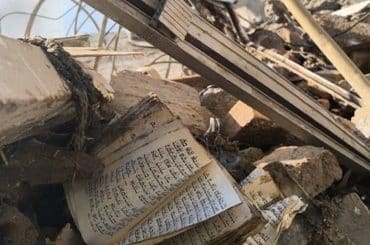
Zionist genocide against Palestinians did not start on October 7th 2024 . White racial supremacist Zionist Invaders planned genocide against the native Palestinian population since the invention of Zionism in 1881. White racial supremacist Zionist Invaders laid the groundwork for genocide during the Ottoman and mandatory times. In December 1947 the Zionist Invaders put the genocide into full operation. This genocide has never ceased. After October 7th Zionist genocide against the native Palestinian population reached Nazi Holocaust levels. Zionists have displaced Nazis in the role of ultimate Evil. Even if Hamas were to surrender, Zionist Colonial settlers would never stop commission of genocide. Because we Palestinians are descendants of Greco-Roman judeans and rabbinic Jews are not, our very existence is an existential threat to Zionist Colonial settlers.
Interesting take on this, and quite different from the Electronic Intifada’s interpretation, yesterday. They said most signs were in effect asking to let the children live. And that Dahlan’s factions seemed to be behind the few anti-Hamas slogans. That Hamas didn’t shut down such protests, could be interpreted as there being more freedom of speech in Gaza, at this moment, than in either the UK or the US.
“In Israeli media, this footage was instantly seized upon and repackaged: proof, it claimed, that Israel’s campaign was working, driving a wedge between the population and resistance groups.”
Let’s see how Israeli ( and U.S. ) media report it when Jews are critical of Israel – there’s usually a double standard. But in particular, let’s see if the media picks up on a conference of observant Jews that’s happening March 30, this weekend.
Smol Emuni US is a group of members of the observant Jewish community, committed to the foundational religious principle that all people are created in the image of God. We consider the pursuit of justice, equality, and dignity for Jews, Palestinians and all people a fundamental religious imperative. …We believe that extreme nationalism and socio-economic disparities breed racism and cruelty in the US and Israel. This conference will launch Smol Emuni US.creating a public forum for the observant community to grapple with these issues….We are working in collaboration with Hasmol Haemuni Israel, a group of activists from the religious, Haredi and Masorti community who seek to promote peace, equality and justice in Israeli society.
https://www.smolemunius.com/about
They will be showing parts of “No Other Land”. Check out the speakers:
https://www.smolemunius.com/conference
I think we have seen the last of those demos, a couple timely executions and everyone will get the message.
https://english.aawsat.com/arab-world/5126648-sources-asharq-al-awsat-hamas-executes-%E2%80%98spies%E2%80%99-after-leaders-get-assassinated