

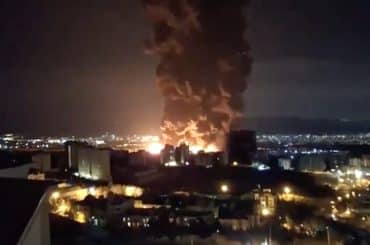
Israel announced resuming its military assault on the Gaza Strip early on Tuesday morning. The first wave of airstrikes killed over 400 Palestinians, including 130 children, and wounded more than 500, according to the Gaza Ministry of Health. The Palestinian Red Crescent Society said that several families were completely wiped out in the assault.
The renewed offensive also targeted key figures in Gaza’s civil administrative authorities, which is part of a new strategy meant to undermine Hamas’s ability to govern in Gaza by targeting “not only the military leadership of Hamas, but also its civil leadership,” according to an inside Israeli source who spoke to Haaretz on Tuesday.
In a statement, the Gaza Government Media Office mourned the killing of the coordinator of government action in Gaza, Isam Da’alis, the Deputy Minister of Justice, Mahmoud Hatteh, the Deputy Minister of Interior, Ahmad Abu Watfeh, and the head of the Security Service, Bahjat Abu Sultan.
But what explains Israel’s timing of the assault and Netanyahu’s decision to return to war amid internal pressure to continue with the ceasefire to secure the release of more Israeli captives? The circumstances surrounding the ongoing ceasefire negotiations last week offer some answers.
Getting out of a bind
Israel’s resumption of attacks on Gaza comes after almost two months of the signing of a ceasefire deal with Hamas brokered by Egypt, Qatar, and the U.S. The offensive also comes on the heels of more than a month of failed attempts to move to the second phase of the ceasefire deal, which is intended to include talks over the end of the war and the beginning of Gaza’s reconstruction in exchange for the release of all remaining Israeli captives. For weeks, Israeli Prime Minister Benjamin Netanyahu has been avoiding starting the second phase of the agreement and has continued to push for an extension of the first phase, with the objective of releasing the maximum number of Israeli captives without committing to ending the war on Gaza.
Then, in early March, Israel closed the Rafah crossing and blocked the entry of all humanitarian aid into Gaza. The impact of the closure was immediate, as prices of goods tripled across the Strip and bakeries went dark, with international organizations like UNRWA limiting the amount of aid delivered to civilians. The seven remaining partially functioning hospitals in Gaza issued warnings that they would soon stop working due to the lack of fuel to power their generators. According to the UN, hunger is beginning to loom once again for Gaza’s devastated population.
These Israeli measures, which violated the terms of the ceasefire, were seen as an Israeli attempt to pressure Hamas into making concessions over its conditions regarding the end of the war — namely, to relinquish control over the Gaza Strip and back down on its condition of a full Israeli withdrawal from Gaza, especially from the Philadelphi corridor along the Egyptian border. Netanyahu had repeated throughout the first phase of the ceasefire that he would not accept any role to be played by Hamas or the Palestinian Authority in running Gaza after the war. This rendered any postwar discussion with Hamas meaningless.
Trump’s envoy to the region, Steve Witkoff, also affirmed on February 26 that Hamas’s continued governance of the strip was “a red line” for both Israel and the U.S. Even when another special envoy of the U.S. administration, Adam Boehler, reported that Hamas was ready to discuss not only relinquishing power, but also disarming — a claim Hamas never confirmed — Israel considered Boehler’s direct talks with Hamas representatives unacceptable.
In short, Israel was pulling every trick in the book to try to postpone implementing the ceasefire in all its phases. But Hamas threw a wrench in those plans when it announced last week that it was willing to release Israeli-American captive Edan Alexander and the remains of four other deceased Israeli captives in exchange for “a clear roadmap for talks on the second phase.”
Also read: Why Hamas just agreed to release an Israeli-American captive, and why Netanyahu is furious.
Netanyahu was outraged, because Hamas was holding Israel to the ceasefire agreement that it had willingly signed. Backed into a corner, Netanyahu accused Hamas of “manipulation” and “psychological warfare,” insisting that Hamas “remains firm in its refusal and has not budged an inch.” The only way out of the bind was to blow up the entire deal.
But there are also internal political reasons underlying Israel’s renewed onslaught.
Netanyahu and his allies
Another aspect of Netanyahu’s decision to return to war concerns his internal battle with the Israeli legal and political system, as well as his constellation of far-right alliances and their demands for resuming hostilities.
Netanyahu’s far-right allies, which up until the ceasefire had made up his cabinet, considers the ceasefire in and of itself to be an unacceptable capitulation to Hamas that must be reversed. Netanyahu’s key ally, hardline Finance Minister Bezalel Smotrich, stayed in the government coalition despite opposing the ceasefire in order to secure the government’s stability. The consolation prize was the renewed onslaught on the West Bank, dubbed “Operation Iron Wall.”
But Smotrich also repeatedly said that Netanyahu promised him to resume the war, expecting an even harsher and more cruel attack on the people of Gaza that would lead to their mass displacement. Netanyahu never denied having made such promises, but even the families of Israeli captives have repeatedly accused Netanyahu of being more faithful to his promises to Smotrich than to the lives of their captive relatives in Gaza.
The other key figure of Israel’s religious right, Itamar Ben-Gvir, had quit the government following the signing of the ceasefire deal. On Tuesday, after Israel officially announced resuming the war, Ben-Gvir agreed to return to Netanyahu’s cabinet.
All these developments took place as Netanyahu continues to tighten his own control over Israel’s decision-making bodies. After the resignation of former army Chief of Staff, Herzl Halevi, Netanyahu appointed Eyal Zamir, described by Israeli reports as close to Netanyahu, to be the next army chief. Netanyahu also dismissed the head of the internal intelligence service, Ronen Barr, a day before resuming the war. Bar refused the dismissal, adding to the ongoing political crisis in Israel.
This political crisis is multi-faceted.
Firstly, Israeli leaders can’t agree on the formation of an investigative committee into the security failure of the October 7 attacks. Opponents of Netanyahu accuse him of attempting to manipulate its formation to save himself from investigation, while Netanyahu accuses his opponents of wanting to use the committee to attack him politically.
Secondly, Netanyahu himself is facing multiple accusations of corruption and a pending trial that continues to be postponed due to the war.
On Tuesday, a new hearing scheduled for Netanyahu at the Israeli court for his corruption cases was suspended due to the return to war.
Dovetailing interests
For the U.S., and particularly for the Trump administration, the Middle East agenda always seemed to be larger than Israel’s war on Gaza and Netanyahu’s political games. Trump pledged to end the war and move on to normalization agreements between Israel and Arab countries, especially Saudi Arabia. After that no longer appeared tenable if Trump were to insist on “owning Gaza” and turning it into a “Riviera” after the expulsion of its people, Steve Witkoff met Arab foreign ministers in Doha last week, reportedly agreeing to take the Arab plan to rebuild Gaza without the displacement of the population as “a basis” for reconstruction plans.
However, this larger U.S. view of the Middle East could itself be a reason behind Israel’s resumption of the war. A day before the return of Israel’s bombardment, the U.S. launched a series of strikes against Yemen, where the Ansar Allah movement (commonly known as the “Houthis”) had also resumed its attacks against Israeli and U.S. ships in the Red Sea in response to Israel’s blocking of humanitarian aid into Gaza. On Monday, Trump directly accused Iran of being responsible for Ansar Allah’s actions, vowing that Tehran will “suffer the consequences.”
Amidst the ongoing attempts to redraw the geopolitical map of the Middle East, with Israel insisting on maintaining its recent occupation of new Syrian territories and military positions in south Lebanon, the U.S. is now making a show of force against Iran. Washington’s endorsement of Israel’s renewed bombing campaign should be understood in this same context.
After more than a year and a half of Israel’s wholesale attack on their lives, Palestinians in Gaza find themselves caught in the middle of these intersecting agendas. This happens again amid a deafening silence among the international community, for whom Palestinian lives continue to be expendable.

Israel is run by ghouls and psychopaths. Israel’s demise— when it comes—will be self-inflicted as a result of its own extremism and hubris. The Palestinians and their allies have never represented, and never will, a serious security threat—and certainly not an existential one.
As vile and barbaric as Israel has repeatedly proven to be, it is the governments of Britain, France, Germany and the US that are primarily responsible for the horrors hundreds of thousands, if not millions, of children have suffered in Palestine, Syria, Lebanon, Iraq and beyond. One is always reminded of the depraved words of Madeleine Albright when asked on 60 Minutes about the death of half a million Iraqi children from US sanctions. She said it was “worth it”.
World leaders today are cowards or fascists. History won’t be kind to any of them.
P.S. Where is the ICC?