

We are not witnessing a rupture with how things used to be.
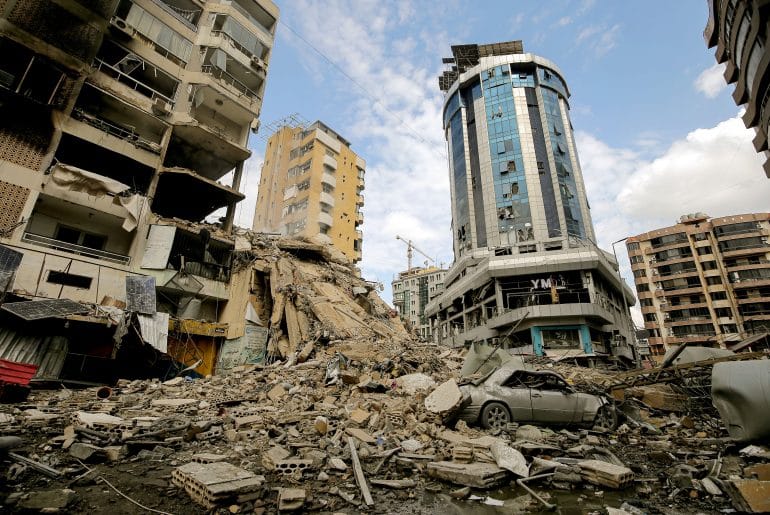
What is unfolding today in Gaza, where food aid falls from the sky like ordinance and “humanitarian corridors” double as kill zones, is not the collapse of humanitarianism, but its logical consummation under conditions of settler-colonial necropolitics.
It is tempting to read these scenes — the parachute that failed, the sacks of flour soaked in blood — as tragic malfunctions. They are not.
They are the grammar of a system that has long sutured humanitarian concern to military logistics, relief to surveillance, and aid to domination.
But something has shifted — not in content, but in form.
For decades, Israel maintained an uneasy but instrumental alliance with the architecture of humanitarianism. In the long expanse between the years following the Nakba and the siege and destruction of Gaza, this alliance operated as a double gesture: securing international legitimacy through the performance of restraint, while choreographing violence within the idiom of “security” and “self-defense.” The Red Cross, UNRWA, and a chorus of NGOs served as both witnesses and enablers, simultaneously limiting and legitimizing the occupation’s machinery.
In this war, humanitarianism is no longer simply absorbed and weaponized. It is being bypassed, discarded, and cannibalized.
The Gaza Humanitarian Foundation (GHF), Israel’s new model for aid delivery, signals this shift with brutal clarity: aid is no longer mediated through international law or the optics of neutrality, but flows through private American contractors under military command.
The new aid plan is being used by Israel as part of its demographic war in Gaza: by orchestrating aid flows into selected zones, primarily in the south, Israel is working to condense the population into increasingly narrow and governable enclaves. This forced concentration is not a consequence of war — it is the war’s strategic aim.
In other words, aid is a tool for soft transfer, pushing Palestinians into regions that can be more easily monitored, controlled, and eventually severed from any claim to the land. Starvation and desperation are not side effects, but intended effects, forcing displacement through need.
Israel simply cannot do this with the existing humanitarian infrastructure of UNRWA and the WFP. It has tried to do so over 19 months of genocide and fallen short. This is why the removal of international aid organizations signals a shift toward the unilateral management of the Strip under a new apparatus of military-humanitarian control. By sidelining these bodies, Israel makes room for a more compliant infrastructure: private contractors, militarized aid programs, and internally cultivated Palestinian collaborators who can administer local populations without challenging the broader regime of occupation and erasure.
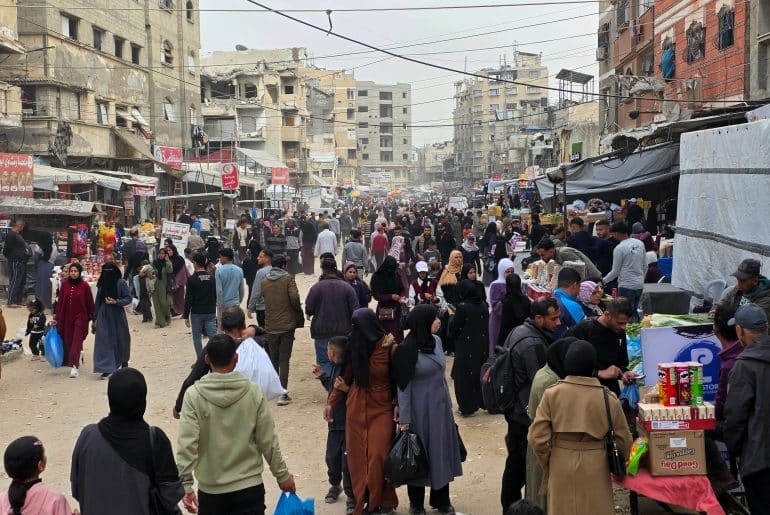
These aid distribution sites, under the guise of relief, are also choreographed spaces of entrapment, where the architecture of chaos, desperation, and humiliation is meticulously staged. People wait for hours in the scorching sun, under drones, under guns, under the gaze of an occupying army that controls what enters, who lives, and who dies. The crowd surges, the fences collapse, shots are fired, and Palestinians are killed.
The Palestinian is made visible only in hunger and at the edge of riot. In these moments, dignity is not just deferred, but is systematically stripped, replaced with the performance of disorder that justifies further killings and further control. The aid site becomes the set-piece where Israel can lure the starving into kill zones and use a loaf of bread as a pretext for a bullet.
The new humanitarianism
This inaugurates a new paradigm in which humanitarianism is no longer mediated through international law or multilateral consensus, but is now militarized, privatized, and securitized. It is disaster capitalism taken to the extreme, eroding liberal humanitarian institutions in favor of militarized neoliberal corporations.
The time is ripe for this because Israel has grown weary of performance. It no longer needs the restraint rituals, with the carefully measured body counts, the proportional language of conflict resolution, and the legal architectures erected after World War II. In their place, we find a new modality of power that openly transgresses, dares the world to respond, and thrives not on legitimacy, but impunity.
What happened in Tal al-Sultan on May 27 offered the world yet another glimpse into this emerging logic. At the launch of the GHF’s first aid distribution center, thousands of Palestinians gathered, driven by the extremity of hunger. As fences broke under the weight of the crowd, Israeli forces responded with what they called “warning shots.” By the end of the day, three Palestinians lay dead, 48 were injured, and seven others were missing. This was not the failure of humanitarian logistics; it was the logic fulfilled. The aid site became the set-piece where Israel can lure the starving into kill zones and use a loaf of bread as a pretext for a bullet.
This is not merely a new war on Gaza. It is a war on the very category of the “human” as it applies to Palestinians, and eventually a remaking that will impact the whole world. Where once humanitarian discourse functioned as the frame through which violence could be rendered legible, disciplined by legalese, and tempered by press releases, humanitarianism itself is being disposed of as a limiting condition.
This reconfiguration also entails a war against memory. International organizations, however limited, often function as record-keepers of hunger, of attacks, of displacement, and of death. With their expulsion comes the erasure of witnesses and the silencing of documentation. The absence of institutional observers allows Israel to proceed with its campaign of annihilation without the burdens of image, number, or name. This is because the presence of the UN and other aid organizations, even if partly complicit, implied that the world was still watching and that aid was still being distributed in a manner not conducive to ethnic cleansing.
Inequality of hunger
Beyond achieving its demographic aims, Israel is also utilizing the GHF as part of its policy of what could effectively be termed “inequality of hunger”: the aid provided by the GHF is woefully insufficient to meet the vast and urgent needs of Gaza’s besieged population, with the UN estimating that a minimum of 500 aid trucks per day are required to sustain basic life, while fewer than 100 are permitted entry. The deliberate reduction of aid so far below the minimum threshold of survival isn’t just arbitrary cruelty; it is meant to create the conditions for social collapse.
It’s already been pointed out that this is the use of manufactured scarcity as a bargaining chip to extract political concessions from the Palestinian resistance. But it should also be stressed that the deprivation is an instrument of social disintegration: by distributing just enough food to kindle desperation, but never enough to sustain dignity, the system manufactures moral collapse. The social fabric fractures, resulting in the slow erosion of solidarity — the final battlefield of any collective struggle.
It is one thing to have a famine, which at least means equality in hunger. It’s quite another to trickle in just enough resources to create an internal struggle that results in the cannibalization of social relations, hitting harder than any massacre.
The criminality of aid
There are, one might say, two criminalities at work in Gaza’s hunger corridors. The first is sanitized, institutional, and entirely rational, what we might call the criminality of logistics perpetrated by the colonizer. Deliberate starvation is achieved through border control, using aid as spectacle, the sealing of exits, and then the airdropping of salvation in neatly packaged boxes. This is not merely a failure of ethics but a success of policy. It is the criminality of biometric scans, of the humanitarian mask concealing the military boot, made possible by both Netanyahu’s cabinet and the likes of Trump Inc., that curious synthesis of gangster capitalism and state violence performing massacres in the name of order.
But this is not all. The organized internal collaborators, the micro-warlords who “tax” the aid and divert it before it reaches the starved, form a local apparatus of distribution grounded in theft-as-policy. This is the internalized supplement to the occupation — the colonized enforcer recruited in the midst of war to serve further social disintegration.
In this setting, the crime is everywhere: in the massacre itself, in the very architecture of aid that creates the need for it. Israel is not the sole criminal; the entire configuration is criminal, including the aid agencies, the paperwork, the silence, the drone overhead, and the collaborator on the ground.
The other “criminality” unfolds when the crowd surges, breaching the fence and reaching for what was always theirs — bread, oil, rice, the right to live. This is not looting, but the repossession of stolen sustenance. It is the planning of those without a plan, the logistics of a community erupting through the fractures of engineered despair. It is the refusal to die standing in line beneath the drones, dignity deferred.
The people aren’t a mob, but a flood — a living force breaching the containment zone of famine, liberating food from its branded prison. What Israel frames as chaos is, in truth, collective clarity.
This second criminality — the crime of survival — is incomprehensible to the humanitarian and liberal gaze. It remains illegible to institutions conditioned only to distinguish the compliant needy from the dangerous deviant. But this collective act of taking is not a cry for help, but a disruption of the very logic that made help necessary. After 600 days of massacres and destruction, the fences fell, sacks were passed between hands, and colonial time stuttered.
This, too, is what unfolded last week — Palestinians in Gaza surged through the tightly scripted scene of domination, disrupting Israel’s illusion of total control even as it outsourced its sovereignty to American private contractors. The scene itself was torn apart twice: first, when most Palestinians in Gaza did not show up, refusing even the choreography itself, and second, when the crowd surged through the fence.
This, then, is the moment we are left with: one in which Israel no longer bothers to veil its actions behind humanitarian fig leaves, but openly scorns the very language that once masked its violence. And the world is being dared — to intervene, yes, but more precisely, to confront the fact that its interventions and discourses were always part of the problem, always hollow and devoid of substance.
One could ask the liberals what remains of this language, not only in Gaza, but in the futures yet to come?
And amid all this, what remains central is that, despite everything, Palestinians still find a way — whether through deliberate planning or spontaneous rupture — to flood the infrastructure of annihilation.
Abdaljawad Omar
Abdaljawad Omar is a writer and Assistant Professor at Birzeit University, Palestine. Follow him on X @HHamayel2.

Of course this has nothing to do with ending the illegal blockade or starvation. Just like the cease fire negotiations have nothing to do with ending the war. It is just a continuation of the genocide. Complying with the Vienna Law of Treaties prohibition against negotiations concluded with threats or use of force “would cross a red line” and be “unacceptable” for US and Israeli Zionists. Those rules are only applicable to everyone else.
See: How Israel and Witkoff Are Trying to Strong-Arm Hamas Into a Deal That Does Not End The Genocide.
Gaza Freedom Flotilla Sails to Break Illegal Israeli Siege
June 3, 2025
The ship symbolizes the spirit of Palestinian resilience and the growing global resistance to Israel’s collective punishment and starvation policies, says Ann Wright.
“The Gaza Flotilla sailboat Madleen set off from Catania, Sicily, Italy on Sunday for a seven-day voyage to Gaza to break the 40-year illegal Israeli naval blockade of Gaza and now to stop the 600-day genocide of Palestinians in Gaza.
The Madleen and her 12-person crew and participants departed Sicily, about 4pm Central European Summer Time on Sunday, following four very successful community events in Catania, each event having several hundred members of the local community attending.
The Madleen, named after Gaza’s first and only professional fisherwoman, is a symbol of the unyielding spirit of Palestinian resilience and the growing global resistance to Israel’s use of collective punishment and deliberate starvation policies.
Her launch comes just one month after Israeli drones bombed Conscience, another Freedom Flotilla aid ship, in international waters off the coast of Malta — underscoring both the urgency and the danger of this mission to break the siege on Gaza.
The Israeli military bombed the Conscience as the flotilla coalition was ready to board around 35 participants onto the ship. The bombing occurred hours following the flight of an Israeli military C-130 Hercules aircraft around Malta.
In international complicity of stopping the Conscience from departing Malta, the U.S. government no doubt put pressure on the small Pacific island of Palau, which is dependent on U.S. funding through the Compact of Free Association, to cancel the flag and certification of the Conscience, which was done in the afternoon of May 1, only hours before the Israeli military bombed the Conscience.
Madleen is carrying urgently needed supplies for the people of Gaza, including baby formula, flour, rice, diapers, women’s sanitary products, water desalination kits, medical supplies, crutches, and children’s prosthetics.”
https://consortiumnews.com/2025/06/03/gaza-freedom-flotilla-sails-to-break-illegal-israeli-siege/
Zen And The Art Of New York Times Headline Writing
Caitlin Johnstone
Jun 04, 2025
“The New York Times has just published one of the most insane headlines I have ever seen it publish, which is really saying something.
“Gaza’s Deadly Aid Deliveries,” the title blares.
If you were among the majority of people who only skim the headline without reading the rest of the article, you would have no idea that Israel has spent the last few days massacring starving civilians at aid sites and lying about it. You would also have no idea that it is Israel who’s been starving them in the first place.
The headline is written in such a passive, amorphous way that it sounds like the aid deliveries themselves are deadly. Like the bags of flour are picking up assault rifles and firing on desperate Palestinians queuing for food or something.
The sub-headline is no better: “Israel’s troops have repeatedly shot near food distribution sites.”
Oh? They’ve shot “near” food distribution sites, have they? Could their discharging their weapons in close proximity to the aid sites possibly have something to do with the aforementioned deadliness of the aid deliveries? Are we the readers supposed to connect these two pieces of information for ourselves, or are we meant to view them as two separate data points which may or may not have anything to with one another?
The article itself makes it clear that Israel has admitted that IDF troops fired their weapons “near” people waiting for aid after they failed to respond to “warning shots”, so you don’t have to be Sherlock Holmes to figure out what happened here. But in mainstream publications the headlines are written by editors, not by the journalists who write the articles, so they get to frame the story in whatever way suits their propaganda agenda for the majority who never read past the headline.”
https://www.caitlinjohnst.one/p/zen-and-the-art-of-new-york-times