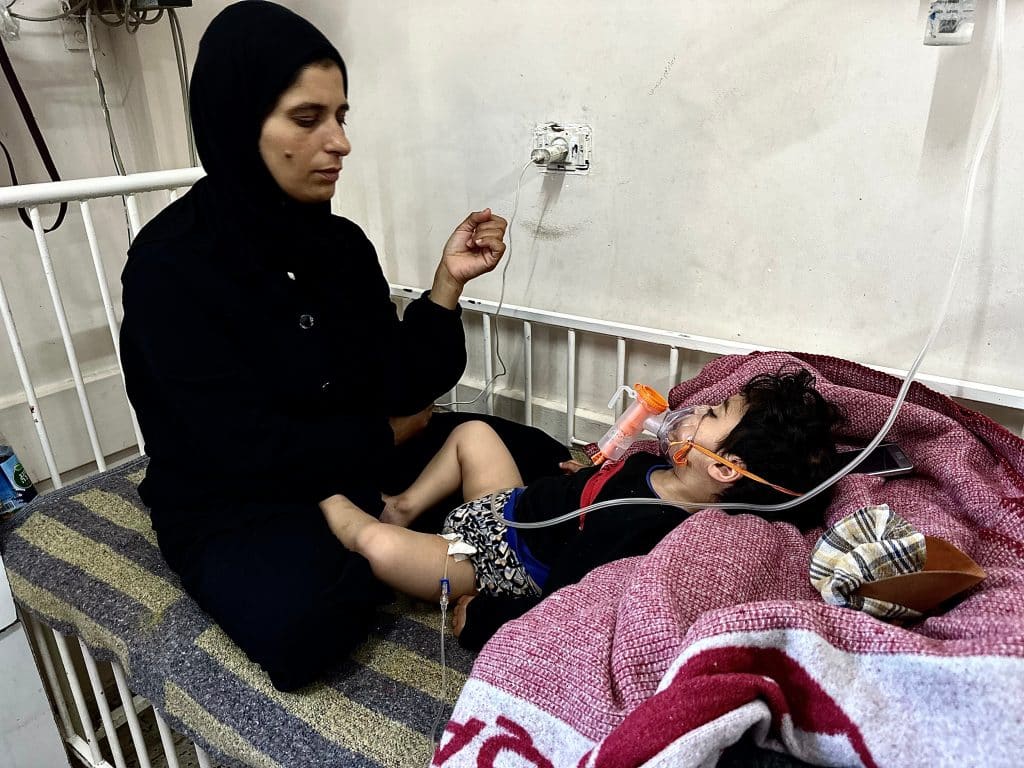
At Nasser Medical Complex in Khan Younis, Manal Zaqout accompanies her 6-year-old daughter, Aya, for treatment. Aya had been moved to the hospital from the al-Mawasi areas east of Khan Younis after a continuous cough, fever, and fatigue that refused to resolve itself. The child was diagnosed with the flu, but the symptoms were far more severe than regular influenza.
On Sunday, the Gaza Government Media Office said that a “new strain” of the virus is spreading across Gaza amid a severe shortage in medicines due to Israel’s blockade of humanitarian assistance to the Strip.
“The rapid spread is attributed to extreme overcrowding, lack of water and ventilation, and the deterioration of healthcare services due to the war, in addition to restrictions imposed by the occupation,” the Government Media Office said in the statement.
Manal does not believe that her child, who suffers from malnutrition, is experiencing any normal flu — the symptoms Aya has been exhibiting are far more complicated than anything else she’s seen her daughter weather.
“We know the flu,” Manal tells Mondoweiss. “We know how to deal with it. We know how it affects people. We can keep it at bay with simple medications and warm fluids.”

Dr. Ahmad al-Farra, the head of pediatrics at Nasser Hospital and a representative of the Ministry of Health at the medical complex, told Mondoweiss that seasonal diseases had never become this life-threatening for patients before the war.
But current conditions, especially famine and widespread malnutrition, have turned routine illnesses into life-threatening conditions, al-Farra said, especially for children, the elderly, and those with preexisting conditions.
“Usually, we see about ten people per day complaining of a viral infection during the flu season,” al-Farra said. “But today, on September 2 alone, Nasser Hospital received over 140 patients in the pediatrics department, all of them with viral infections.”
“We’re talking about ten times more respiratory illnesses,” he said, describing the numbers as “unprecedented.”
Al-Farra said that the Ministry of Health could not be sure of the type of virus due to the scarcity of tests. “The circulating virus is an influenza virus, but we can’t determine whether it is COVID or some other strain. We don’t have PCR or RT-PCR tests,” he explained. “So we treat it as an influenza virus based on our clinical exam in children.”
Al-Fara pointed out that patients have presented with inflammation in the upper respiratory tract, which then descends to the lower respiratory tract, accompanied by a severe cough and “bronchial weakness.” Sometimes, al-Farra added, gastrointestinal symptoms such as diarrhea, fever, and general fatigue were present.
“These seasonal diseases can affect anyone, but infants and the elderly are the most vulnerable,” al-Farra said, stressing that the famine in Gaza is the major contributor to the observed skyrocketing of infections.
What famine does to population-level immunity
“The danger of the virus lies in the lack of food supplies, severe famine, and the lack of hygiene kits, disinfectants, and sanitizers,” al-Farra said. “The spread of the virus is also exacerbated by extreme overcrowding in displacement centers that lack basic hygiene. Furthermore, the anxiety experienced by residents affects the immune system, making children more susceptible to the disease.”
In its daily report for September 2, the Ministry of Health stated that since the declaration of famine in Gaza by the UN-backed Integrated Food Security Phase Classification (IPC) on August 22, 83 people have died due to malnutrition, including 15 children. The Ministry added that during the last 24 hours, 13 people had died of malnutrition, raising the malnutrition death toll from the start of the war to 361, including 130 children.
The report published by IPC, which is the largest famine-monitoring body in the world, said that over 500,000 people in the Gaza Strip, roughly a quarter of the population, were either close to or had already reached “catastrophic levels of famine” (IPC Phase 5).
Earlier in July, the Government Media Office stated that 40,000 infants in Gaza suffer from malnutrition, while 250,000 children under the age of five face “severe food shortages,” and over 1.2 million children are experiencing “acute food insecurity.”
“Before the war, these viruses came every year, and they used to cause death to the elderly and those with chronic diseases like diabetes, high blood pressure, and lung diseases,” al-Farra said. “But this year, it comes amid the food insecurity and the unavailability of food, which is essential to fighting viruses.”
Al-Farra explained that malnutrition and severe food insecurity are the first factors that lead to protein deficiency, which is vital to fighting illness.
“All components of the immune system depend on protein,” al-Farra said. “Including white blood cells, the enzymes that aid them, and inflammatory mediators like cytokines and interleukins, which activate and drive white blood cells.”
Al-Farra added that the second factor affecting immunity is vitamin deficiency, which is obviously widespread during a famine and in places experiencing acute food insecurity.
Finally, al-Farra said that nutrition in and of itself is important to maintaining the vitality of the skin, the respiratory system, and mucous membranes, which are important for fighting viral and bacterial infections. Therefore, viruses or bacteria can easily enter the body through the mucous membranes when nutrition is unavailable.
“In the face of famine and malnutrition, we expect a greater prevalence of viral and bacterial diseases,” al-Farra said, adding that the deaths from respiratory illnesses exacerbated by the famine are expected to rise.