
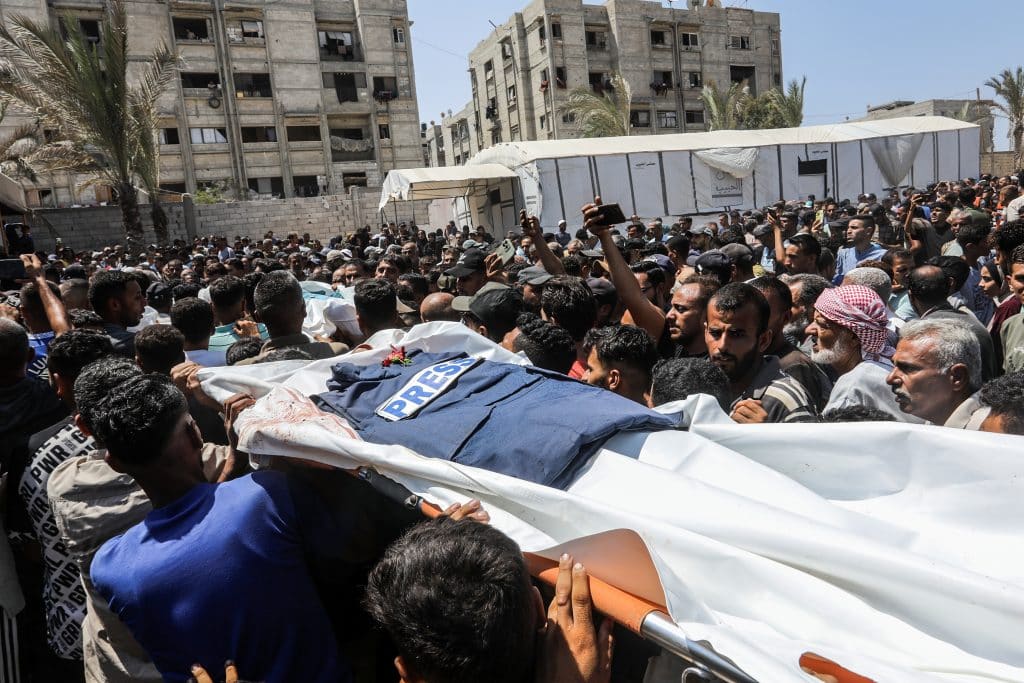
On August 25, Palestinian journalist Adli Abu Taha called his brother Moaz, also a journalist, minutes after news broke of an Israeli strike on Nasser Hospital in Khan Younis, southern Gaza. Moaz was there.
“I’m fine, but Hossam Al-Masri was just killed,” Moaz told his brother, who urged him to leave the site. Moaz reassured him that he would leave shortly, but wanted to finish filming the aftermath of the strike, which was on an outdoor stairwell. Minutes later, a second Israeli strike hit the stairwell, killing Moaz.
A total of five Palestinian journalists were killed on that day.
Moaz Taha was 27. A talented freelance videojournalist, he was passionate about his work. He had been filming the aftermath of the Israeli strike that killed Hossam al-Masri, a 49-year-old photojournalist who was operating a live feed for Reuters. When an Israeli tank fired the first shell, Reuters said that the live feed “suddenly shut down.”
In December, Hossam was covering Israel’s siege of Nasser Hospital and was among the last to leave. As Hossam continued to cover the genocide in Gaza, he carried a personal agony. His wife had been suffering from cancer, and the lack of medical treatment in Gaza due to the Israeli blockade and destruction of the health sector worsened her condition. His colleague, Palestinian journalist Amr Tabash, recalled on Instagram how a few days before he was killed, Hossam asked him to help evacuate his wife to get the treatment she needed. Hossam’s wife remains in Gaza with their children.
In the same strike, Palestinian freelance journalist Mariam Abu Daqqah was killed. A 33-year-old mother, Mariam worked for various outlets, including the Associated Press and The Independent. Her brother, Sudqi Abu Daqah, told the Arabic edition of The Independent that Mariam used to visit the displaced encampments in Gaza. Whenever she could, she would buy pencils and notebooks for the orphaned children in the encampments.
At night, Mariam would often look at her phone and cry as she kissed the picture of her son, Ghaith, who was 13. She had managed to evacuate him out of Gaza to go live with his father in the United Arab Emirates. Sensing the rising Israeli targeting of journalists, Mariam wrote her will to her son in advance: “Don’t cry for me, but pray for me. Keep up with your studies and grow up to be successful.”
At the moment of the Israeli strike, another young journalist, 24-year-old Muhammad Salama, was killed. He had made his way into his profession with considerable personal struggle, having lost his mother as a child and living with his father’s relatives until he graduated from a vocational college with a photography diploma. He followed veteran photojournalists and learned from them as he honed his skills. He was one of the few journalists left in Khan Younis after the first Israeli invasion of the city in December 2023. He joined Al Jazeera in February 2024.
Last November, on his birthday, Muhammad got engaged to his colleague and journalist, Hala Asfour. They both hoped to marry once there was a ceasefire.
These are some of the over 250 Palestinian journalists that Israel has killed in Gaza since the beginning of its war on the Strip in October 2023. But Israel’s targeting of Palestinian journalists didn’t begin in 2023. It didn’t begin with the killing of veteran Palestinian journalist Shireen Abu Akleh in May 2022 in Jenin. And it didn’t even begin with the killing of Gaza photojournalist Yasser Murtaja during the Great March of Return in April 2018.
Israel’s policy of targeting Palestinian voices has gone on for decades. Israel’s first-ever targeted assassination of a Palestinian was of a journalist and a writer. His name was Ghassan Kanafani.
On the morning of July 8, 1972, Kanafani entered his car in the Hazemiyah neighborhood of Beirut and turned the key in the ignition, triggering the bomb that Israeli agents had planted in the vehicle and blowing his body to pieces. Kanafani was accompanied by his niece, 17-year-old Lamis, who was also killed in the assassination.
Kanafani, now a towering figure in Palestinian literature and political history, was also one of the earliest Palestinian proponents of what is today regarded as “committed journalism” — journalism in the service of the cause of liberation. But this tradition only began with Kanafani. It was picked up and taken to heart as a model to be emulated by entire generations of Palestinian writers, intellectuals, and journalists. Many of them are in Gaza today, carrying on Kanafani’s legacy and giving their lives in the service of their people.
This is an excerpt of a forthcoming essay on Palestinian journalists and their reflections on what it means to work in their profession in a time of genocide.

This is HEROISM.