

A few days before the genocide began, I had a visa to enter the UK. I was happy and beyond excited, as I was planning on going to London to represent Mondoweiss and talk about the stories I tell. I was excited to meet some of my readers and to engage with the audience that follows my stories. I felt secure in the idea that I would briefly leave my wife, son, and elderly mother behind in our large family home. They were surrounded by loved ones, and I wouldn’t be away for more than two weeks.
Then the war came, and it changed everything. The crossings were closed overnight, and the primary concern of people in Gaza became survival and finding enough food and water.
From the second month of the war, all of us realized that this war was completely different from anything we’d experienced before. We were sure of it when the Israeli army insisted on evacuating the entire northern half of Gaza, which included our home.
Now, the family home we once had, the window I always woke up beside, the lemon, olive, and fig trees that surrounded our building — all of it is gone now.
At the beginning of the war, I did not think of leaving Gaza. As Palestinians, we know what exile means. But this changed after my mother fell ill. She was hospitalized and died shortly thereafter because treatment was unavailable. What my mother needed was so simple: a few dietary supplements and some medications would have been enough to save her life. I scoured the entire area between Rafah and Khan Younis in an attempt to find them. I failed.
That made me think: what if I fail in finding food for my son tomorrow? Would I be able to watch him die of hunger before my eyes, just as I watched my mother die of illness? How much was I willing to keep facing this fate, again and again, until I have no one left? I decided then and there that we must survive.
My son hadn’t turned one yet. He had committed no sin to deserve this fate. Why should my child and all the children of Gaza live under these harsh conditions? Surely, if I took him away from his homeland so he could be safe, it wouldn’t be a crime, would it? Surely this wouldn’t be considered a betrayal of our homeland?
Leaving Gaza was the hardest decision of my life. After much hardship, we were finally able to secure passage to Egypt, where we spent a year and a half. Exile set in, settling in our minds and making itself felt in every step.
But I wasn’t the one who was most affected by our displacement. It was my son.
Whenever I look at my son, I know he will never again have the love we left behind in Gaza.
He’s two-and-a-half now, and he’s never had the chance to get to know his neighborhood or grow up with his cousins. He’s never run out to the street to play with the other children in the neighborhood. He never got to stroll through the market with me or to tag along on family visits. I couldn’t even celebrate his first birthday in our home. I had a huge party planned, but we ended up celebrating it in an abandoned home in Yibna refugee camp, whose glass was broken in the dead of winter. My son has no friends. He hasn’t been able to find even one in exile to visit and play with. We’re his only friends, myself and his mother, and my son was robbed of his childhood.
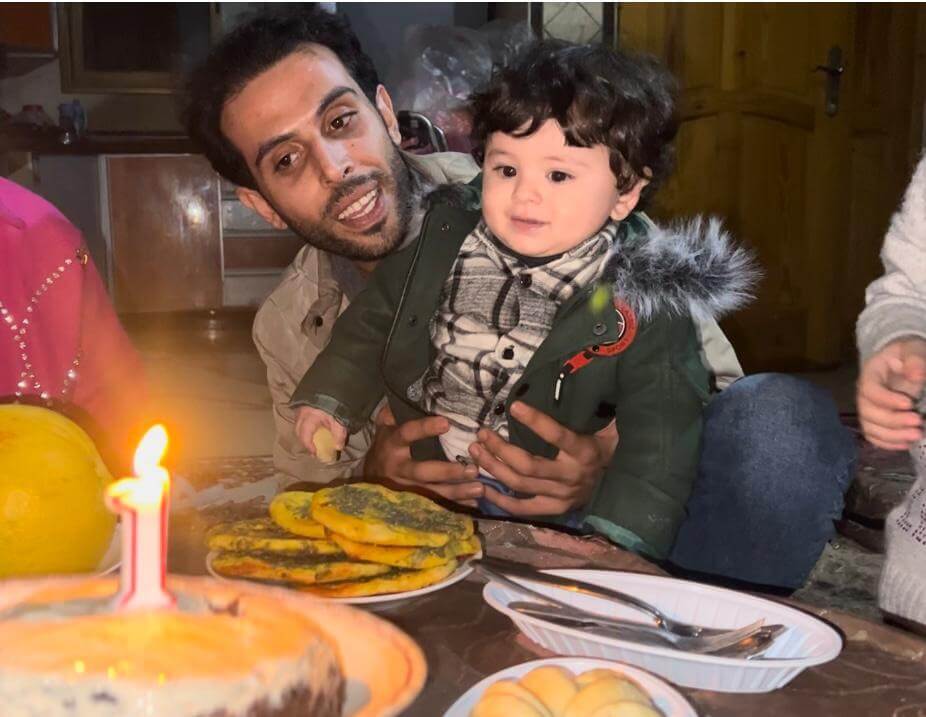
It drives me mad with guilt, even if that was the price of survival. My child is now alone after having been surrounded by a family that was his world — aunts, uncles, cousins. His older cousins used to come over day after day to play with him and his toys. Now, whenever I look at him, I know he will never again have the love we left behind in Gaza.
Being forced to leave behind your home, your siblings, and countless loved ones carries a finality that is too much to bear. Gaza is the only place in the world where he could have found that kind of love, and we left it behind.
Now, I talk to him about Gaza and browse the photos that connect us to home, where our whole lives have been spent. I showed him picture after picture and explained a great deal. I tell him: Look, this is Gaza! This is our home, our land. We’re going to return one day. I try not to show him the images of destruction. We always watch the news on television, and whenever a report comes on, we remember and talk about Gaza and all the areas that appear on the screen.
He has picked up all these words while sitting with us. When he sees destruction on the TV screen, he loudly says: “Gaza, Gaza, our home.” But I don’t want him to think of Gaza as a place of death and destruction. It is the most beautiful place on earth.
For long months, I often thought twice before eating anything: I told myself that my family back home is unable to find a piece of bread right now.
What is strange is that we are the owners of the land. Every time I discover a new country, I realize that the land from which we were driven out is the most remarkable and ancient of lands in the world. It is a place blessed with geographical and natural diversity. We have everything, from the mountain against the sea to the rolling fields, thick forests, and sprawling deserts. We have everything that makes us the owners of a free country. The only thing stopping us is the occupation.
Whenever we watch the news, we thank God that we survived. And we regret it every day.
Tareq S. Hajjaj
Tareq S. Hajjaj is the Gaza Correspondent for Mondoweiss and a member of the Palestinian Writers Union. Follow him on Twitter/X at @Tareqshajjaj.


https://www.ynetnews.com/magazine/article/rkvuwyb6gl
𝗔𝗯𝗲𝗱, 𝗮 𝗠𝘂𝘀𝗹𝗶𝗺, 𝗮𝗻𝗱 𝗬𝘂𝗹𝗶𝗮, 𝗮 𝗝𝗲𝘄, 𝘄𝗲𝗿𝗲 𝗽𝗹𝗮𝗻𝗻𝗶𝗻𝗴 𝘁𝗵𝗲𝗶𝗿 𝘄𝗲𝗱𝗱𝗶𝗻𝗴. 𝗧𝗵𝗲𝘆 𝘄𝗲𝗿𝗲 𝗺𝘂𝗿𝗱𝗲𝗿𝗲𝗱 𝗼𝗻 𝗢𝗰𝘁𝗼𝗯𝗲𝗿 𝟳.
Yulia Cheban (24) and Abed Al-Rahman Al-Ziadna (26) were murdered in the October 7 massacre at the place they loved most – the sea.
In videos the couple filmed at Zikim Beach after a romantic night, the “Red Alert” siren can be heard, followed by Abed calling out to his beloved. In the background, gunshots are heard, followed by Abed’s voice saying, “It’s war.”
At 6:30 a.m., Abed texted his family that rockets had begun. 15 minutes later, the line went dead.
According to witness accounts and evidence found at the scene, Abed was murdered in his car. He tried to help other civilians escape, as the back seat was also covered in blood – not his own.
Abed’s body was identified first; ten days later, Yulia’s was found.
They had been together for three years and were planning to get married. They loved exploring Israel, but most of all, they loved the sea: camping under the stars or diving in the Red Sea.
Their story is also a story of love. Abed’s father, Atef, said:
“Love doesn’t distinguish between a Muslim and a Jew. We live in one country and must protect one another. There is no ‘Jew’ or ‘Arab’ — we all share the same blood; we are all the same.”
May their memory be a blessing