

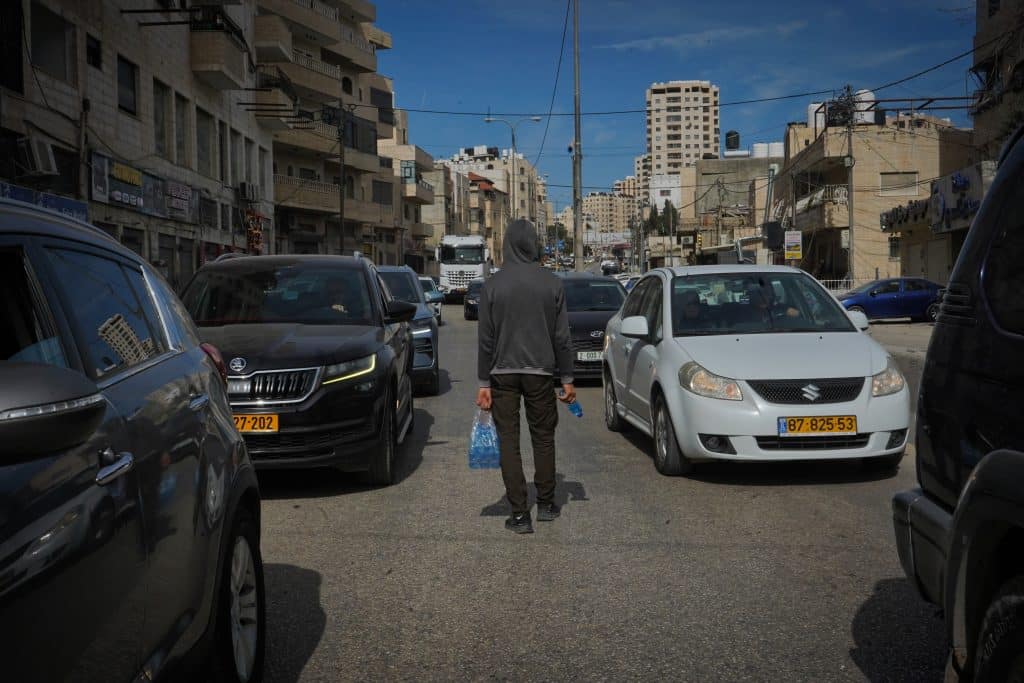
The entrance to Qalandia refugee camp is quiet and nearly empty of people on a late Friday morning. Located just north of Jerusalem, the camp announces itself with the blue iron fence of a UN Relief and Works Agency school and a series of painted murals along its outer walls. A few dozen meters past the entrance, the stillness gives way to the low bustle of daily life. For seven decades, this corner of Palestine has welcomed visitors in a perpetual state of suspension, neither fully settled nor in motion.
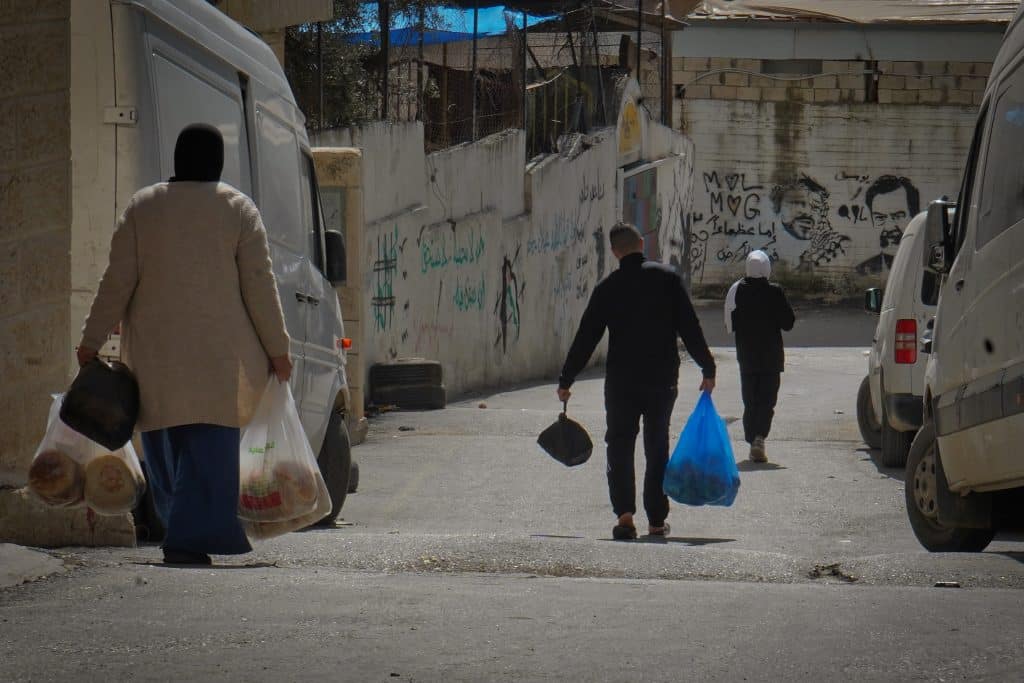
Vendors have turned a side of the street into a popular market, selling vegetables, fruit, and home accessories. Deeper in, men, women, and children form queues outside local food vendors waiting for their plate of hummus or bag of falafel. Others walk back home in the narrow side streets and alleyways carrying bags of groceries. Children stop along the path to play as older men stand in front of the large mosque door, chatting as they wait for the start of the weekly prayer.
It is hard to detect, but underneath the seemingly normal routine, there’s a palpable sense of anguish. The unease is shaped by years of accumulated collective trauma for a community perpetually in the crosshairs of Israeli settlement expansion, its future uncertain, its residents still absorbing the shock of the most recent military campaign.
In late December 2025, the Israeli army launched a wide-scale demolition campaign in Qalandia refugee camp and the neighboring town of Kufr Aqab, destroying dozens of Palestinian businesses and structures. A month later, in late January 2026, the campaign resumed, claiming even more structures.
The objective of the operations was to clear an entire area adjacent to the Israeli separation wall of the presence of any Palestinians. Dubbed “Operation Capital’s Shield” by the Israeli army, it was the largest incursion into the area in years. The Israeli army described it as a “law enforcement” operation targeting structures built near the wall that allegedly allowed Palestinians to cross illegally into Jerusalem. But Palestinians see these operations as part of a broader effort to separate Palestinian communities in Jerusalem’s periphery from the city itself, and to consolidate new Israeli settlements between Jerusalem and its Palestinian hinterland to the north.
Established in 1949, Qalandia refugee camp was named after the Palestinian town of the same name, which is today separated from the camp by the apartheid wall. The camp is confined to a tiny urban expanse directly adjacent to the larger town of Kufr Aqab, itself akin to a dense forest of residential towers straddling both sides of “Al-Quds Street,” which connects Jerusalem to Ramallah.
In a not-so-distant past unknown to the younger generation of Palestinians, buses used to leave Ramallah through this same road and arrive at Jerusalem’s iconic Damascus Gate right outside of the Old City in under twenty minutes. Now, both Qalandia refugee camp and Kufr Aqab remain separated from the city by the wall, even though they are legally part of Jerusalem. The Palestinian Authority (PA), present just ten minutes away in Ramallah, doesn’t have jurisdiction here, but the Israeli municipality of Jerusalem is mostly absent as well. This has turned this vast urban jungle into a no-man’s-land.

Here, there are no municipal services, no urban planning, and no security presence aside from the Israeli army’s regular raids to arrest Palestinians or demolish property.
Ahmad Hamad, a local resident of Qalandia refugee camp, recalls the demolition of his small business in early January. “I was working in my convenience store, near the Jerusalem road, when the occupation forces began to raid Qalandia and fire tear gas and stun grenades,” Hamad says. “I immediately began to close the store, but there wasn’t enough time. The soldiers arrived too fast and detained my employees. Then they searched the store and confiscated all the cigarettes that were up for sale, and after that, a bulldozer began to demolish the external part of the store.”

In total, Hamad lost around 150,000 shekels ($50,000). The store was the only source of income for himself, his family of six children, and his 12 employees. “I am going to need at least five years to recover,” he says.
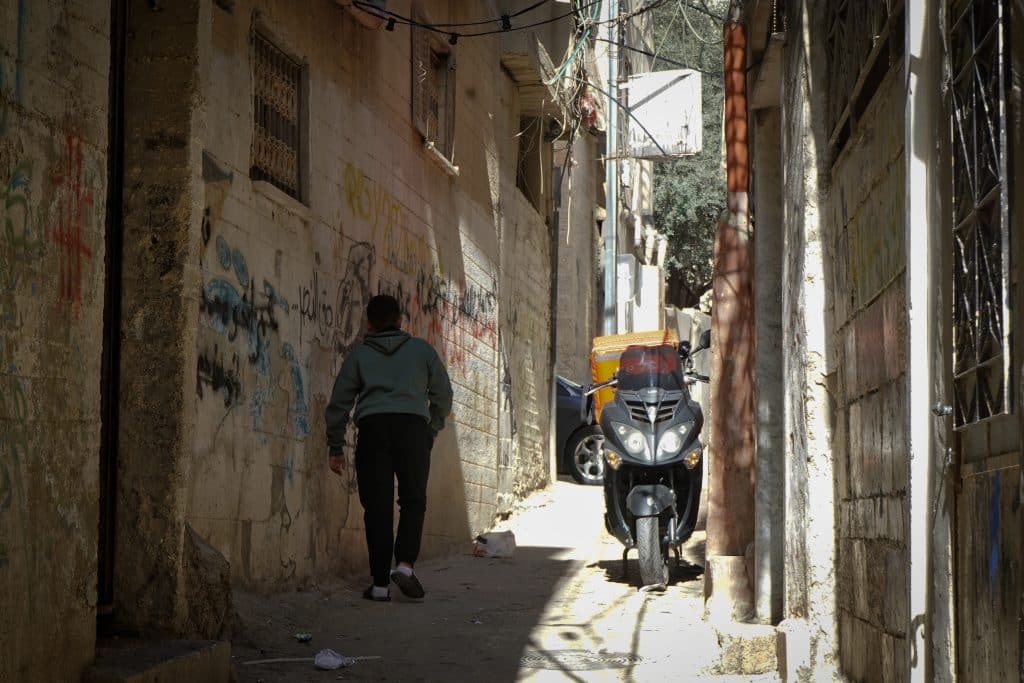
Hamad relies on individual delivery workers to take groceries to homes in the camp. In the inner alleys, a motorbike with a delivery basket can be seen on every other corner, resting beside a house door, as it would on a Friday morning when the shops are still closed.
Hamad notes that the demolitions increase pressure on residents and make life impossible for them over time. “People here are living in constant worry that their businesses will be next,” he said. “But also that these demolitions will extend to homes, and that we will be unable to keep living here.”
The plan for ‘Greater Jerusalem’
The recent Israeli demolition campaign comes amid the renewal of discussion by Israel’s Jerusalem Planning Committee of an Israeli settlement project in the area. The discussion over the project was renewed in early January, but it has been in the pipeline since at least 2018. It would see the construction of 9,000 housing units in the area of the old Jerusalem airport on the lands of Qalandia, separated by the wall from its neighboring refugee camp. Last week, the Planning Committee deferred the final approval of the project.
On Monday, Israeli daily Yediot Ahonot reported that the Israeli government is considering starting a project to build a “neighborhood” for religious Israelis that would expand the existing settlement of Adam, just 3.5 kilometers away from Qalandia. This would be a different project from the planned settlement, which is also supposed to house religious Israelis. Both projects further separate Palestinian towns like al-Ram and Qalandia from Jerusalem, completing a belt of Israeli settlements that would keep those communities trapped.
Khalil Tafakji, an expert in Israeli settlements, told to Mondoweiss that “these are two different projects that complement each other, and they are part of the larger Israeli ‘Greater Jerusalem’ project.”
However, Tafakji explains that the Israeli vision of a “Greater Jerusalem” includes the expansion of the Jerusalem municipal limits into West Bank territory, which continues to be under the jurisdiction of the Israeli army and the Israeli Ministry of Settlements. “This means that the project needs a Knesset decision before implementing it on the ground, and this hasn’t happened yet,” he says.
According to Tafakji, the Israeli media reports are not an indication that a new decision has been taken, but rather that the project is “on the table.” Yet an indication of its continued salience can be gleaned by Israeli settlement watchdog Peace Now’s description of the project as an expansion of Jerusalem’s municipality into the West Bank. It is being justified under the guise of adding neighborhoods to existing settlements, but this is a form of “de facto annexation through the back door,” Peace Now says.

Official or not, the Israeli settlement project north of Jerusalem is advancing, and it passes through the front door of more than 180,000 Palestinians in Kufr Aqab, al-Ram, Shu’fat, and Qalandia. In these no-man’s-lands, the technical distinctions between official and de facto annexation are drowned out by the rumble of Israeli bulldozers. Most importantly, all of it happens with the fate of the northern West Bank’s refugee camps — which have been completely depopulated and have been prevented from returning for over a year now — hovering in the backdrop.
“When the latest wave of raids began in late December, I immediately thought of Jenin and Tulkarem, and felt that our turn had come,” a resident of Qalandia in her late twenties, who preferred to remain anonymous, told Mondoweiss. “I began to think of what we will do, where we will go, especially with the children in our extended family. And I found it very difficult to talk to my parents about the real possibility. I knew that everybody was having the same thoughts.”
The general feeling among residents, she said, was that “all of this is only the beginning,” and that “more raids and demolitions will follow.”
“Many of the businesses deemed illegal are owned by people in Qalandia and Kufr Aqab. Oothers are owned by Palestinians who live in Jerusalem, but the shops are run by locals. They’re the only outlet for people here due to the exclusion they face in both Jerusalem and Ramallah,” the resident said.
“Especially us refugees in Qalandia, we’re forced to live in the camp and only those who earn enough money move out,” she explained, adding that the way the economy is structured in Ramallah excludes them.
She points out that many young men can’t finish their studies because they are detained and arrested several times over, and the only way for them to make a living is to open a small business. Yet obtaining the requisite permit in Ramallah is difficult. “Small businesses here depend on the local population to the point that most young people don’t even go to Ramallah to hang out,” she says.
Since October 2023, the Israeli government has advanced its settlement expansion projects in all of the West Bank. Last week, the Israeli cabinet approved the final draft of a bill that would transfer civil authority in several parts of the territories controlled by the Palestinian Authority to the Israeli army’s Civil Administration. It would also facilitate the purchase of land by Israelis in all of the West Bank.
Even if the north of Jerusalem is in many ways a no-man’s-land, it is included in Israel’s annexation ambitions. That is the broader context of the demolition work in these peripheral zones, carried out under the pretext of illegality. “These structures are illegal, but was it legal to expel us from our homes on the other side of the wall and force us to be refugees?” the Qalandia resident exclaims. “The occupation threw us here, and now it’s punishing us for it. Even worse, it’s treating us as an obstacle to its settlement projects.”
“Qalandia and Kufr Aqab are their own world, with its own laws,” she reflected. “But it’s because we have been forced to live like this.”
Qassam Muaddi
Qassam Muaddi is the Palestine Staff Writer for Mondoweiss. Follow him on Twitter/X at @QassaMMuaddi.
Maybe we should start referring to these refugee camps as “Palestinian ghettoes” the message might get through.