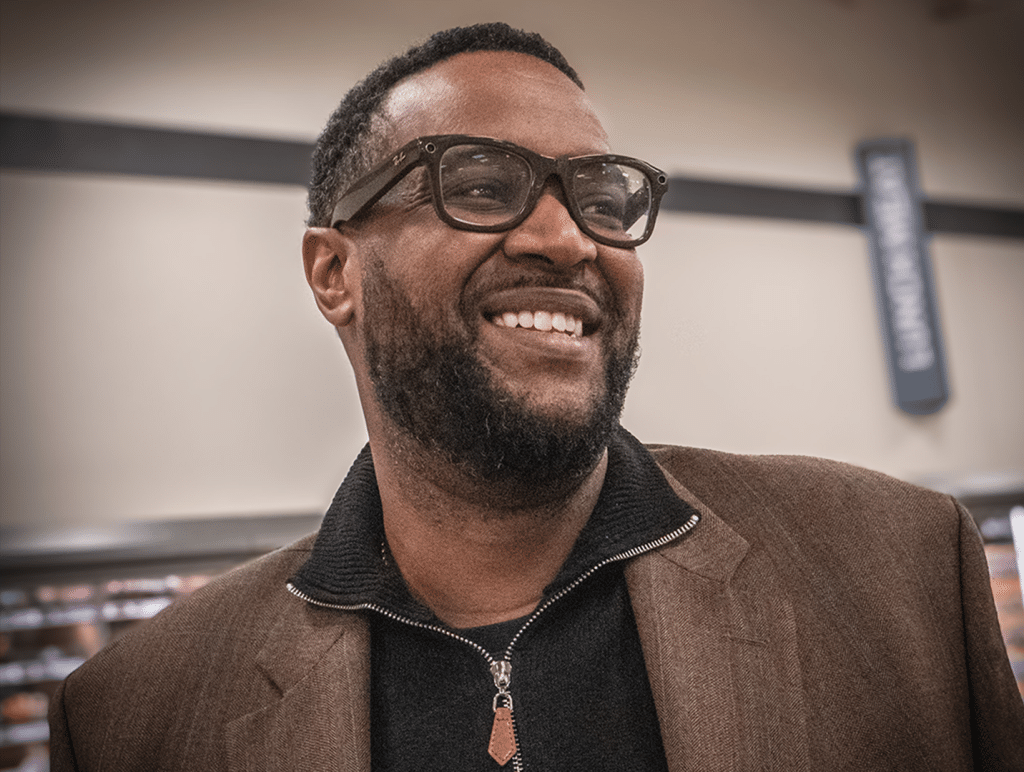
Having come from a long line of Baptist preachers and civil rights activists, Damon Lynch IV had often heard friends and family members say they were drawn to their service by “a calling from God.”
At age 41, Lynch himself had never felt a particular calling until a cold day in October when he decided to challenge incumbent U.S Rep. Greg Landsman in the May 5 Democratic primary.
Like many progressives in the Cincinnati-based district, Lynch said he was fed up with Landsman’s record of unquestioning support for Israel, including $31 billion in U.S. aid for Israel’s genocide in Gaza, while shortchanging Americans who struggle to pay for housing, health care, gas and groceries.
The war in Iran is bringing Lynch’s message home to millions of American families as hostilities enter their third week and Iran continues to block the oil lifeline through the Strait of Hormuz. Gas prices are up 32 percent, or nearly a dollar a gallon, with the next wave of inflation expected to hit groceries as the cost of oil-based fertilizers and transportation climb. Meanwhile, U.S. expenditures for the war have reached nearly $13 billion with the Pentagon asking Congress for $200 billion more.
Landsman has been at the forefront in pressing for the war against Iran. He was one of just four Democrats in Congress who voted against curbing Trump’s war powers in the Middle East. On March 20, however, nearly three weeks into the war, he released a statement that the mission in Iran had been accomplished and that he now supports a resolution to stop the expansion of the war and the deployment of US ground troops.
Why did Lynch wait so long to enter the race? “I asked everyone I could think of (to run in the primary), but nobody would take the challenge,” Lynch said. “And that’s when, whatever gods may be, said, ‘It’s you.’”
After collecting enough petition signatures, Lynch registered for the May 5 primary just two days before the February 4 deadline. Soon after, he learned that two other potential candidates were in the pipeline.
Lyndsey Ferreira, a Newtown resident and disabled Navy veteran, immediately threw her support to Lynch. Jason Alghussein, a Cincinnati mural artist and digital designer with deep Palestinian roots, came on board as Lynch’s campaign manager and social media wrangler. He quickly designed Lynch’s campaign website.
Alghussein, whose grandfather Yacob Al Ghussein was a leader of the 1936 Arab Revolt, says he’s lost at least 39 relatives in the Gaza war, perhaps more. “I don’t have an accurate count because even the infrastructure for counting [the dead in Gaza] has been decimated.” He noted that Landsman was one of only 22 Democrats who voted to censure U.S. Rep. Rashida Tlaib, a fellow Democrat and the only Palestinian-American in Congress, for her floor speech criticizing Israel.
Lynch and Alghussein have less than two months to win over enough voters to beat Landsman, the favorite among the party establishment. Landsman is also the favorite of the American Israel Political Action Committee (AIPAC) and other pro-Israel donors, who collectively have donated $1.73 million to his campaign so far, according to Track AIPAC, a website that monitors pro-Israel donations to US political candidates.
The campaign plans to make the election a referendum on Landsman’s support for Israel.
Since taking office in 2023, Landsman has visited Israel five times, including a visit in August 2023 sponsored by an AIPAC affiliate to meet with Israeli leaders. Landsman is a 2015 graduate of the Wexner Heritage Program, a two-year leadership training program for Jewish North American volunteers sponsored by controversial billionaire Les Wexner, the Columbus retail magnate and one-time financial enabler of Jeffrey Epstein. Eliot Brandt, the CEO of AIPAC, is also a graduate of the Wexner program.
The program’s values statement says in part: “We thoughtfully stretch Wexner cohorts across a wide range of viewpoints about what will best strengthen our Jewish future. We invest in individuals seeking to contribute to a professional, fully representative, and collaborative civil service in the State of Israel.”
Landsman’s campaign office did not respond to requests for an interview.
As of March 10, Lynch said he had raised about $20,000 in small campaign donations. He said he is not discouraged, however, especially since his volunteer numbers are growing. More than a hundred have signed up so far with the aim of doing door-to-door campaigning, Lynch said.
“I know that Greg Landsman has a lot of money in that campaign account, and he’s got a big war chest,” Lynch told Mondoweiss. “But I genuinely believe that the people are behind us. And we have the enthusiasm of the people. There is no amount of money that can go up against that.”
Does Lynch have a chance?
Political analysts like David Niven of the University of Cincinnati say no. “With the wind at Democrats’ back and an incumbent Democrat in office, this is not going to be a seriously contested district,” Niven said. “The formula for beating a House incumbent really requires that that House incumbent be asleep at the wheel, and that’s not the case here. “
Lynch thinks otherwise. “Our strategy is this: every week, Donald Trump and Greg Landsman give us a reason to protest,” he said, citing in particular the expense and risks to the U.S. of the ongoing war with Iran. Lynch said donations to the campaign picked up in early March after two U.S. missile strikes on a girls’ school in Iran killed 175 people, many of them children.
“Our strategy is to find the disgruntled, to find the progressive movement in Cincinnati, and we’ve been doing that,” he said. “Surprisingly, it’s been hard for us to find people who don’t like us.”
America, now nearly $40 trillion in debt, has spent more than $8 trillion on wars in the Middle East and surrounding regions since the 9/11 attacks in 2001, including the unsuccessful regime change operations in Afghanistan and Iraq.
“Meanwhile, there’s war at home,” Lynch said. “There’s a war on affordability. There’s a war on healthcare. There’s a war on working families. There’s a war on unions. And we don’t even blink at those things. But when they need money over there, (Congress is) signing off on it. Billions at a time.”
At least one Washington political observer said he wasn’t surprised by Lynch’s growing support. The pro-Israel lobby “is losing its grip on the Democratic Party” and its funding for candidates is “becoming a liability,”said Craig Holman, a congressional lobbyist for Public Citizen, a nonprofit consumer advocacy group. Netanyahu’s brutality “has cast a very negative light on Israel, initially among young voters… But now it has spread throughout much of the Democratic Party.”
Holman noted how AIPAC’s strategy backfired in New Jersey’s Democratic primary in February for the House seat vacated by newly-elected Gov. Mikie Sherrill. United Democracy, a super PAC affiliated with AIPAC, spent $2.3 million in the final weeks of the primary to defeat frontrunner Tom Malinowski, all because he dared to say he would condition U.S. aid to Israel. But instead of paving the way for its own Democratic candidate, Lt. Tahesha Way, United Democracy’s attack ads allowed an even more anti-Israel candidate to be nominated, Analilia Mejia, a progressive Democrat and the only candidate to call the war in Gaza a genocide.
Backing from AIPAC and its affiliated organizations and mega-donors used to be the norm for Democratic candidates, Holman said, but “now endorsements from AIPAC or even financial support from AIPAC is considered a liability in many, many races.”
As of March 2, Track AIPAC listed 74 Senate and House candidates who had vowed to reject donations from AIPAC and any other major pro-Israeli donors. Some of them have already been winners with the help of Track AIPAC endorsements.
In recent Texas congressional races, Greg Casar, Frederick Haynes, and Tonya Lloyd all won their party’s nominations while a fourth endorsed candidate, Maureen Galindo, advanced to a run-off. In Arkansas, Robb Ryerse clinched the Democratic nomination. And, in North Carolina, Ashley Bell won the nomination while Nida Allam came within 1,200 votes of defeating incumbent Valerie Foushee, the AIPAC and Big Tech favorite.
An NBC poll released March 16 found that more American voters now view Israel negatively than positively, a reversal from just a few years ago before Israel began its crushing and unrelenting response to the Hamas Oct. 7 attack. The about-face has been especially strong among independents and Democrats, fueling contested congressional primaries like the one in Ohio and potentially shaping the party’s 2028 presidential race.
For the 2026 election, Ohio Republicans re-gerrymandered the First Congressional District, carving the city of Cincinnati from the rest of Hamilton County and adding the Republican-leaning counties of Warren and Clinton. “The Black vote is intact,” Lynch said, knowing it will be one of his strengths in the upcoming primary.
Although Lynch has never run for public office before, his grandfather, Damon Lynch Jr., marched alongside Martin Luther King Jr. and brought King’s peaceful style of civil rights advocacy to Cincinnati. His father, Damon Lynch III, continued his father’s advocacy and has worked to stem gun violence in Cincinnati. Lynch III is pastor at the New Prospect Baptist Church in Roselawn while Lynch Jr. retired in 2022 after 52 years as pastor of New Jerusalem Missionary Baptist Church in Carthage.
Lynch IV, a small business consultant and logistics entrepreneur, doesn’t preach but he’s been active in community organizing at New Prospect, serving as its director of sustainability and creating urban farms to fight inner-city food deserts.
Besides shoring up his base in Cincinnati and visiting all 52 neighborhoods, Lynch said he plans to appear at Democratic clubs and organizations and community council meetings in Warren and Clinton counties as well. He’s already made visits to Clinton County in support of residents opposed to the development of AI data centers there.
“You know where else we’re going? To the pickleball courts,” Lynch said. “Pickleball’s an older person’s sport, and older people vote, especially in primaries.”
Lynch believes his message will appeal to both black and white working people in the district. “I’ve got a very easy product to sell,” he said. “I could be wrong, but I believe Ohioans aren’t for having our representative be more than a million dollars in the hole to another government, and us having that government take all our money to blow up some other people. That’s my belief.”