
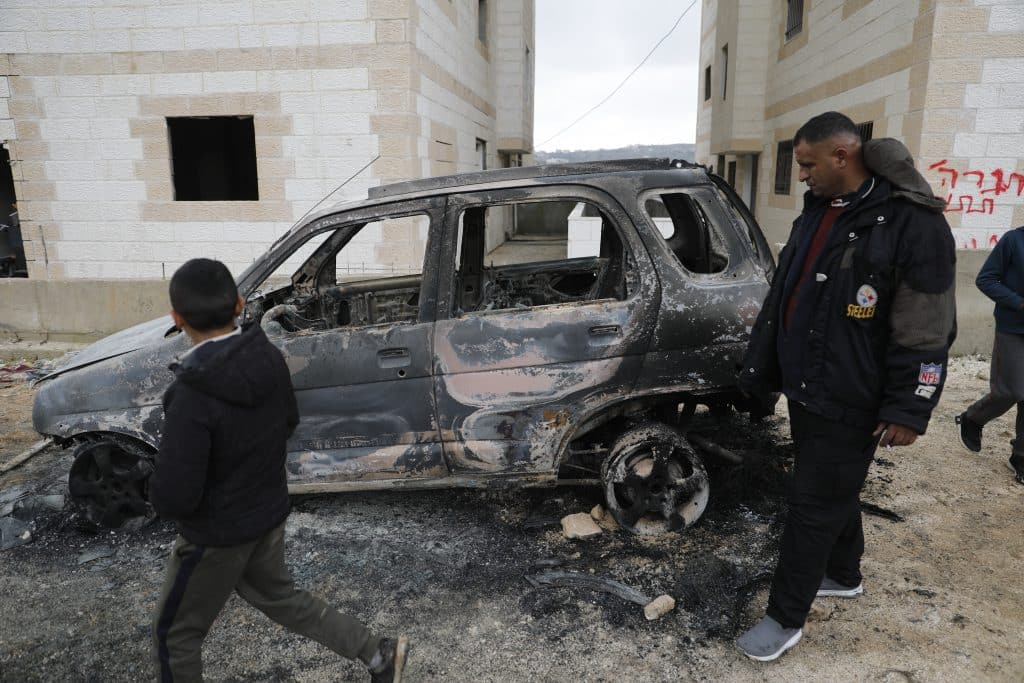
Palestinian life is being slowly but systematically eroded in the West Bank.
It has gotten to the point that the continued existence of Palestinians on their land is now legitimately called into question, but this basic fact doesn’t seem to carry any weight for Palestinians in their daily lives, running contrary to the predictions of Israeli security officials that there would be an “explosion” among Palestinians in the West Bank during Ramadan. In recent years, the holy month has historically been a flashpoint period for Palestinian protest, given the intensification of Israeli restrictions on worshippers at the al-Aqsa Mosque compound. Yet Ramadan came and went, and Israel not only continued to impose restrictions on but ramped them up under the pretext of “safety” measures amid the U.S.-Israeli war on Iran.
For the first time in centuries, Muslim worshippers were unable to attend Eid prayers at al-Aqsa, and the Palestinian street remained silent.
Life in the West Bank under occupation is far different today from how it was even a year ago. The sense of uneasy normalcy that used to pervade daily life has been rendered completely untenable as Palestinians are robbed of any sense of safety amid renewed waves of Israeli settler rampages, claiming the lives of seven Palestinians just last week and raising the number of Palestinians killed by Israeli forces or settlers to 23 since the beginning of the year. The regularity of these attacks has pushed Palestinians into a daily rhythm of weighing personal safety against the need to carry on with their lives before even considering stepping out of their doors.
Over 900 checkpoints, gates, and roadblocks have turned entire towns into caged enclaves (sometimes literally), while a surge of home demolitions by Israeli forces reached 300 demolished homes in the first month and a half of 2026. All this occurs alongside the explicit Israeli policy goal of “burying” a Palestinian state, as articulated by hardline Israeli Finance Minister Bezalel Smotrich, who advocates for “encouraging emigration” and formalizing the annexation of vast parts of the West Bank to Israel.
This raises a perplexing question: why aren’t Palestinians resisting what can only be described as an existential threat to their presence on their land?
Beneath this picture, there’s another story that isn’t usually told: of how Palestinian society in the West Bank has been subjected to a systematic process of social, political, and economic devastation, weakening it to the point that Israel is able to accelerate its annexation of the West Bank without any significant blowback.
The background: the economic subordination of the West Bank
There’s a material basis underlying the apparent quiescence of Palestinians in the West Bank: the Palestinian economy’s structural dependence on Israel.
That dependency is exercised through two main pillars: wages from Palestinian labor in Israel, and salaries from public sector jobs with the PA, as well as other donor-driven sectors.
It is a vulnerability that isn’t particularly new, resulting from years of decimation of Palestinian economic capabilities. According to social and economic researcher Jebril Muhammad, “the Israeli occupation restricted the creation of new Palestinian industries since the 1970s, and forced some existing factories to close,” he told Mondoweiss.
“Israeli agricultural production flooded the market, and labor inside Israel provided more jobs and better wages, which in a few years turned the main Palestinian labor force into workers in the Israeli economy,” Muhammad explained.
This transformed the Palestinian labor force into one dependent on the Israeli economy as both a source of employment and consumption, Muhammad says. This process continued after the creation of the PA, which signed the 1995 Paris Protocols, a set of agreements formalizing restrictions on Palestinian economic autonomy.
“The Paris economic protocol imposed limits on exports for Palestinians in the West Bank, their industrial development, and even what they can invest in,” Muhammad added. “This further increased Palestinians’ dependency on Israel for two main sources of income: labor in Israel, and salaries coming from the PA, the private sector, and the NGO sector.”
In essence, Israel has controlled the flow of vital economic resources into and out of the West Bank for decades. Whether (and when) the flow is interrupted has always been a question of Israel’s choice. After October 2023, it chose to plunge the Palestinian economy into crisis.
Palestinian businessman Nureddin Jaradat told the local Falastine newspaper in February that the results have been a “prolonged recession” in the Palestinian economy. Public employees haven’t been receiving full salaries for more than two years, tens of thousands of workers have lost their work permits in Israel, and the cost of living has only been increasing. According to the Palestinian Central Bureau of Statistics, unemployment in the West Bank has reached 27%.
This, Jaradat said, is largely driven by two main weapons Israel has used to bring the Palestinian economy to its knees: revoking the more than 150,000 work permits for Palestinian day-laborers who used to work in Israel before October 2023, and withholding the billions of shekels in Palestinian customs revenue.
Customs revenue, which Israel collects on behalf of the PA, represents more than 60% of the PA’s income. This directly impacts its ability to pay salaries of teachers, doctors, and public workers, who have been receiving only partial and irregular salaries since 2022.
The revocation of working permits has also been devastating, as Palestinian workers in Israel earned a major portion of household income for hundreds of thousands of families in the West Bank. In some parts of the West Bank, entire villages might have depended on such labor for their economic survival.
The assault on Palestinian society
Meanwhile, Palestinian civil society’s capacity to respond to the needs of the population has been gradually weakened over the years. According to Muhammad, “during the Second Intifada, Israeli military action targeted the PA institutions, weakening its capacity to live up to its responsibility of reconstruction and social services.”
“This made the PA leave the space for non-profit groups, who increased their dependency on international aid,” he added. “This created a system where local and international NGOs formed a complementary relation, relieving the PA of much of its social responsibility.”
Yet even these organizations are now being prevented from operating in Palestine. In early January, Israel issued a ban on over 37 international aid organizations, making it even more difficult for Palestinian civil society in the West Bank to sustain its core function of providing relief and support to Palestinian communities (Israel had already designated several Palestinian organizations as “terrorist” groups in 2021, shutting them down).
Amid the crackdown on civil society, an entire generation of Palestinian youth in the West Bank has been exhausted in confronting Israeli occupation. In 2015, the killing of a Palestinian student at Al-Quds University by Israeli forces triggered a wave of youth protests across the West Bank. Some media outlets called it a Third Intifada.
The protests were met with a heavy Israeli crackdown, using live fire and mass arrests. Israeli forces even began to implement a shoot-to-kill policy against Palestinian youth at checkpoints, which was used to retroactively justify extrajudicial executions against Palestinians who “looked suspicious” and fabricated claims that they were carrying a knife. Israel also resumed its policy of withholding the bodies of slain Palestinians and revived its policy of punitive home demolitions.
These measures intensified in subsequent years, especially after the emergence of armed groups in 2021 and the escalation of Israeli raids thereafter, which included airstrikes for the first time in 20 years in refugee camps in 2022.
At the level of political leadership, the PA continued to lose political legitimacy, and today the Palestinian political field is irrevocably fractured, the product of a crisis of political representation among all Palestinian political factions.
If the Palestinians of the West Bank are not showing a mass reaction to the Israeli offensive against their existence, it is because they have been consistently reacting to Israeli policies for decades, all while being battered down in the process.
After October 7, 2023, the conditions of Israeli domination were solidified into the wholesale assault on Palestinian existence that we see today. Resistance to these conditions now carries immense costs — namely, arrest or death — and which of those two is worse is an open question; prison conditions for Palestinian detainees have worsened so dramatically that exposure to torture, starvation, beatings, and sexual violence has become a matter of Israeli policy.
The cumulative effect of this reality is to terrorize Palestinians into complacency.

I don’t need to read the article to know the answer: Israel is just waiting to play the victim and commit another genocide.
“The cumulative effect of this reality is to terrorize Palestinians into complacency.”
Israel’s parliament votes to expand death penalty for Palestinians | CNN
“Israel’s parliament votes to expand death penalty for Palestinians…The Israeli parliament finalized a controversial bill Monday that would effectively expand the death penalty for Palestinians convicted of terrorism and nationalistic murders — a cornerstone issue for the country’s far right for over a decade.The bill stipulates that residents in the West Bank who kill an Israeli “with the intent to negate the existence of the State of Israel” will be sentenced to death.?”
Who will determine the ‘intent‘ of Palestinians?
As Qassam so clearly points out in this piece the Palestinians have been beaten down for over a century and continue to be purposely beaten down by the violent, hate filled Zionist.
“Yet Ramadan came and went, and Israel not only continued to impose restrictions on but ramped them up under the pretext of “safety” measures amid the U.S.-Israeli war on Iran.”
Some incredible coverage of the past and present.
Francesca Albanese
https://www.youtube.com/watch?v=vWUtNrhXxIc
https://www.democracynow.org/2026/3/26/albanese_un_palestine_rapporteur
History of the Colonial war against Palestinians
Chris Hedges “Palestinian 36” documentary
https://www.youtube.com/watch?v=12wXnP03BOE
Qassam Muaddi, by holding up a mirror, has advanced the Israeli-Palestinian delemma. Realities are best faced. Needed are intellectuals willing to discuss and debate visions for co-existence.
Israelis are in a hole. Palestinians are in a hole. Lemonade is needed.