


A few years ago, I witnessed a human rights organization’s interview with a released Palestinian prisoner. He was a 16-year-old teenager who had spent four months in Israeli detention, and when the human rights lawyer asked him if he had been tortured, he shrugged and said that he hadn’t.
Then the lawyer asked him how he was treated. He said that he was deprived of sleep and kept in the cold on his first night of detention; he was handcuffed to the chair during interrogation sessions, placed in stress positions, and had been threatened with violence, cursed at, and insulted. The teenager had no idea that these practices constituted torture. To him, as long as he wasn’t beaten, there was nothing out of the ordinary. It was just “normal.”
This skewed perception of what is considered “normal” for Palestinians is not just true for that teenager. It’s reflected in how the mainstream media treats Palestinians’ reality in the West Bank, especially after October 7.
For the past three weeks, the West Bank has been largely absent from mainstream media headlines. The relative stability that accompanied the period after the end of Ramadan and Passover was marked by a lack of news, and the Israeli army hasn’t expanded its mass expulsion campaign to new refugee camps. There also hasn’t been any Palestinian attack on Israeli troops or settlers, and the over 900 Israeli checkpoints that dot the entire West Bank have remained open most of the time, slightly easing Palestinians’ everyday movement. Most Palestinians noted this period of “relative calm” through Eid and Easter, comparing it to the past few months in which military assaults across the West Bank had become the new normal.
But the relative (and temporary) “stability” of the West Bank isn’t the only thing that is not deemed newsworthy. For the mainstream media, Israel’s daily violence against Palestinians in the West Bank no longer qualifies as deserving of coverage. It simply isn’t out of the ordinary.
Here’s a brief list of what has happened in the West Bank in just the last week.
The Israeli army demolished several Palestinian homes and multiple other properties in the West Bank. This included a three-floor residential building in the village of Zaatara, east of Bethlehem; several water wells in the town of Tarqumiyya, near Hebron; a shop in the town of al-Jib, north of Jerusalem; a house in the Silwan neighborhood in Jerusalem; a tract of bulldozed Palestinian farmland in the town of Kufl Hares near Salfit; two homes belonging to two Palestinian brothers in the village of Ni’lin, west of Ramallah, which left four families homeless; a seven-floor residential building in Beit Ummar, north of Hebron, located in a parcel of land close to the Israeli Karmei Tzur settlement; and 14 Palestinian properties that were handed demolition orders in the town of Anata, north of Jerusalem.
All this has amounted to a blitz of demolitions across the West Bank. In the past month alone, Israeli forces demolished 58 Palestinian properties — and 5,900 properties since October 7, 2023.
The latest wave of demolitions was preceded, earlier this month, by statements made by Israel’s finance minister, Bezalel Smotrich, that “illegal” Palestinian building has become “a scourge” to Israel. Smotrich’s statements came in the context of his announcement of “a revolution [of settlement expansion] in Judea and Samaria [the Israeli term for the West Bank] unprecedented since 1967.” That same week, the Israeli cabinet approved a large infrastructure project to isolate Palestinian circulation from the east of Jerusalem, where Israel has plans to expand its settlements to reach the Jordan Valley.
But the duality of settlement expansion and the crippling of Palestinian building in the West Bank is only one part of the ongoing colonization process, and it’s mostly absent in mainstream coverage. The other piece of the puzzle is the increasing settler violence against Palestinians.
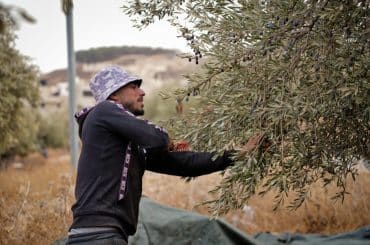
On Wednesday, dozens of Israeli settlers attacked the village of Sinjil, northeast of Ramallah, and torched seven farming cabins and five cars, while attacking Palestinian farmers with stones and forcing several families to flee their homes at the edge of the village. Video footage taken by a villager showed settlers carrying out the attack in the presence of the Israeli army, who did not intervene. That same day, Israeli settlers injured five Palestinians in Ain al-Beida and two in Bardala in the northern Jordan Valley.
This is only a part of what a period of “calm” looks like for Palestinians in the West Bank. Although these events are occasionally reported as isolated incidents, they are rarely pieced together as parts of a larger context.
But they are a constant and nonstop reality. It was the case before October 2023, and it continues to be the case today. It is in this larger context that the more “spectacular” escalation can only be understood, like Israel’s ongoing military campaign in Jenin and Tulkarem, or occasional attacks on Israeli soldiers and settlers by individual Palestinians.
Beneath the surface of these events is the daily life of Palestinians in the West Bank — their economy, their social life, their mental and physical health, their access to water, housing, and education, their absolute lack of security, and their increasingly fading horizon for a future in their country.
This reality, and the engineered coercive environment created by decades-long Israeli policies, are the single most important and ongoing event, without which any escalation of Israeli violence in the West Bank becomes impossible to fully appreciate. It is an accumulation of separated events, through which Palestinians appear only as background noise, always in the same role: passive receivers of Israeli violence, or perpetrators of violence themselves (most often leading to their own death), without context. It is as if, for Palestinians to exist, they have to be killed, either passively or as “terrorists.”
Before October 7, this dismissal of the Palestinian context under colonial occupation had been the order of the day. The relative “calm” had been the visible reality in the West Bank until 2019, when young Palestinian men began to confront Israeli forces in the northern West Bank, where the Israeli army began to increase its military crackdown on Palestinian refugee camps. In Gaza, the relative “calm” remained the predominant impression of both Israel and most mainstream coverage.
After October 7, many have claimed that Palestine and its cause have been irreversibly catapulted to the center of media and political discourse due to the immensity of their daily killing. But it often seems that the immensity of Palestinian death has only raised the bar for Palestinians’ public existence. Anything less than a full-blown genocide, regardless of how dramatic it might be for those living under it, falls into the definition of “relative calm.”
Last Sunday, the BBC broadcast “The Settlers”, a new documentary by Louis Theroux about what’s really going on in the West Bank.
https://www.bbc.co.uk/iplayer/episode/m002bm1y/louis-theroux-the-settlers
Theroux is a subtle operator, his method being to ask pertinent questions and let his interviewees condemn themselves out of their own mouths. (In the past he has interviewed other religious fanatics in the US and Palestine (notably the Westboro Baptist Church), as well as a disturbing programme on the odious paedophile TV star Jimmy Savile.) Central to “The Settlers” are his talks with the odious settler leader, Daniella Weiss, who is determined to drive Palestinians (described by one rabbi in the film as “camel riders” to be got rid of) from Gaza and to settle it.
I appreciate that many here may not be able to access the BBC iPlayer to watch the film. It appeared briefly on YouTube before it was removed for breach of copyright, but is worth searching out. It complements the Oscar-winning “No Other Land”. Kudos to the BBC for keeping it available, unlike their earlier film on children in Gaza.