

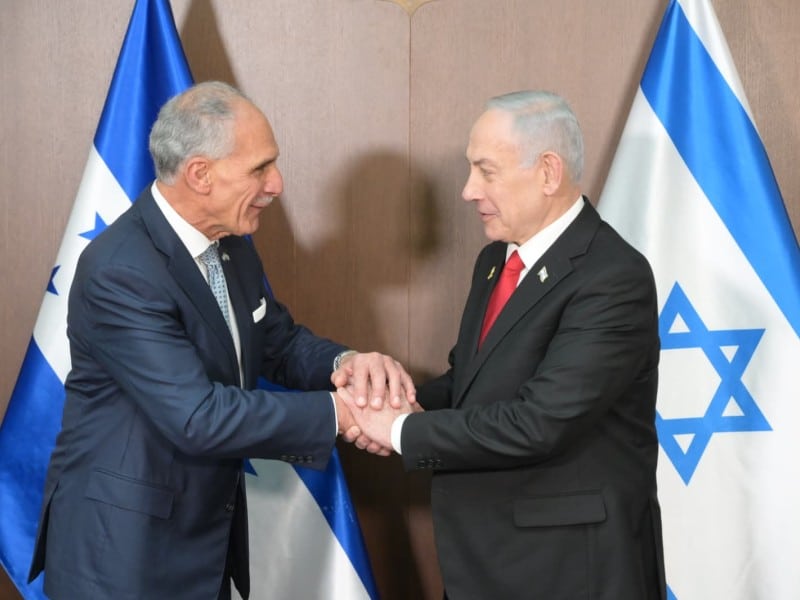
Honduras is poised to strengthen its solidarity with Israel under President Nasry “Tito” Asfura.
The former mayor of Tegucigalpa, a construction magnate with close ties to U.S. President Donald Trump, is also the son of Christian Palestinian migrants from Bethlehem who fled during Ottoman rule. Beyond acknowledging that history, however, he does not identify as Palestinian himself.
Multiple factors contribute to Asfura’s stance toward Israel and the U.S., from his own market-driven mindset to the Christian Zionist pastors and politicians that surround him. But these all add up to Asfura and Honduras under him pivoting in a direction much more favorable to Israel and the United States.
Since entering office in January 2026, Asfura has been quick to establish his pro-Israel bona fides. He has failed to condemn the ongoing genocide in Gaza, where over 75,000 people have been killed since October 2023, and as one of his first official acts as president, met with Israel’s Ambassador to Honduras, Nadav D. Goren. Also, on a trip to Jerusalem days earlier, he was greeted by genocidaires Gideon Sa’ar, Isaac Herzog, and Benjamin Netanyahu, who affirmed their desire to work together in agriculture and technology, thus “refashioning the relationship between Israel and Honduras.”
For some in the Palestinian-Honduran community, those horrified by the slaughter in Gaza, his behaviour is inexcusable. On January 21, 2026, the Comunidad Palestina Honduras condemned his trip to Jerusalem, expressing “their deep concern, pain, and dismay.”
“It particularly affects us that these actions come from the President-elect, who cannot ignore his Palestinian origins nor the history of dispossession, exile, and resistance that marks thousands of families—a history that is also ours,” their statement read.
After all, Latin America is home to the largest Palestinian community outside of the Middle East and North Africa, and while the majority reside in Chile, Honduras has the largest population per capita.
The first wave of Palestinian migrants who arrived in Latin America during the late 19th century was primarily young men seeking to earn money and return home. Many found work, built homes, and settled down. The majority, even if they wanted to, were unable to go back: “by 1937, Palestinians in Latin America had filed 9,000 applications for citizenship, and not more than 100 — a paltry one percent — had been accepted,” according to research by historian Nadim Bawalsa.
“What’s interesting about Honduras is that their entry into economic life was slightly different from other places in Latin America,” said Amy Fallas, a historian of the modern and transnational Middle East. While many began as peddlers, selling souvenirs from the Holy Land, others provided services to Honduras’ banana plantations, a rapidly expanding industry in the northern regions.
Because of their wide networks and economic acumen, they were particularly successful in that global economy, and that early success directly fuels the political and economic prowess of individuals like Asfura, Palestinian-Hondureños with capital and status. After all, “much of their political and financial standing was made possible because of this multigenerational success that their Palestinian ancestors had to fight for,” Fallas explained to Mondoweiss.
“That [heritage] is not something that should be discarded, even if they want to,” Fallas added.
Growing business ties
Last week, Asfura’s government announced its decision to withdraw from The Hague Group, a global bloc of nations committed to the defense of international law in Palestine.
This decision coincided with a March 4, 2026, meeting of the bloc, attended by representatives from 40 countries. So the timing was strategic, according to Guillaume Long, diplomatic advisor to The Hague Group.
“Obviously Israel wanted to weaken the meeting,” Long told Mondoweiss. “They wanted both countries [Honduras and Bolivia] to announce their withdrawal from the group on the day that this meeting happened, so that would be the main news.”
Asfura “is clearly ideologically pro-Israel, pro-U.S.,” said Long, but make no mistake, “the key player here is not going to be Honduras, it’s going to be Israel.”
And one primary driver of the relationship may be the financial stakes Asfura is looking to build with the Netanyahu government. For the Honduran economy, driven predominantly by agriculture and textiles, Israel has something else to offer.
On his January trip to Israel, Asfura sought to learn about Israel’s agrotech industry, exploring new technologies that “will help take the Honduran agricultural sector to the next level.”
That industry relies on the occupation of Palestinian land. Technologies from drip irrigation systems to pesticide-spraying drones, are “used against captive Palestinians, before being deployed to ‘civil’ sectors like agriculture and sold worldwide.” But this doesn’t appear to be an issue for Asfura. And Israel is looking to build ties too.
“Israel’s game now is to try and entrench ties over the long run, so that even if there is a change of government in Honduras, or elsewhere, they can still be very present in those countries,” Long explained to Mondoweiss.
Israel’s history with Honduras
Although Asfura is looking to further develop his country’s relationship with Tel Aviv, Israel’s role in Honduras and the region is not new.
Located between Nicaragua, El Salvador, and Guatemala – the sites of rampant human-rights violations and western interventionism – throughout the late 20th century, Honduras became a strategic base for U.S. violence and, by proxy, Israeli exports.
Over the course of the 1970s, Israel sold Honduras 12 refurbished Dassault Super-Mystere fighter-interceptors (fighter jets), three Arava transport planes, a Westwind jet, Galil automatic rifles, Uzi submachine guns, 14 RBY Mk armored cars, 106 mm mortars, and five rapid patrol boats.
In December 1982, Israeli Prime Minister Ariel Sharon “agreed in a semisecret meeting here to sell Israeli Kfir fighter jets, armored tanks, and Galil assault rifles to the Honduran armed forces,” according to an unidentified military source at the time.
This special relationship continued during the presidency of Juan Orlando Hernandez (2014-2022), a convicted drug trafficker who was recently pardoned by Trump. Amid the charges that had been brought against him was the murder of Franklin Arita Mata, a rival drug trafficker, executed by assassins using grenade launchers, M16s, and Israeli-made Galil assault rifles.
In 2016, Hernandez also proposed a military cooperation agreement between Honduras and Israel, including the purchase of security equipment. By 2019, local news reported the arrival of 1000 Israeli soldiers at an air base in Palmerola to train local soldiers and police in border protection and anti-drug trafficking.
Tried and tested in Palestine, then exported around the world, the same tools and tactics are used against Palestinians today.
But, like Hernandez, the current president is undisturbed about deepening Honduras’s relationship with Israel amid allegations of war crimes and genocide. And it’s clear that,despite his heritage, Asfura’s support for Israel is not just practical. It’s ideological.
Christian Zionism
Evangelicalism is rising across Latin America, usurping the historically dominant Catholic community. In Honduras, evangelicals constitute an estimated 48% of the population.
While the president’s own denomination is unknown, one of his close advisors, Roy Santos, is an evangelical pastor who served as the honorary president of parliament for Israel in Honduras during the administration of Juan Orlando Hernández.
In addition, on January 20, 2026, Asfura elected Tomás Zambrano as president of Congress. Also an evangelical Christian, Zambrano is chairman of Honduras’ Congressional Israel Allies Caucus, a chapter of the Israel Allies Foundation, a Christian Zionist lobbying group seeking to promote “faith-based diplomacy” between Israel and “bible-believing Christians” around the world.
This influence is already feeding policy. In fact, on February 23, Asfura and Zambrano met with Israeli Ambassador Goren to discuss a “new stage of bilateral relations,” including the creation of a parliamentary friendship group.
Zambrano was also instrumental in moving his country’s embassy from Tel Aviv to Jerusalem in 2021. “It was not easy,” he said in an interview with the Jerusalem Post, “but we did it, in spite of the fact that several strong economic groups in Honduras are of Palestinian origin.” After all, “Honduras is a highly Christian country – Catholics and Evangelicals – and the two churches backed our resolution,” he said.
Christian Zionism, particularly amongst evangelicals, “has been growing exponentially since the upheavals in Central America during the civil wars of the 70s and 80s,” said Fallas. But it’s not just individuals or singular churches. “There are huge megachurches that basically function as branches that are trained to promote a particular ideology,” she told Mondoweiss.
Christian Zionism thus exploits vulnerabilities in communities that rely on the church for social and economic aid. In a way, argued Fallas, who was raised in a Christian Zionist Latino household, this element is more powerful than the more commonly cited “end of times” narrative – the belief that the presence of Jewish people in Israel is a precursor to Christ’s return. “Beyond the afterlife, beyond harkening the end times, it’s really about ameliorating one’s circumstances with divine favor in the geopolitical realities that we face,” she explained.
This is one way Palestinian Latinos, like Asfura, come to support Zionism, and with his cabinet, “we’re seeing that at the highest level of governance,” says Fallas.
And in the process, Asfura is hurting a part of the community he is obligated to serve. “Listen to the cry of oppressed peoples and act with ethical consistency,” pleaded the Comunidad Palestina Honduras. “Particularly when it comes to the community from which one comes.”


When religion becomes less about human kindness and more of a business transaction. Silly me!