

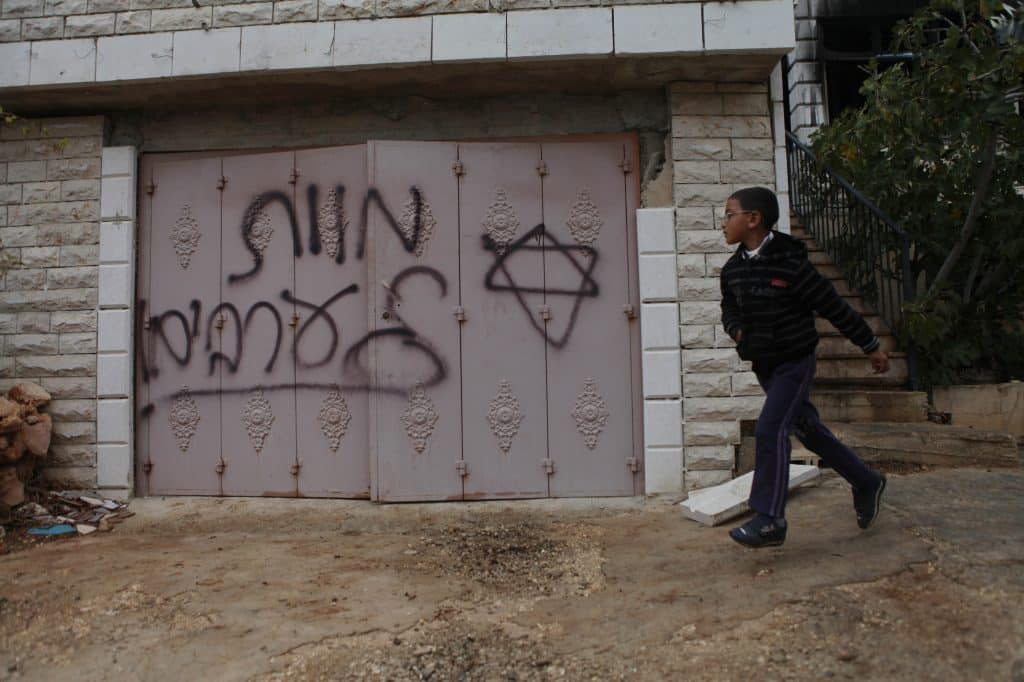
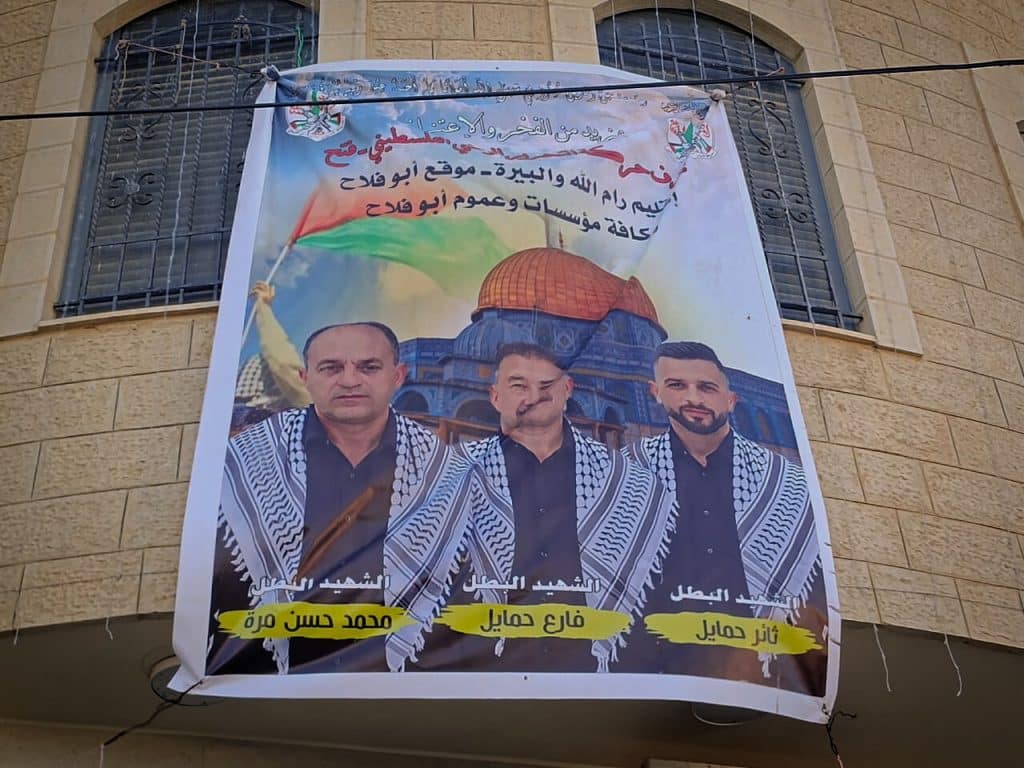
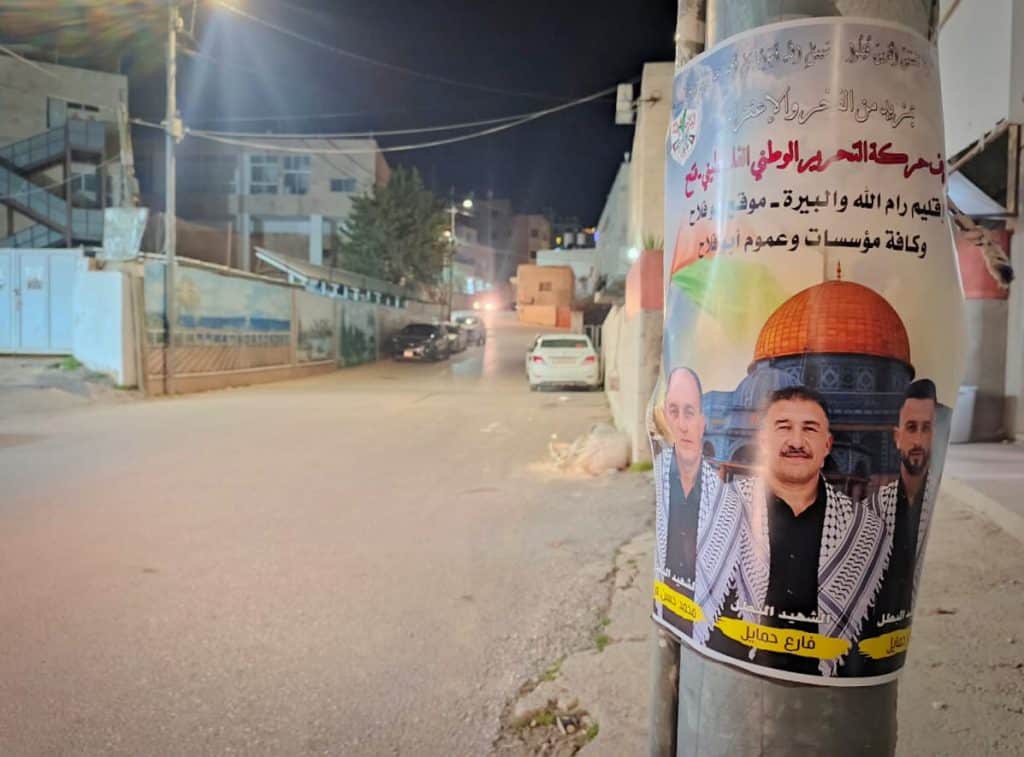
The streets of the Palestinian village of Abu Falah, northeast of Ramallah, are quiet. They usually would be on a Ramadan afternoon, but this is different. An inexplicable tension hangs in the air, and even the children walking along the sidewalk are restrained, staring at the unknown car with suspicion. An elder sits in front of a store looking away anxiously, as if expecting something to happen. Along the main street, three faces greet the visitors, looking down from posters hanging from power lines and closed storefronts.
At the center of the village, cars are parked in front of the large Abu Falah public hall. Mourners have congregated on the third day of a funeral wake to pay their respects to the families of three slain Palestinian men, killed by Israeli settlers on the night of March 7. Two of the victims are older men, Muhammad Murra, 57, and Fari’ Hamayel, 55, while the third, Thaer Hamayel, was 30.
They weren’t the only Palestinians whose lives were taken by Israeli settlers that week. A few days earlier, another Israeli attack killed brothers Muhammad and Fahim Muammar in the village of Qaryut, east of Nablus. Another Palestinian, Ameer Shanaran, was killed by an Israeli settler in Masafer Yatta of the South Hebron Hills on the same day as the Abu Fallah killings.
In total, settler pogroms had killed five Palestinians in the West Bank in less than a week, part of a broader escalation in settler violence and Israeli military restrictions on the lives of Palestinians since the start of the ongoing U.S.-Israeli war on Iran.
Settler violence has been on the rise in the West Bank for months, with 486 attacks recorded in January, according to Bedouin’s rights defense group al-Baidar, while in February, settlers launched 511 attacks, the Palestinian Wall and Settlements Resistance Commission reported.
The recent deadly attack on Abu Falah is significant because it lies deeper inland amid Ramallah’s central hill country; in contrast, settler attacks in the governorate have largely concentrated around the line of villages on the eastern edges of Ramallah overlooking the Jordan Valley, such as al-Mughayyir, Turmus Ayya, Deir Dibwan, and Taybeh.
While Abu Falah has experienced attacks over the past two years, none of them were as coordinated and deadly as the one that took the lives of the three men in early March. Muwafaq Omari, a resident of the village, says that ever since settlers established an outpost near the village in the wake of October 7, they have launched occasional raids on the outskirts of town, primarily targeting farmland and burning wheat and barley crops during the harvest season. “But those attacks were small in number, and there were no casualties,” Omari told Mondoweiss. “We never imagined that settlers would attack in the dozens and shoot firearms, as they did last week.”
It was late at night, after the evening prayers that are customarily held after breaking the Ramadan fast. Omari was returning home from the prayers when he received a call from his daughter. She lived at the edge of the village, where settler attacks are more frequent. “She was frightened, and said that settlers were attacking houses and that some young men were trying to push the settlers off,” Omari recalls. “I panicked and rushed to the location, but couldn’t reach my daughter’s house. It was too risky.”
His daughter, still in shock from the day’s events, declined to speak to Mondoweiss.
Muhammad Abu Karsh, another resident of Abu Fala in his thirties, is a Civil Defense volunteer in the village. “I was home when a friend called me and said that the settlers were attacking, and several were injured,” he recounts. “I rushed to the location and didn’t even have time to put my civil defence jacket on.”
When he arrived, he saw dozens of settlers roaming in the fields, some of them minors, throwing stones at a distance. “About half an hour later, a white pick-up truck arrived on the settlers’ side, this time with firearms that appeared in the hands of settlers,” Abu Karsh continues. “The settlers then opened fire into the crowd. That’s when everybody began to run back to the village, including myself.”
But the settlers went after them, continuing to shoot. “The settlers came so close that they were shooting in between the houses, and Muhammad Murra’s house was one of them. He was shot in front of his own house, but I didn’t look back. And I didn’t know that in the first shots, Thaer and Fari’ were the first casualties,” Abu Karsh added.

‘Unprecedented trauma’ in Abu Falah
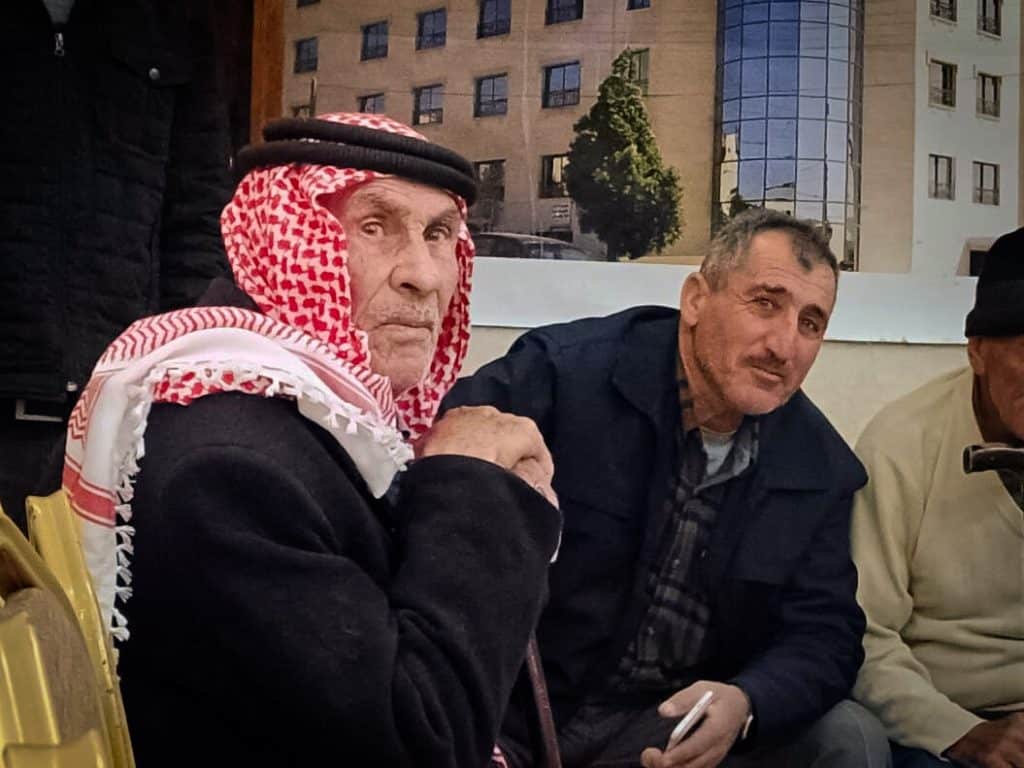
In the public hall, men sit in rows of chairs, some of them chatting as a few young men walk between the rows serving bitter coffee. One man in a red kufiyyeh sits in complete silence, as if contemplating. “That is my grandfather from my mother’s side, he hasn’t yet comprehended the loss of Thaer,” says Saif Hamayel, 26, the brother of Thaer Hamayel, one of the three victims.
“My other grandfather on my father’s side has been missing since 1967, when he left to join the fida’iyyin [PLO guerrilla fighters] during the war. He was never heard from again,” Saif says. “My father was his only son, and he was only one year old. That’s the same age as Thaer’s son, who will also now grow up without a father alongside his three-year-old sister.”
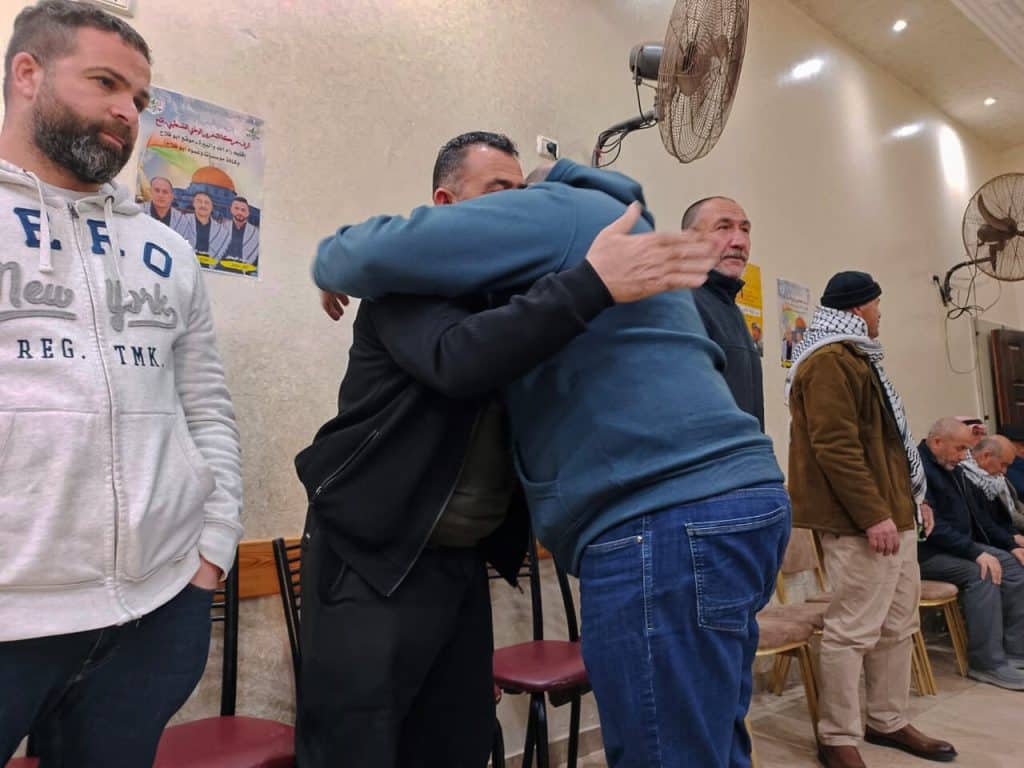
Saif stands up to accept condolences from a new group of mourners who enter the hall, one of whom embraces him in clear emotion. After a while, Saif returns to his seat and continues to speak. “On Saturday, Thaer walked by the store where I work in Ramallah and just waved at me, smiling,” Saif sighs with a light smile. “We didn’t talk. He didn’t say anything. It was the last time I saw my brother alive.”
The next time he saw his brother dead was in the middle of the attack. “That same night, I was volunteering in transporting the wounded. At one point, there was a young man shot in the head and bleeding from the ears, and I rushed to help him,” Saif recounts. When he looked at the man’s lifeless face, it was Thaer.
Thaer used to work in construction. His brother recalls that he loved life and always smiled, “He liked stopping by the village to say hello to people, and he was always ready to help,” says Seif.
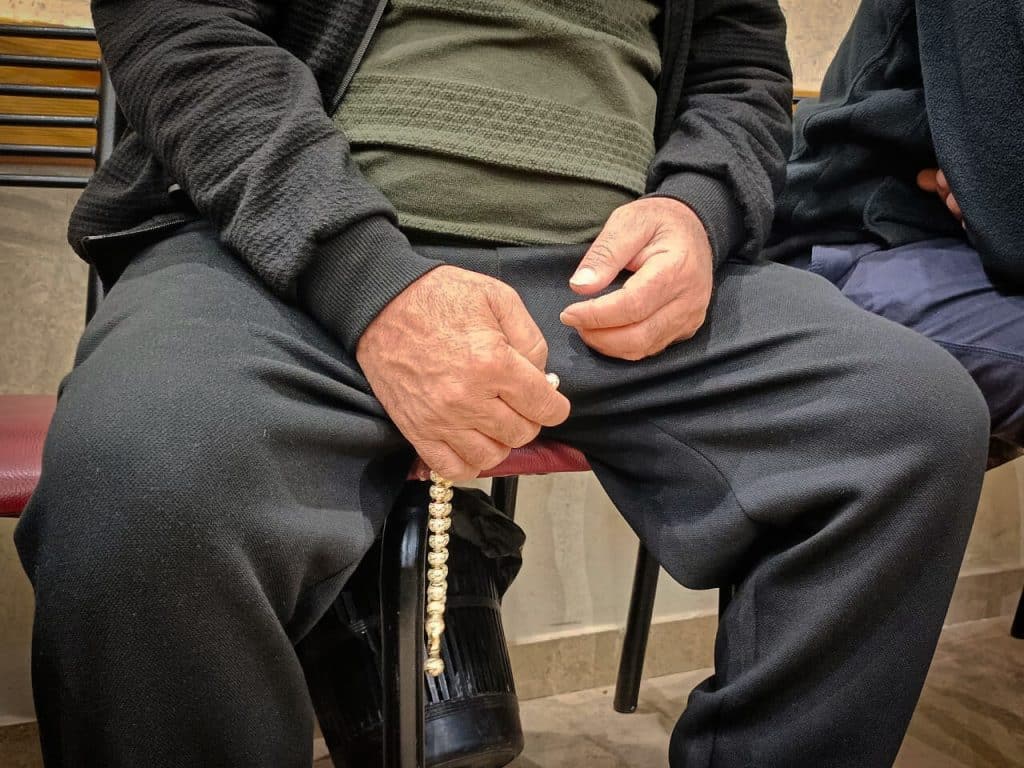
Beside Saif sits a man in his fifties. He turns the prayer beads, a misbaha, in his hand, his face expressionless. I learn that his name is Yasser, the younger brother of another of the three martyrs, 55-year-old Fari’ Hamayel. As he listens to Saif’s account, he shares his own. “Thaer was among the first to rush to the location when settlers attacked, and he saw Fari’ there,” Yasser says. “They were together when I spoke with Fari’ on the phone during the settler attack.”
“There’s a feeling of vulnerability and humiliation that you can be killed in our own town without consequences.”
Muhammad Abu Karsh
That was the last time he spoke to his brother, he says, before turning his eyes back to the ground, resuming turning the beads of the misbaha. He continues talking without looking up. “I never imagined that Fari’ would die this way. We worked together in stone cutting, because there are a lot of stone quarries in our region,” he says.
When they were young, Fari’ decided to try his luck in America. They were the only three years he and his brother were apart. When he finally came back to Palestine, he married and had children. “We raised our kids together,” Yasser says. “I knew that he was killed in the morning, and I still can’t understand what happened.”
The settler attack ended at around 2 a.m., according to residents, only to give way to an Israeli army raid, which lasted until the morning. “The occupation army was nearby the whole time, and it did nothing to stop the settlers. They only came in when the settlers began to withdraw,” says Muhammad Abu Karsh, the Civil Defense volunteer. “We all rushed back to our homes as the military jeeps entered and began launching tear gas and stun grenades all over the place.
The army remained in the village until sunrise. When they left, people began to gather in the mosque, where it was confirmed that Fari’ and Thaer were killed, in addition to Muhammad Murra, who was shot by a settler in front of his house.
“The trauma is unprecedented in Abu Falah,” Abu Karsh reflects. “We are still in the middle of it. People don’t leave their homes anymore. Life seems paralyzed. There’s a feeling of vulnerability and humiliation that you can be killed in our own town without consequences, without justice being served.”
This absence of justice is a matter of Israeli governmental policy. Last January, Israel’s hardline National Security Minister, Itamar Ben-Gvir, allowed for 18 additional Israeli settlements in the West Bank to issue firearm permits to settlers. In November 2024, the Israeli government cancelled the procedure of administrative detention for Israeli settlers in the West Bank, making it more difficult to arrest settlers accused of violent attacks against Palestinians.
The evening call to prayer marks the hour of iftar, when the community breaks its fast. Family members of the slain insist that mourners stay for the meal. Outside the public hall, people begin walking home as night falls in a remarkable silence. The street in the center of Abu Falah empties suddenly, while the faces of the three victims watch over it from the posters.
Qassam Muaddi
Qassam Muaddi is the Palestine Staff Writer for Mondoweiss. He covers social, political, and cultural developments in Palestine, and has written for several outlets in English and French, including the Catholic Terre Sainte Magazine and other outlets. Follow him on Twitter/X at @QassaMMuaddi.

With World’s Eyes on Iran, Israel Locks Down the West Bank….The Israeli military has closed checkpoints around the West Bank, restricting Palestinians’ movement as settler violence ramps up.
With World’s Eyes on Iran, Israel Locks Down the West Bank
How low can Israel go? We know very low.
https://www.bbc.com/news/articles/cm2xrz71zm3o
Jewish Israeli land, home thieves have been at this a long time. All the while IDF often protect them. Murdering Palestinians, knowing the Israeli Justus system will investigate themselves and nothing NOTHING will be done.
The Jewish Israeli land, home thieves get away with this violence over and over again. The international community does little to nothing.
Breaking bones
https://www.youtube.com/watch?v=3wWlkVBaPKM
https://www.youtube.com/watch?v=Q5C7mFExBVk
https://www.youtube.com/watch?v=fxLDYkX7l9A
https://www.youtube.com/watch?v=ihnLnWuaRtg
https://www.youtube.com/watch?v=xhXIYns7ZeM
https://www.youtube.com/watch?v=M-Ahyy6_aS8
https://www.youtube.com/watch?v=gnIfQbO4dDI