
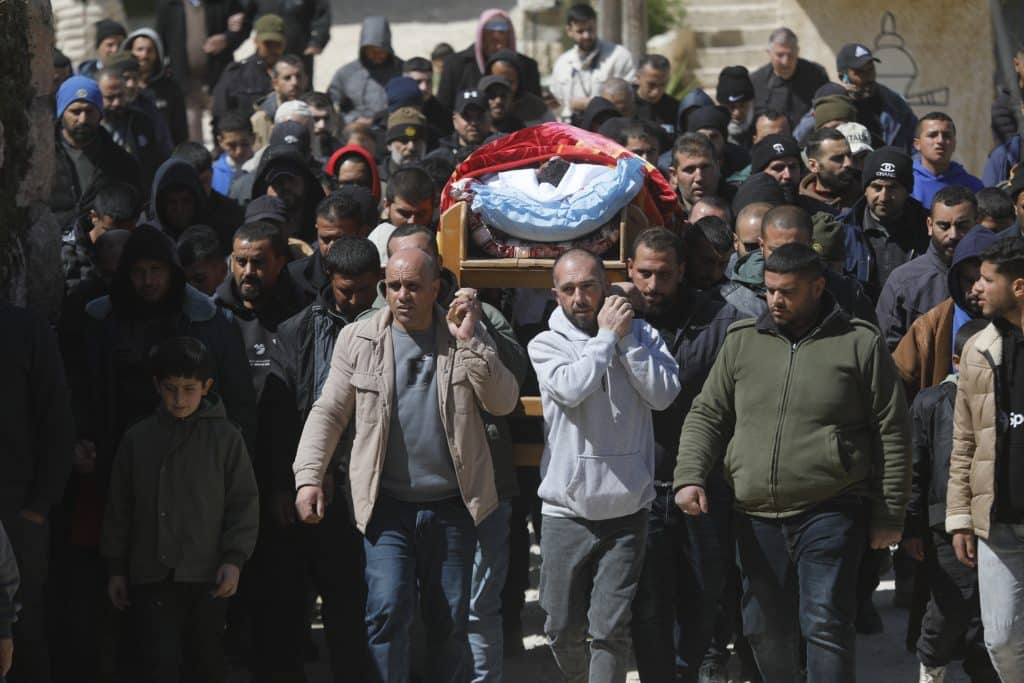
Israel’s accelerating crackdown on the West Bank over the past two years has reached the point of feeling like the new normal. Palestinians say that the strangulation of their daily lives is here to stay, with many describing the regime of closures and land seizures as “irreversible.”
But this crackdown also runs contrary to the longstanding Israeli policy of avoiding “friction” in the West Bank to prevent an “explosion” among Palestinians in response to Israeli repression. This was the dominant approach of successive Israeli governments up until October 7, 2023.
In late February of this year, shortly before the beginning of Ramadan, the Israeli army and security branches warned the Israeli government of a possible escalation in Palestinian “violence” in the West Bank. The holy month has been known in the past to coincide with mounting political tensions due to the role the al-Aqsa Mosque in galvanizing protests around the right of Palestinians to pray freely at the holy site. Israel historically attempted to maintain calm during these months by allowing Palestinians from the West Bank to obtain permits to visit al-Aqsa.
But this year, Israel broke with convention, using only 10,000 permits for Palestinians to visit during Ramadan, a historic low made worse by the restriction of the permits to children under 12, men over 55, and women over 50. Then, once the U.S.-Israeli war on Iran started, Israel revoked all Ramadan-related permits.
These measures come after Israeli settlers stormed the al-Aqsa compound 24 times during February alone, with thousands of Israelis taking part in Jewish religious rituals in violation of the accepted status quo at the site.
This all represents a sharp escalation, given that similar provocations at al-Aqsa in Ramadan have elicited widespread protests across Jerusalem and the West Bank in the past. The most notable example was the 2021 “Unity Intifada” that broke out in response to settler provocations at al-Aqsa and the threat of displacing residents of the Sheikh Jarrah neighborhood.
It is as if the Israeli government is deliberately trying to provoke an eruption in the West Bank, running contrary to all warnings from the Israeli security establishment of an imminent “security escalation.” But why would Israel want such a conflagration?
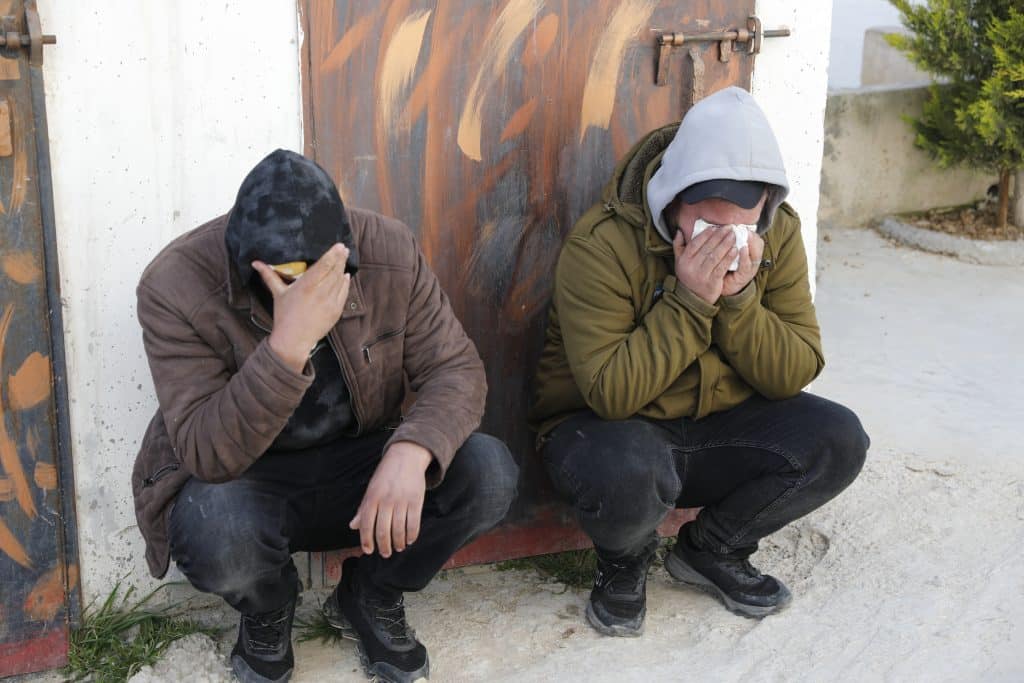
Creating ‘irreversible’ facts on the ground
Israel has entered a phase where it is trying to bring its conflict with its enemies to a “decisive end,” according to Palestinian historian Bilal Shalash.
This is clearly evidenced in its ongoing aggression in Iran and Lebanon, but the West Bank is another arena where Israel seeks to clear the deck. “Israel is motivated by the fact that its main sponsor and ally, the U.S., is trying to do the same thing at a global scale, from Latin America to Iran,” Shalash explains. “And in the case of Iran, it also happens to be the center of opposition to Israel’s domination in the region.”
Shalash argues that this marks a break with the previous Israeli policy of launching smaller-scale periodic crackdowns on Palestinian communities in a bid to avoid a major conflagration. Such limited waves of repression, which Shalash says Israeli officials have called “mowing the lawn,” were designed to keep political tensions below a certain threshold, and were “followed by periods of relative stability,” he explains.
This philosophy has been the doctrine governing Israel’s regime since it occupied the West Bank in 1967, Shalash explains. “Israeli generals recommended that as long as daily life went on normally, without any large-scale upheavals, Israel could deal with acts of resistance individually,” he noted.
“Israel has effectively dismantled all social structures that could produce any collective reaction to what it is doing in the West Bank.”
Khaled Odetallah
But historically, Shalash says, Israel has also interrupted this strategy in favor of escalating its crackdown on Palestinians when a large-scale wave of Palestinian resistance caught it by surprise. “This was the case in the late 1960s and early 1970s, when there was a wave of Palestinian armed resistance,” he explained. “And in the late 1980s and early 1990s, which was in response to the First Intifada.”
Other events included Operation Defensive Shield in 2002, which responded to the Second Intifada, and the current unprecedented escalation over the past two years, which followed October 7, 2023.
The latter campaign, however, has also marked a qualitative shift, according to Shalash, who explains that the Hamas attack made Israeli leaders conclude that “mowing the lawn” no longer worked. “This intensified wave of Israeli repression has a new feature: it is attempting to create demographic and geographic realities that are irreversible,” he said.
Those irreversible facts are the displacement of thousands of Palestinians, sometimes erasing communities in their entirety, from large parts of the West Bank while de facto annexing those areas. It is supposed to lead to what Shalash describes as a “‘decisive’ outcome” in which “Palestinians would be cornered in isolated ghettoes inside an annexed territory.”
“They would have no political system of their own, and they would live in conditions that push them to leave the country in large numbers,” Shalash explained.
Whether this actually comes to pass, however, depends on how Palestinians react, Shalash stresses.
This particular factor is the main difference between the current Israeli crackdown and previous ones, says Khaled Odetallah, the founder of Palestine’s Popular University and one of the co-editors of Al-Janub: The Palestinian Journal for Liberation Studies.
“The difference is that this time Israel is also taking advantage of the general paralysis in Palestinian society as a result of a heavy crackdown that has been ongoing for several years, and which has only doubled since October 2023,” Odetallah pointed out.
“Israel has effectively dismantled all social structures that could produce any collective reaction to what it is doing in the West Bank, from shutting down NGOs and human rights associations, to mass-arresting union and student activists, and even by displacing entire refugee camps, in Jenin and Tulkarem,” he noted.
In the absence of a strong Palestinian entity that is capable of pushing back, Odetallah says, “it is difficult to see how the ‘decisive’ process that Israel has set in motion in the West Bank can be halted.”
How to resist Israel’s ‘decisive’ plan
The situation Shalash and Odetallah paint is dire. But Odetallah says that things might even get worse.“The Palestinian Authority’s entire relevance relies on the Gulf states’ insistence on a Palestinian state as a condition of normalizing relations with Israel,” Odetallah explains, “But that might change as a result of the ongoing war on Iran.”
“We are not in the prelude to this ‘decisive’ process,” Odetallah says. “We are in the middle of it. It would normally trigger a reaction. But so far, that remains completely absent.”
For Odetallah, the main thing Palestinians need to consider now is to remain on their lands and to resist the unrelenting pressures that Israel is exerting upon Palestinian communities to pack up and leave. Palestinians have called this strategy sumud, or “steadfastness.” But Odetallah doesn’t consider it a passive position. “It is an effort to sustain people’s capacity to stay and live as a collective,” he explained. “This steadfastness requires a lot of work, socially and economically, and a lot of support, too, especially since the current ‘decisive’ Israeli offensive doesn’t show any sign of stopping.”
Since the beginning of Ramadan, three weeks ago, Israeli forces have conducted more than 200 arrests in the West Bank, according to the Palestinian Prisoners Club, which has also reported an increase in raids on Palestinian prisoners’ cells by Israeli prison service forces. Meanwhile, Israeli forces have demolished more than 300 Palestinian properties in the West Bank since the beginning of the year, according to the Jerusalem Legal Aid Center. This reality is coupled with the skyrocketing of Israeli settler violence, which has killed five Palestinians in the West Bank in the last week alone.
These measures are all coming to a head in the lead-up to the Israeli elections, due next November. In mid-February, Smotrich laid out his vision for the tasks of the Israeli government’s upcoming tasks in a public speech from a West Bank settlement. He stressed that the next Israeli government must “revoke the Oslo Accords and extend Israeli sovereignty” to the West Bank. He also said that Israel must “take practical steps to encourage emigration” of Palestinians out of the West Bank and Gaza.
According to Smotrich, this would secure a “long-term solution” to the Palestinian question. This “solution” is ethnic cleansing by any other name.
This is why the Israeli government is trying to provoke an eruption in the West Bank. It wants to use it as an excuse to move toward the “decisive” action it has sought for decades.

israel’s EPITOME OF DEPRAVITY…denying Palestinians refuge from aerial attacks.
Thank you for the excellent analysis. You say: “This was the dominant approach of successive Israeli governments up until October 7, 2003.” Did you mean 2023?
“The latter campaign, however, has also marked a qualitative shift, according to Shalash, who explains that the Hamas attack made Israeli leaders conclude that “mowing the lawn” no longer worked. “This intensified wave of Israeli repression has a new feature: it is attempting to create demographic and geographic realities that are irreversible,” he said.
Those irreversible facts are the displacement of thousands of Palestinians, sometimes erasing communities in their entirety, from large parts of the West Bank while de facto annexing those areas. It is supposed to lead to what Shalash describes as a “‘decisive’ outcome” in which “Palestinians would be cornered in isolated ghettoes inside an annexed territory.”
More and more people really starting to get Israel is an apartheid state that has committed genocide and is now implementing on a bigger scale their “Greater Israel” expansion. So many former CIA analyst, military historians, former IAEA inspectors and many others believe Israel is doing itself great harm. Unable to recover. Possibly pushed to use their nuclear weapons. Giraldi, Mearhsheimer, Kwiatowski, Prof Diesen, Wilkerson etc etc all predicting Israel may use their nuclear weapons. I know Former President Jimmy Carter and retired Lt General Scowcroft predicted this several decades ago.
Amazing to think that the self appointed “only democracy in the middle east” (choke) Israel refused to allow international reporters into Gaza as they committed genocide and now essentially have the media shut down in Israel. Not allowing the facts on the ground out to the world.
Israel’s land thieves and military have consistently committed brutal and heinous crimes. You sure will not be seeing any of these reports on Rachel Maddows’s or any other MSNBC, CNN, Fox etc programs
https://www.youtube.com/watch?v=MigDCDWIJgk
https://www.youtube.com/watch?v=Hms_26vyjvY
https://www.youtube.com/watch?v=Wd7-mHNqCec
I volunteered on AL-TAMIMI v. ADELSON (1:16-cv-00445)District Court, District of Columbia.
I believe that Zionist plutocrats often act autonomously.
Autonomous actions by Zionist plutocrats to perpetrate genocide has never ceased.
Item 77 on the docket (above) is the Amended Complaint. It is worthwhile to read this complaint.