
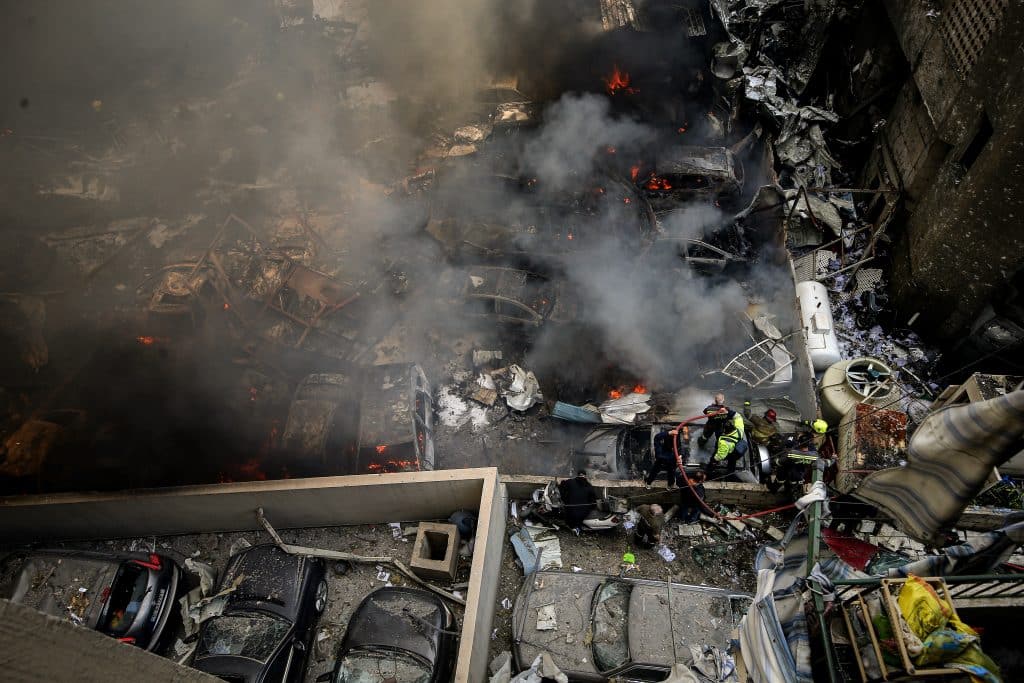
On Thursday, U.S. President Donald Trump announced a ten-day ceasefire between Israel and Hezbollah after speaking to both Israeli Prime Minister Benjamin Netanyahu and Lebanese President Joseph Aoun, inviting both of them to Washington to engage in direct talks.
The announcement marks a watershed moment in Lebanese politics, becoming the first time in which the Lebanese state has apparently agreed to negotiate with Israel directly, itself a violation of the Lebanese constitution, which upholds Israel as an enemy nation. Mondoweiss contributor Craig Mokhiber commented on the prospect of an Israeli-Lebanese rapprochement as a product of “the same toxic alliance between Christian nationalism and Israeli Zionism that has corrupted U.S. politics for decades,” which, he argued, “now appears poised to destroy the 83-year-old experiment that is Lebanese independence.”
Mokhiber warned that the Lebanese government’s bid to enter into “a devil’s pact” with the U.S. and Israel would cleave open sectarian-political rifts that threaten to unravel the very fabric of the Lebanese political order. “Israel is betting it can provoke a civil war, and then sit on the sidelines laughing as Lebanon bleeds,” he wrote.
Underlying Mokhiber’s warning is Israel’s long history of exploiting sectarian tensions within the societies of the region, particularly Lebanon, to advance its own expansionist project. President Aoun represents the Maronite Christian political camp that has historically been at odds with political forces in Lebanon that advocated resistance against Israel, including the Palestine Liberation Organization during the 1980s and Hezbollah over the past several decades.
Today, Israel is demanding that the Lebanese state cede to Israel the right to occupy parts of southern Lebanon, disarm Hezbollah, and sign a peace treaty with Israel. In contrast, the Lebanese government has demanded an Israeli withdrawal from Lebanese territory, but it also agrees that Hezbollah must be disarmed, and that the Lebanese army should have a monopoly over arms.
Currently and historically, Hezbollah and its allies — mostly the left and the Shi’a Muslim political camp — have stood as a bulwark against any kind of diplomatic relations with Israel, while Hezbollah’s opponents, including Christian parties and parliament members, today voice support for the Lebanese government’s earlier decision in March to ban all of Hezbollah’s military activities. Its bitter rhetorical confrontation with Hezbollah has been ongoing for years, reaching its peak when Hezbollah joined the regional fray in the U.S.-Israeli war on Iran. The backlash from this part of Lebanese politics led to accusations that Hezbollah was acting as an agent of Iran, entangling Lebanon in a foreign war. This has only deepened the sectarian rifts that have plagued Lebanese politics for several decades — rifts that Israel has sought to widen for its own benefit for just as long.
Throughout the most recent round of Israeli aggression in Lebanon, the Israeli army sought to drive a wedge between the country’s Shi’a population in Southern Lebanon and the Christian population in the same area. On March 31, the Arabic-language spokesperson for the Israeli army, Avichai Adraee, claimed that Hezbollah fighters had taken the Christian-majority Lebanese village of Qawzah as a base of operations, calling on Lebanese Christians in southern Lebanon to reject the presence of Hezbollah in their villages.
But the Israeli army’s announcements went beyond warning Lebanese Christians against Hezbollah. Local leaders in southern Lebanon villages were quoted by the New York Times and Drop Site News as saying that the Israeli army warned them against harboring any Shi’a Muslim civilians, who form the main popular base from which Hezbollah draws much of its support and membership.
Adraee’s statement and the reported calls to village leaders did not emerge from a vacuum. They were exploiting a status quo that Israel already established in Lebanon during the last round of fighting in October 2024, excepting some Christian-majority villages in the Lebanese south from its bombing and making them into de facto safe zones, while also targeting some Christian-majority areas to which displaced Shi’a civilians had fled.
This status quo was broken in early March when the Israeli army began to strike Christian-majority villages, including them in the displacement orders. In early March, Israeli forces bombed the Lebanese village of Alma al-Shaab, killing the first Lebanese Christian in the current wave of fighting. Shortly after, the UNIFL international peace-keeping forces helped with the evacuation of Alma al-Shaab. Days later, another Israeli strike in the village of Qileah killed Lebanese Catholic priest Pierre al-Raei, while he was helping medics treat the wounded.
Following the strikes, the head of the Lebanese Christian right-wing Phalange party, Sami Gemayel, called upon the Lebanese army to reinforce its presence in Christian-majority villages, claiming that Hezbollah members had taken position in a house in Qileah, which provoked the Israeli strike that killed Father al-Raei.
All of this has proceeded according to an Israeli playbook honed over decades. Its central approach has been to identify sectarian, religious, or ethnic tensions in the region and to work on widening them, selectively arming or supporting one group and pitting it against the other. It has done this in Lebanon, Syria, Palestine, and Iran, pitting Sunnis against Shi’as, Druze against Sunnis, and Christians against Muslims. It goes as far back as the 1980s, though the end of the Lebanese Civil War in 1990 led to a temporary cooling of sectarian tensions.
Now with Israel’s renewed onslaught, Israel will attempt to use the ceasefire announced by Trump to solidify a new status quo: either a long-term military occupation of Southern Lebanon, or the devolving of Lebanon into a civil war.
Here are three times Israel tried to use sectarian tensions in the region to further its colonial interests, from Lebanon to Syria.
The Christian-Muslim divide in the Lebanese Civil War
Sectarianism has been part of Lebanese politics since the country’s founding as a modern state with a confessional political system. When Lebanon gained its independence from France in 1943, its leaders made a verbal agreement called the National Pact, agreeing to distribute the representation of the largest three communities across government positions: the president of the republic was to be Maronite Christian, the Prime Minister a Sunni Muslim, and the parliament speaker a Shiite Muslim.
The problem is that this agreement did not account for the unequal distribution of wealth within Lebanese society, where Muslims were the majority of the marginalized population. This heightened tensions, weakening the state’s central control for 30 years, in its combination of class contradictions and sectarian polarization. These tensions hardened after the 1948 Nakba when Israeli forces conducted limited incursions into Lebanon, continuing into the early 1950s. The Shi’a-majority population in Southern Lebanon bore the brunt of Israeli fire amid the abandonment of the population by the state and other economic elites, who focused on building a Western-like modern image of Lebanon.
Meanwhile, right-wing forces, mainly the Phalange party representing urban Christian commercial elites, began to promote a repressive policy towards the Palestinian refugee population and the left-wing Lebanese movements that sympathized with them. These Left-wing Lebanese movements voiced the plight of disenfranchised Muslim populations, but many of their leaders and members were Christians who supported the Palestinian struggle and opposed sectarian politics. These tensions grew after Palestinian camps in Lebanon became bases for Palestinian cross-border guerrilla operations against Israel, dividing Lebanese politics even further, until politics completely collapsed and civil war broke out in 1975.
During and after the civil war, sectarian divisions in Lebanon reached their peak and became a major fact of life in Lebanon and in Lebanese politics. In 1982, Israel launched its first large-scale invasion of Lebanon, with the explicit goal of pushing Palestinian guerrillas away from the border and creating a buffer zone in the south of Lebanon to secure the northern Israeli towns in the Galilee. However, Israel’s real goals went much further.
Shortly before the invasion, Israel’s then-Defense Minister, Ariel Sharon, secretly visited Lebanon and met the leader of the Lebanese Phalange, Bashir Gemayel, to coordinate action during the war. Both men agreed that Israeli forces would reach the capital, Beirut, and push Palestinian forces out of Lebanon entirely, which would change the political equation in Lebanon in favor of the Phalangists. The Phalange militias, Sharon and Bashir agreed, would act as a spearhead for Israeli ground troops in Palestinian camps and Lebanese towns, and Gemayel committed to signing a peace agreement with Israel if he were elected as president.
Israel had been arming and training Phalange fighters, attempting to influence the balance of forces within the Lebanese civil war for several years already. After invading Lebanon, Israel fought its way to Beirut, besieged the city, and bombed it for three months straight. The siege ended with a U.S.-brokered agreement in which thousands of Palestinian fighters left Lebanon by sea. Bashir Gemayel was also elected president by the Lebanese parliament, whose members were forced to meet in a building under the guise of Israeli tanks to vote him in. But Gemayel was assassinated before he took office, dealing a heavy blow to Israel’s hopes of a friendly government in Lebanon.
At the same time, left-wing Lebanese factions launched their call to armed resistance against Israeli occupation, forming the Lebanese National Resistance Front. Lebanese resistance grew in the following years, in tandem with the ongoing civil war. It was in these circumstances that another group committed to resisting Israeli occupation was also formed: Hezbollah.
Sunni-Shi’a divide after Israel’s withdrawal
After the end of the civil war in 1990, all Lebanese factions that took part in the conflict disarmed, including the leftist parties that formed the Lebanese National Resistance Front against Israel. But Hezbollah, which took shape as a reaction to the Israeli occupation and did not take part in the civil war, kept its arms and adopted the language and slogans of Iran’s Islamic revolution.
Meanwhile, the once-powerful right-wing Christian Phalange lost much of its political influence, and with it some privileges in the Lebanese government, all of which was inherited by a new force: a coalition of elites gathered around the Lebanese, Saudi-nationalized construction and banking tycoon, Rafiq Hariri, whose construction companies won most of the bids for post-civil war reconstruction.
As a Sunni Muslim with close ties to the Saudi royal family and state, Hariri became Lebanon’s new Prime Minister and the face of Saudi influence in the country. Part of the Saudi policy in the region at the time was competing with Iran for regional influence, which gave rise to a nascent form of Sunni-Shi’a sectarianism. The sectarian discourse grew louder after sectarian violence broke out in the U.S.-Occupied Iraq in 2004. Hariri was assassinated in 2005, and Hezbollah and Syria were widely accused of being behind the assassination, implying that they were doing Iran’s bidding in pushing back against the Saudi presence in Lebanon.
The 2005 assassination of Hariri saw a resurgence of Sunni-Shi’a sectarian tensions in Lebanon, which then rose to unprecedented levels after Hezbollah joined the war in Syria in 2012 on the side of the Assad regime against the predominantly Sunni rebel forces. Once more, Hezbollah was accused of being Iran’s agent and of fighting a sectarian war in Syria against Sunnis. In the south, where Lebanese and Syrian borders meet with Israeli-occupied territory in the Golan Heights, Israel exploited this sectarian friction militarily, providing a safe haven for Syrian rebels to move along the border, and even treating some of their wounded in Israeli hospitals. At the same time, Israel began to launch strikes against Hezbollah and the Syrian regime’s targets in all of Syria, using the internal conflict to extend its military influence and challenge Hezbollah’s military presence and activity across Syrian territory.
Muslim-Druze divide after the fall of the Assad regime
After the fall of the al-Assad regime in late 2024, Israel used the attack of the new Syrian government forces on Druze areas in the south of Syria to justify its incursion in the region and occupation of new Syrian territory. In reality, the Israeli incursion in southern Syria served and still serves a strategic function: to cut Hezbollah’s supply lines through Syria and flank the south of Lebanon from the east, as Israel has been trying to do during the current war.
In July of last year, the new Syrian government launched a military campaign in the Druze-majority southern city of Sweida, aiming at disarming the remaining Druze self-defense groups that had formed during the civil war. The Syrian Druze groups had refused to disarm before there was a new constitution in the country that guaranteed their rights. During the campaign, multiple violations of human rights were reported at the hands of Syrian government forces, ranging from humiliation of Druze clerics to arbitrary killings of civilians.
Israel had already used the brief vacuum in government created by the fall of the al-Assad regime to expand its occupation of Syrian territory, reaching an area equivalent to that of the Gaza Strip. This area included the strategic summit of Mount al-Sheikh, where Israeli forces established a permanent military outpost. After the eruption of clashes with Druze groups in Sweida, Israel launched strikes at government buildings in Damascus and on Syrian forces in the south. The Israeli Prime Minister and Defense Minister both stated that these strikes were necessary to protect the Druze community.
This Israeli intervention was meant to have a direct impact on Lebanon. For decades, many Syrian Druze saw their political reference either in the Syrian state, especially those under Israeli occupation in the Golan Heights, or in the secular, predominantly Druze force in Lebanon, known as the Socialist Progressive Party, led by the late historic Druze leader Kamal Jumblat, and his son and successor, Walid Jumblat.
The Jumblat supporters were basically supposed to be put against the wall, and accept Israel’s cover for their community in Syria, pushing them further from Hezbollah and its allies in Lebanon. Although the Jumblat supporters in Sweida refused to ally with Israel, another group appeared in Sweida, led by the Druze cleric Hikmat al-Hajri, who openly requested that Israel intervene militarily to protect Syrian Druzes, dividing the Druze-Syrian community.
What will come of the Lebanon ceasefire?
While it is true that the sectarian divide in Lebanon is the result of unresolved social contradictions in its society — and was not caused by Israel in the first place — one thing is certain: Israel has and will continue to exploit and weaponize this divide. As the ceasefire with Lebanon takes hold, Israel will attempt to capitalize upon the destruction it wrought across the country to push for its endgame: weakening Hezbollah and entrenching Israeli expansionism. And it will use renewed sectarian tensions to achieve these goals.
This brings us back to Craig Mokhiber’s warning of a Lebanese-Israeli deal. Although Israel was reportedly “coerced” by Trump to cease firing upon Hezbollah, since Netanyahu was already being lambasted for allowing the ceasefire with Iran to happen, the prospect of direct negotiations between the Lebanese President and the Israeli Prime Minister would form a turning point in the Lebanese political map.
Israel will continue to attempt to exploit the sectarian tensions and to use the U.S.-brokered ceasefire to push President Aoun to take belligerent action against Hezbollah. It will be under the banner of disarmament and the state’s monopoly over arms. Netanyahu likely knows that this would not result in Hezbollah disarming, but it may be enough to reignite the fires of a civil war that had been lying dormant since 1990.
Israel will not remain a neutral observer in the ensuing chaos. It would continue to aid the Lebanese forces willing to continue escalating against Hezbollah, whether covertly or overtly. Netanyahu will attempt to condition any withdrawal on Hezbollah’s disarmament, knowing the likelihood of success is slim. In either scenario, it would be a boon for Netanyahu: if Hezbollah is disarmed, he would be able to take credit for decisively defeating a formidable foe, and if it isn’t, Israel will continue to occupy the south, calling it a “buffer zone” for security purposes. In reality, it would further entrench Israeli territorial expansionism and the vision for “Greater Israel.”
And for Lebanon, it would herald a return to the period of direct Lebanese collaboration with Israel’s occupation of the south.
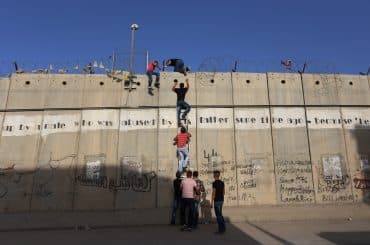

The situation is further complicated by the fact that there is a growing movement in Israel to settle parts of Lebanon:
Support for Settlement of Lebanon Goes Mainstream in Israel…What was once a fringe curiosity is now an organized movement with broad governmental and public support….That idea is now a “broad and troubling consensus” in Israel, as the journalist Moshe Gilad wrote in Haaretz on April 9th. In early March, soon after Hezbollah launched attacks on Israel in response to the joint US and Israel war on Iran, Israeli public figures began calling for the occupation and depopulation of southern Lebanon—a claim repeated again and again by mainstream Israeli media personalities. Retired military leaders and politicians also voiced their support, and members of Knesset soon joined the call for occupation.
Support for Settlement of Lebanon Goes Mainstream in Israel
“I Want to Occupy”: Inside the Israeli Movement Pushing to Raze and Settle Southern Lebanon
“I Want to Occupy”: Israelis Push to Settle Southern Lebanon
‘The Nakba is being recreated’: The Israeli obsession with Lebanon’s Litani River
‘The Nakba is being recreated’: The Israeli obsession with Lebanon’s Litani River
The idea that Trump or the UN has the authority to order a belligerent community that has been subjected to several generations of ethnic cleansing, and a series of foreign invasions, military occupations, and genocidal armed conflicts from British, French, American, Fascist Phalangist, and Druze Militias to unilaterally disarm themselves is simply ludicrous. The UN Security Council had no power to prevent Kosovo from unilaterally declaring its independence. Judge Lauterpacht was correct that it had no authority to impose an arms embargo against a defenseless region during an attempted genocide. If Trump is prohibited from doing that under our own Constitution here in the USA, then nothing in the UN Charter empowers him to do that in Gaza, occupied Lebanon, or Iran. I agree that Iran has no right to unilaterally impose blockades and sanctions, but the USA and Israel have no right to unilaterally violate the NPT themselves, conduct wars of aggression, and impose illegal trade sanctions that prevent Iranians from engaging in normal relations with other UN member states. Two wrongs don’t make a right. The international community will have to exercise universal jurisdiction, or standby and watch this escalate into a world war, economic collapse, and famine for much of the planet.
Who is making billions off of this war? Witkoff and Kushner’s involvement being questioned on all media outlets that I am listening to. PBS, BBC, MSNBC, CNN etc…lots of people bringing up asking why are these real estate developers, private equity investors pretending to be peace negotiators and why are so many allowing them to get away with it?
https://www.ft.com/content/5449419d-aa3f-4ca7-99a7-9215dc80d401?syn-25a6b1a6=1
More and more host on mainstream media host asking why are Witkoff and Kushner involved?
https://www.google.com/search?q=why+are+kushner+and+witkoff+involved+with+negotiations&rlz=1CALBTX_enUS1211&oq=why+are+kushner+and+witkoff+involved+with+negotiations&gs_lcrp=EgZjaHJvbWUyBggAEEUYOdIBCTE5MDQxajBqMagCALACAQ&sourceid=chrome&ie=UTF-8#fpstate=ive&vld=cid:87c3ff32,vid:nr1EBjavr3o,st:0