
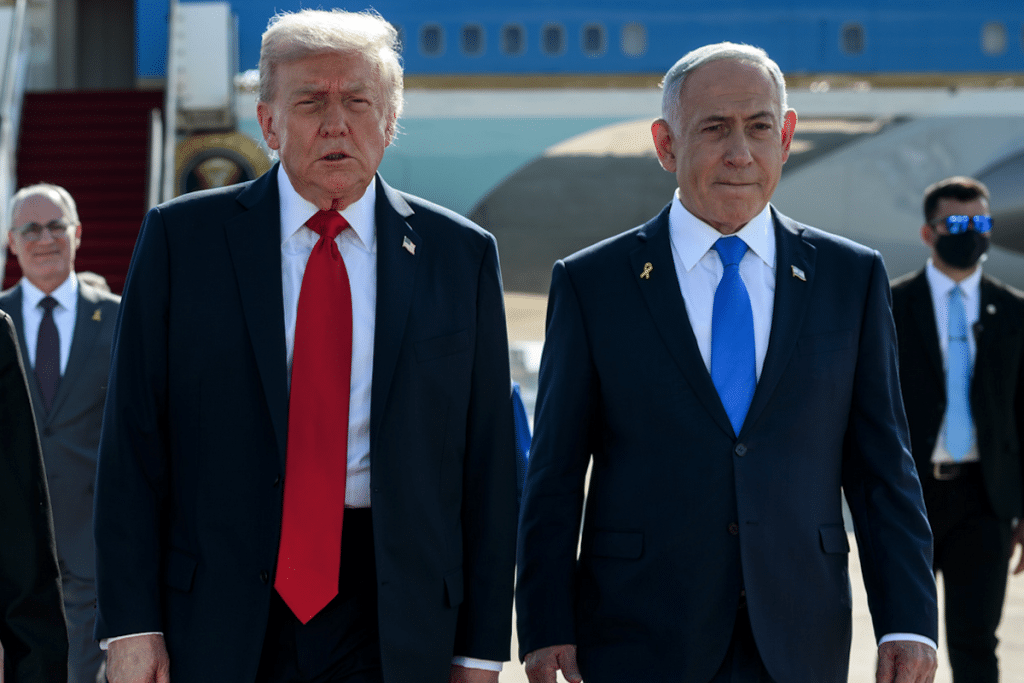
Donald Trump backed away from his apocalyptic threat on Tuesday, declaring his agreement to a ceasefire with Iran instead of following through with committing the greatest act of genocide in history.
We can all be glad he made that decision. But he didn’t leave us in a stable place from which we can expect rapid progress and de-escalation. Instead, we have a ceasefire that is incredibly fragile, and many ways it can be blown up, literally and figuratively.
Still, there is some reason for hope, if we look hard enough.
What are the terms of this ceasefire?
As always when dealing with Trump, much is unclear, and messages have been contradictory.
The most positive, and quite surprising, signal Trump sent in his announcement of the ceasefire was his statement that “We received a 10 point proposal from Iran, and believe it is a workable basis on which to negotiate.”
But Trump soon mitigated that by directly contradicting some of the ten points in the Iranian proposal and by stating the next morning that, “Many of the 15 points have already been been (sic) agreed to,” referencing his own plan, which Iran had already rejected as maximalist and unacceptable.
Trump also said that the ceasefire meant the Strait of Hormuz would be completely open to the free flow of sea traffic. Iran differs, with its foreign minister Abbas Araghchi stating that, “For a period of two weeks, safe passage through the Strait of Hormuz will be possible via coordination with Iran’s Armed Forces and with due consideration of technical limitations.”
That’s a pretty big gap that can be expected to quickly lead to anger and hostilities.
And then there’s Lebanon.
In announcing the ceasefire, Pakistan’s Prime Minister Shehbaz Sherif said that the truce extends “everywhere including Lebanon and elsewhere.”
Yet Israeli PM Benjamin Netanyahu immediately declared that the ceasefire did not include Lebanon. To underscore his message, Israel embarked on a wave of massacres in Lebanon, bombing without even the pretense of targeting “terrorists,” as it has in the past.
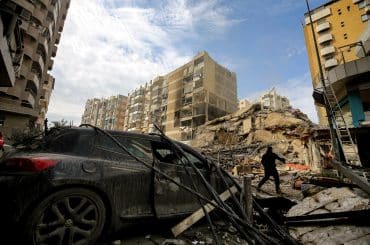
At this writing, Lebanon reports at least 254 dead and over 1,165 wounded in Israeli attacks, the most intense since the war started. Those figures will surely rise as attacks are ongoing.
Western leaders have called for the ceasefire to be implemented in Lebanon, albeit in relatively weak language. But those Western leaders did not include Trump, who called Israel’s invasion of Lebanon a “skirmish” and flatly stated that this was not included in the ceasefire deal.
None of this bodes well for this ceasefire. The hope lies in Trump’s own inconsistency. The irregular and unpredictable connection between what he says and what he does can, on occasion, lead to a relatively positive outcome, as it did when he backed off from his threat on Tuesday. But more often it leads to more rash, reckless, and deadly decisions.
What is Iran’s 10-Point Proposal?
Reportedly, these are the ten points in Iran’s proposal:
1. U.S. commitment to ensure no further acts of aggression;
2. Continued Iranian control of the Strait of Hormuz;
3. Acceptance of Iran’s nuclear enrichment rights;
4. Lifting of all primary sanctions;
5. Lifting of all secondary sanctions;
6. Termination of all United Nations Security Council resolutions against Iran;
7. Termination of all International Atomic Energy Agency Board of Governors resolutions against Iran;
8. Payment of damages to Iran for loss in the war;
9. Withdrawal of U.S. combat forces from the region;
10. Cessation of hostilities on all fronts, including Lebanon.
It should be stressed that Trump’s acknowledgment of these points as a basis for talks doesn’t mean he accepts any of them, in part or whole. Still, it is remarkable that a document that includes recognition of Iran’s right to enrich uranium and the withdrawal of all U.S. combat forces from the region was accepted as a basis for talks by the U.S. president.
In fact, that acceptance is an admission by Trump that he is defeated, whether he acknowledges it or not. Before the war, there was no serious discussion of removing American troops and, more pointedly, Iran had already signaled willingness to agree to highly intrusive nuclear inspections and to refrain from stockpiling any enriched uranium at all.
Now, Trump is negotiating Iran’s right to enrich uranium and scrambling to contain the loss in the Strait of Hormuz.
Iran has been forced out of major Asian and European oil markets by years of U.S. and UN sanctions. Control of the Strait will give it the leverage it didn’t have before to regain access to those markets and to have sanctions removed. Whether a fee structure for passage is part of the new reality or not, Iran now has a level of control over the Strait it didn’t have before.
But Iran needs to be mindful about overplaying its hand. It should not be lost on Iran that, despite the fact that the U.S. and Israel launched an illegal sneak attack, most governments around the world still directed their ire at Iran while the fighting raged. Even relatively friendly countries like China and Russia (which both vetoed a resolution at the UN Security Council, they judged as biased against Iran) did little to support Iran.
Of course, that was due in great measure to the tactics Iran was forced to use in attacking Gulf countries and closing the Strait of Hormuz. Still, Iran needs to be mindful that the world is not sympathetic to the tactics it used in this war.
So overreach is a real danger. If Iran really wants to pursue the departure of American forces from the region, it would have a tough time selling that if Gulf states object. Iran could achieve that goal through a regional defense and peace agreement, but that would take many years to achieve. Trying to do it now would fail and could lead to a breakdown in talks on the war.
Similarly, some have interpreted Sherif’s statement that the ceasefire applies “everywhere including Lebanon and elsewhere,” to include Gaza as well. But there has been no specific mention of Gaza or Palestine in subsequent comments from any side, including Iran. Most likely, even Iran has concluded that matters are sufficiently complicated with Lebanon and the Red Sea area that they don’t want to bring Gaza in at this stage. Again, that probably means pushing that issue down the road, but they are surely aware that insisting on the ceasefire, including Gaza and even the West Bank, would almost certainly lead to the collapse of the ceasefire.
As so often is the case, the Palestinians are forced to endure and wait.
The dangers to the ceasefire
Democratic Congress member Yassamin Ansari of Arizona wisely wrote on X: “I do not appreciate anyone – Democrat or Republican – taking this moment to make TACO jokes to say Trump ‘chickened out.’ The president was threatening genocide against 90 million Iranians. I’m grateful there’s a ceasefire & scores of innocent people didn’t die tonight.”
Ansari nailed the biggest danger to the ceasefire. Circumstances make it very fragile, but it is Trump’s childlike ego that makes it unstable.
Trump calls this ceasefire a “total and complete victory,” and it’s easy to see how far that is from the truth. In fact, he wasn’t just defeated, he was humiliated. This is a major strategic loss for the United States.
J Street Policy Officer and former senior official in both the Defense and State Departments Ilan Goldenberg did a good job summing up the “total strategic disaster.”
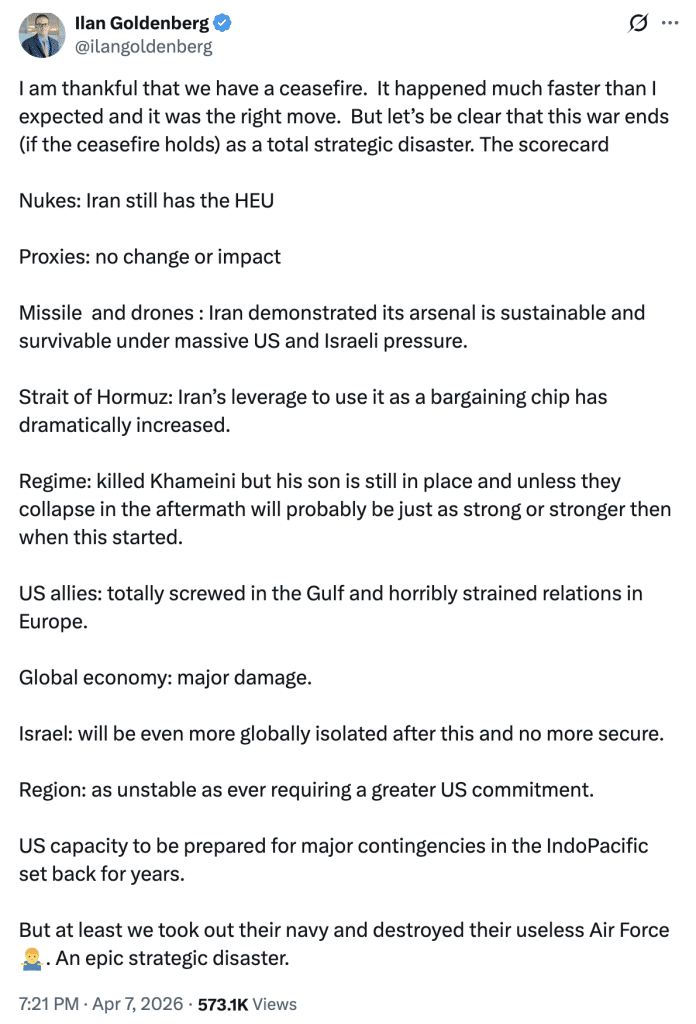
He’s got it right. This was a humiliation for Trump, a man who is terrified of being humiliated beyond all else. Zeteo political correspondent Asawin Suebsaeng reported that he was told directly by a senior administration official that they were going to try to filter the reactions Trump was hearing to the capitulation to Iran lest he reverse course.
Some of what Goldenberg lists might be mitigated in talks over the next two weeks, but it is far more likely that between Trump’s humiliation and the already apparent contradictions between what each side is saying they agreed to, the talks won’t ever get that far.
And, then, of course, there’s Israel.
Netanyahu’s defeat is even greater than Trump’s
Regardless of what he says publicly, few world leaders read the realities like Netanyahu. He knows very well that this was a resounding defeat. And the Israeli people know it too.
The Islamic Republic remains intact and has emerged battered but actually in a stronger political and diplomatic position.
Iran’s leverage with the Strait of Hormuz makes it a regional power much more than it has ever been. As angry as most of the Gulf Arab states are with Iran, they now know they will have to work out an accommodation between them. Not only has the United States shown that, regardless of how much money they pump into the American economy, the U.S. government will not protect them as it will protect Israel. And, even if it tried to do so, Iran’s capabilities would overcome it.
Israel, for all its military might and all its ability to cause terrible destruction, is unable to impose its will on Iran. Indeed, despite a genocide that ranks as one of the great crimes in living memory, Israel has proven unable to eliminate even so poorly armed a force as Hamas and continues to suffer from its inability to contain Hezbollah.
Worse, as much as the genocide downgraded Israel’s status in the United States and the rest of the world, this war has utterly destroyed Israel’s place in American politics. Pro-Israel groups may still be able to gather donors to influence elected officials, but this was never their most powerful tool. Israel’s image as an ally, a western-style state, and as an American “outpost” in the Middle East was the key.
That is gone now. Israel is recognized by more Americans than ever as the apartheid state that it is. It is blamed for the genocide it carried out with American support. And now, it is seen as having dragged the U.S. into a war that has badly damaged American interests.
Netanyahu reacted as he typically does: by launching a ferocious assault on civilians, this time in Lebanon. Opposition leader Yair Lapid blasted Netanyahu when the ceasefire was announced: “There has never been such a political disaster in all of our history. Israel wasn’t even at the table when decisions were made concerning the core of our national security… Netanyahu failed politically, failed strategically, and didn’t meet a single one of the goals that he himself set. It will take us years to repair the political and strategic damage that Netanyahu wrought due to arrogance, negligence, and a lack of strategic planning.”
According to a Pew poll released just before the ceasefire was announced and conducted at the end of March, 60% of Americans now view Israel negatively, compared with just 37% holding a positive view. That is a stunning reversal, and yet, if anything, one is forced to wonder how even 37% of Americans could still see Israel positively.
Netanyahu will be forced to work feverishly to rekindle the flame of this war. But regardless of how it ends, Israel’s tactical position has been irretrievably degraded.
Will the war end?
It’s clear that the odds against this ceasefire holding are high. But there is some reason for hope.
Trump accepted this ceasefire, knowing that it meant accepting defeat, because the other options were worse. He made an apocalyptic bluff and Iran called that bluff. There was never any chance that this war could bring anything positive in terms of America’s perceived self-interest. That’s truer than ever before. Trump has every reason to want to end this war.
Iran holds the cards for dictating a practical peace. Its control of the Strait of Hormuz is its path to ensuring, as much as such things can be ensured, that the U.S. and Israel don’t do this again. Its demonstration of the damage it can cause to its neighbors will give the Gulf states every reason to repair relations with Iran once their understandable rage at having been attacked dies down.
Iran’s position hasn’t changed: it does not need to end the war on unfavorable terms, but it must also recognize that, as strong as its position is, it will need to find what compromises are acceptable to it in order to get a resolution that allows it to rebuild its economy and end sanctions.
Only the Israeli government is incentivized to continue this war. None of its objectives have been met. Its position is considerably weaker than it was before the war. Its response to the ceasefire of massacring scores of Lebanese civilians and its ongoing genocide in Gaza are only driving it deeper into global isolation.
In reality, Israel as a country and Israelis as people are served terribly by continuing this war. But the Israeli government thrives on the insecurity of its own people and aggression toward others. One can hope that more Israelis realize that. But in the meantime, if there is to be a durable end to this war, it will be up to the United States to rein Israel in, something it has been more reluctant to do in the past decade than ever before.
French general Michel Yakovleff recently cited a principle he said he learned at the U.S. Army War College: “You don’t reinforce failure. You move on. You find something else.”
How many times has Israel invaded Lebanon and blitzed Gaza? Has Israel removed the “security” threats therein or reinforced them?