

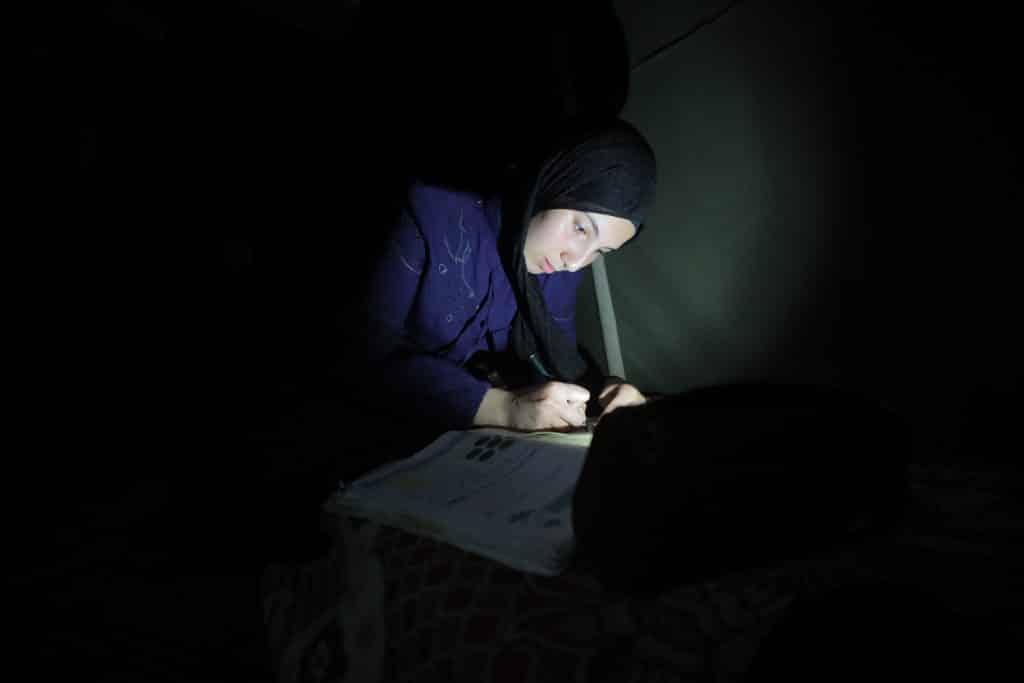
Sumaya Abdel Rahman finished her General Secondary Education Exams one year before the genocide; her younger sister, Dima, started her exams on June 20 this year. Between the two sisters, sharing a tent in Gaza City, the distance could not be greater: one crossed this milestone in a world that still had some semblance of normalcy, and the other is navigating it amid continued food shortages and a stifling blockade.
Memories of Sumaya’s year now seem distant. Life under siege in her time was not easy, but it was still better than “living in tents and experiencing a famine.”
“Watching my sister Dima prepare for the exams fills me with sadness,” Sumaya said. She recalls how their mother used to prepare special foods — honey, nuts, fruit, meals believed to sharpen concentration and memory. “Now Dima often studies while hungry, and she went to her first exam hungry as well.”
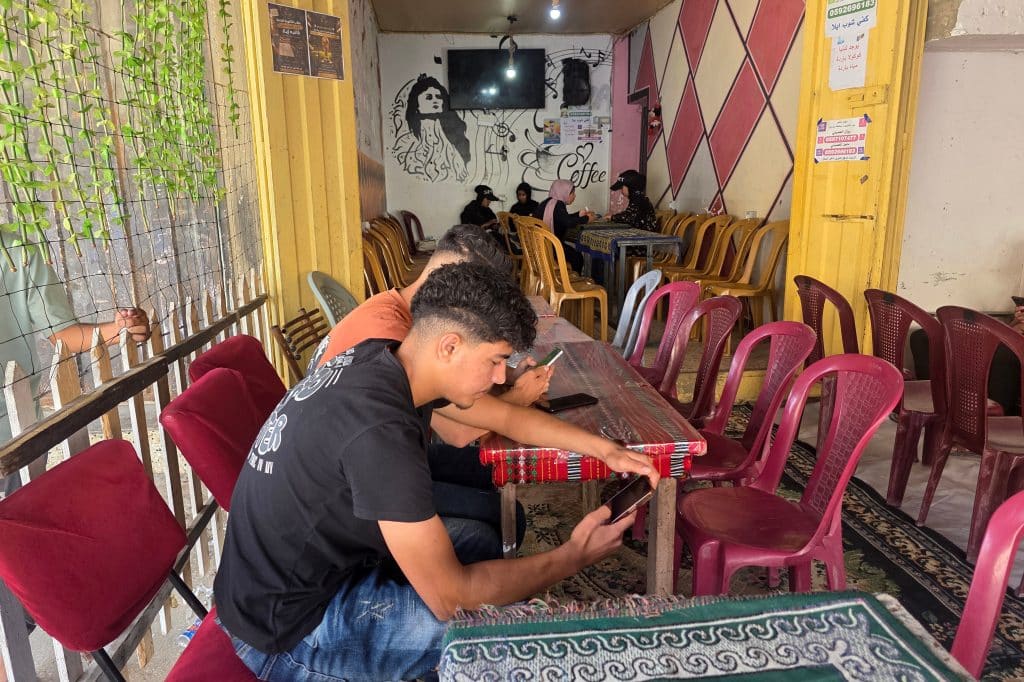
The General Secondary Education Examination, commonly known as “Tawjihi” in Palestine and Jordan, has been conducted online in Gaza for the third consecutive school year, amid the near-total absence of a functioning educational system in the Strip. There are no traditional desks or classrooms, no answer sheets or exam booklets. Instead, students gather in cafes and other locations where electricity and internet access are available, sitting shoulder to shoulder as they complete their exams.
‘I study on the sand’
Dima does not have a quiet room. She has a mattress on the ground inside a tent in Gaza City, no private space of her own, and nowhere to store her textbooks, pens, or school supplies. Several younger siblings share the same tent.
Before the genocide, Tawjihi was inseparable from the atmosphere families created around it. Students were surrounded by care and encouragement throughout the academic year, then sat for exams in unfamiliar schools under strict supervision. Exam papers arrived sealed from the Ministry of Education, sometimes guarded by police in the minutes before the test, while ministry officials inspected the examination halls.
For decades, the Tawjihi has been one of the most significant milestones in Gaza’s social life, carrying rituals, expectations, and preparations unlike anything in the previous twelve years of schooling. Results were announced on local radio, in newspapers, and on online platforms, and a student’s final score determined their academic future and the university majors open to them.
Accordingly, they were given special treatment at home. The family’s guest room would be theirs, along with all the amenities and family support that came with it. Their mothers would cook them special meals, and the whole family would be on hand to provide any support needed.
In short, nothing like today. A proper chair, a desk or table, a reading lamp — let alone an entire room — are now luxuries unavailable to families living in tents.

In previous years, Sumaya’s family did everything possible to provide comfort and support for her during her Tawjihi exams. But for her sister Dima, she is navigating the same academic milestone under entirely different circumstances.
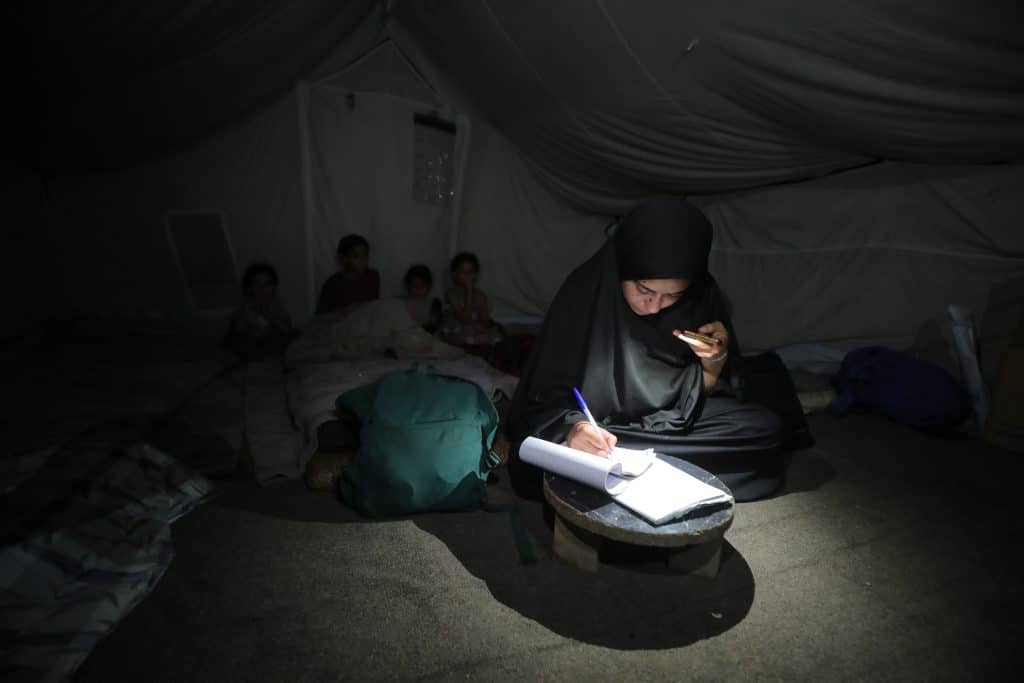
“I don’t have a chair to sit on while studying,” Dima said. “I spend all my time on the same mattress I sleep on. It rests directly on the sand. I sit there for long hours during the day, or at night whenever there is light, no matter how dim, and I keep studying.”
When her sister was preparing for her exams, their father had rigged up a battery-powered lighting system so she could study through the night. “That is no longer possible,” Dima said. “If my family could provide it, they would not hesitate. The circumstances are simply different. Yet the expectations placed on me are exactly the same as before: to excel and achieve high grades.”
“I study on the sand,” she said. “I study while hungry. I study standing up. I study surrounded by the noise of my younger siblings, whom I cannot ask to be quiet, because we are all living in a small tent.”
A message of perseverance
According to the Gaza Government Media Office, 95% of Gaza’s schools were damaged by Israel’s two years of relentless bombardment. Over 90% need essential reconstruction. Of them, 668 were directly bombed. Between them, virtually none of Gaza’s educational infrastructure has survived intact.
Despite this, Palestinians insist on taking the exams. Dr. Ibrahim Ramadan, director of the Khan Younis Directorate of Education, says around 35,000 students are sitting for the exams inside Gaza, while another 2,000 Gazan students are taking them abroad, out of approximately 89,000 students across Palestine.
“The Palestinian people believe in education and defend their right to it, because education is a matter of life and survival,” he told Mondoweiss. “The occupation may destroy buildings and institutions, but it cannot destroy the will to learn. Universities can be burned, and schools demolished, but the right of Palestinians to build their future through education cannot be eliminated.”
The Ministry of Education has adapted by expanding electronic testing through its Wise School platform, an app that students download on their phones, using the number the Ministry of Education provides with each student to log in and start their examinations.
Yet when you speak with students, their conversations revolve less around exams and more around daily hardship.
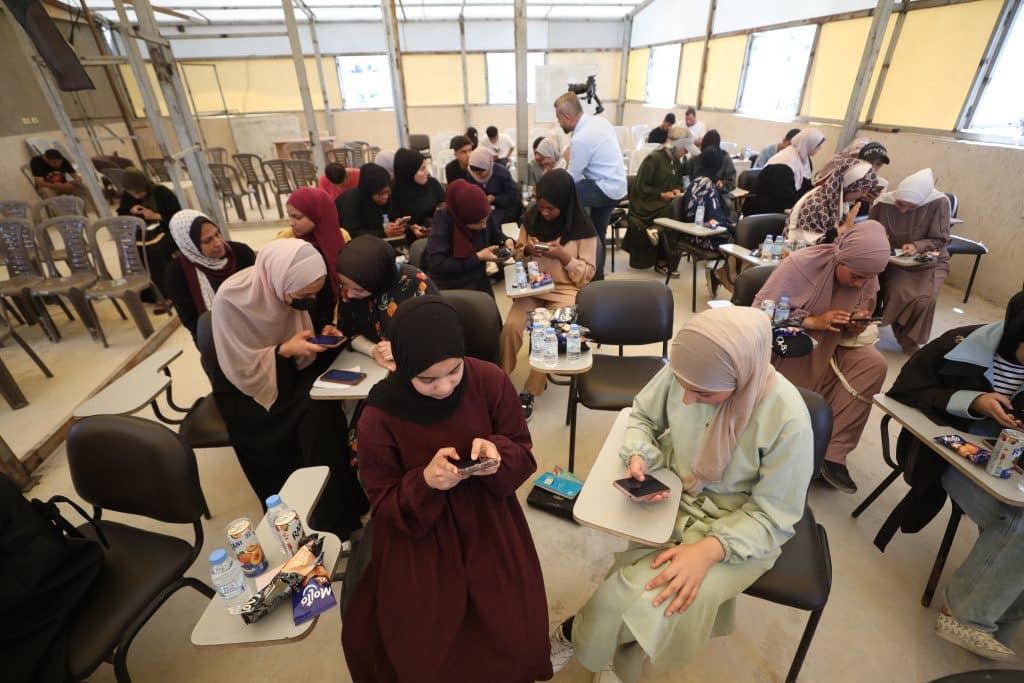
Rola Tubaisi, a student from Khan Younis, came to a cafe to sit for her exams because it had electricity and internet access. She spent the entire school year surrounded by loss, darkness, and displacement, but remained determined to continue.
Like many students, Tubaisi depends on such places because Gaza has had no stable power supply since the genocide began in October 2023. The few locations that still have electricity run largely on solar power. Internet access, phone charging, and basic electrical services often require payment. Educational materials are almost entirely online, forcing students to rely on phones or laptops that need regular charging. Some students don’t even have these devices.
“We struggle to find light from a flashlight,” Tubaisi said. “Having a charged phone or even access to a computer is another challenge. Life in a tent takes away privacy, quiet, and a proper study environment. There are no desks, no organized bookshelves, and no real silence. Every tent adjoins the other, and the noise never stops.”
In the West Bank and Gaza, Tawjihi examinations typically begin in mid-June, with results announced in late July. Before the war, the day’s result transformed Gaza into a scene of celebration. Fireworks light the sky, celebratory gunfire echoes through the streets, sweets are distributed, and families host gatherings. Perhaps most ubiquitous are the ululations that fill neighborhoods, usually reserved for weddings.
But when death stalks you at every corner, talk of these celebrations is akin to a foreign language, Sujood Adnan, a student living in a displacement camp in the al-Mawasi area of Khan Younis, said. “How can anyone feel safe enough to study or focus on the future when death is always a possibility?” she asked. “Shells fall near tents. There is screaming at night. We face hunger, fear, displacement, and death. We study under poor lighting and have faced untold difficulties, but we keep going.”
She insisted that neither war nor hardship would stop students from pursuing their ambitions. “We seek success in any environment and under any circumstance,” she said. “No obstacle will stop our dreams or our efforts to help ourselves and our society. We want to build our homeland and live in freedom and peace. Despite everything being done to prevent us from achieving that, we will continue.”
Tareq S. Hajjaj
Tareq S. Hajjaj is the Gaza Correspondent for Mondoweiss and a member of the Palestinian Writers Union. Follow him on Twitter/X at @Tareqshajjaj.


I used to roll my eyes at almost every New York Times article on Israel. I still have complaints about their reporting, but I no longer roll my eyes: this piece on life in Gaza from last Sunday’s magazine section of the NYT is one of the finest pieces of journalism I’ve seen on the ‘conflict’, I believe it will win a Pulitzer. You can’t read this without thinking that Israel is simply trying to kill every Palestinian it sees:
“The Cost of Survival in Gaza”
Why It Cost This Man $250,000 to Help His Family Survive in Gaza – The New York Times
Thanks as ever, Tareq. These stories of the struggles of Palestinians to even try to do things we take for granted are as valuable as any news report.