

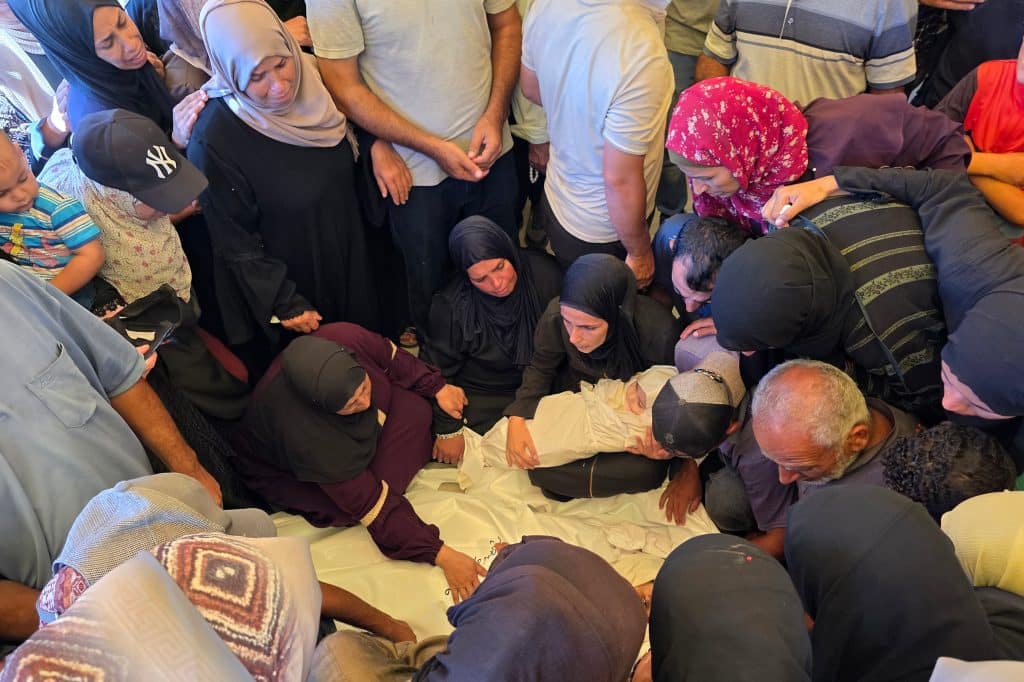
This week, I spent an entire day listening to interviews. Some were phone conversations I had. Others were recordings sent to me by colleagues still reporting from inside Gaza.
I was working on the story of a 23-year-old mother who was killed while carrying her one-year-old daughter as they fled for what they hoped would be safety. Neither survived.
A photograph of her little girl circulated online. It was almost impossible to look at. Her tiny body lay on a hospital bed, seemingly untouched, only to give way to the horrifying image of her skull split open, her brain exposed.
There was no photograph of the mother except the one taken after death, wrapped in a white burial shroud. Witnesses described how the strike had torn her body in half.
As I pieced together the story, I listened to testimony after testimony: the young woman’s mother, her sister, her husband, humanitarian workers, neighbors, and witnesses to the strike.
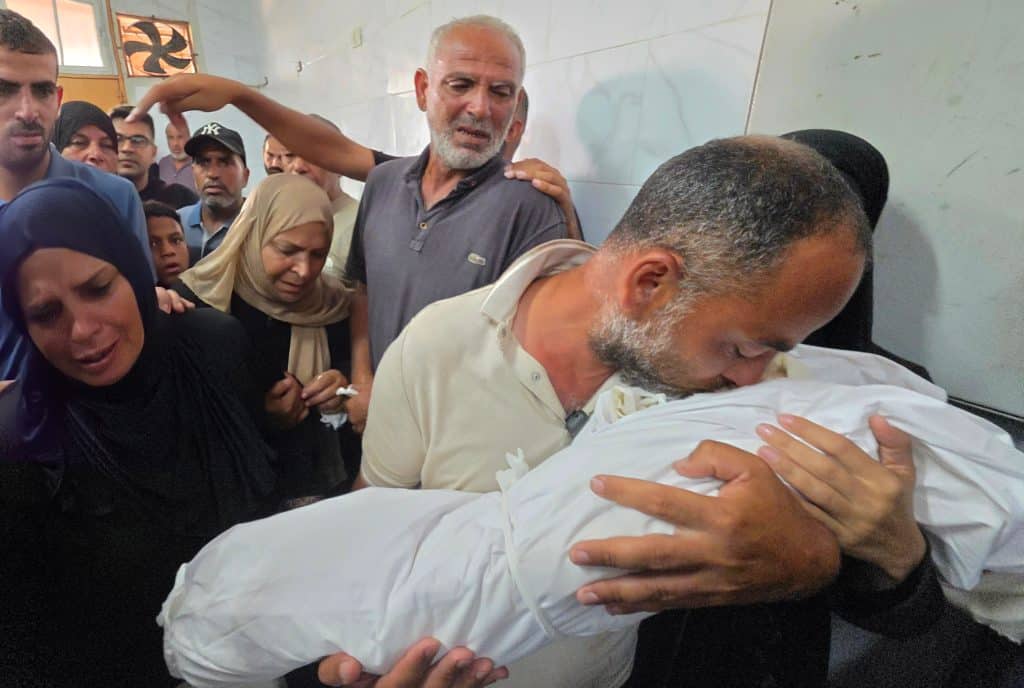
But it was her mother’s voice that stayed with me.
She began calmly. She described how the Israeli military had ordered residents to evacuate and then bombed the place before the family had time to escape. She spoke with remarkable composure right up until she began talking about her daughter. About how young she was. About a life that had barely begun. About losing loved ones, one after another.
“They took everyone we love from us. No one’s led,” she said, her voice breaking before disappearing beneath uncontrollable sobs.
In that moment, there were only two of us.
She stood amid the ruins of Gaza, surrounded by mourners, smoke, shattered buildings, and the unmistakable presence of death.
I sat hundreds of miles away, in the quiet safety of exile, staring at a screen and searching for words capable of carrying the weight of her grief.
I wanted to write her story. Instead, I found myself crying with her. I stepped away from my desk and stood by the window, looking out over a peaceful city that has become my safe haven. I watched ordinary life continue outside while, on my screen, another family had just been destroyed.
I could not stop crying. For nearly three years of genocide, I have reported on Gaza for Mondoweiss. I have written about families erased from civil records, children buried before learning to speak, parents searching through rubble for their sons and daughters.
I have documented loss so relentlessly that I sometimes wonder where all that grief goes.
Perhaps it never disappears.
Perhaps every interview, every funeral, every photograph settles quietly somewhere inside us until one story unlocks everything that came before it.
Yesterday, that mother’s tears unlocked mine.
They carried me back to the months I spent inside Gaza during the war — to saying goodbye to my own mother, to watching families bombed, to seeing my siblings wounded, and to living every day consumed by one thought: how to keep the people I love alive.
Standing at that window, I found myself asking a question I had never asked so plainly before: What profession carries more sorrow than being a Palestinian journalist telling the stories of Palestinians in Gaza?
The stories are never distant. They belong to people we know. People whose names, faces, and memories are inseparable from our own.
Then another question emerged. What profession demands greater resilience?
Eventually, grief must become something else. For us, it becomes words.
Words are the only instrument we possess. They preserve memory when others seek to erase it. They restore dignity to those reduced to statistics. They challenge silence. They outlive bombs.
In an age when truth itself is increasingly contested, our responsibility is not simply to report facts, but to protect them.
That is why we continue.
Not because we are untouched by what we witness, but because we are. Because telling these stories is both our profession and our promise. A promise to those still living through the unimaginable that their voices will travel beyond the siege.
When people in Gaza speak to us, they are rarely speaking only to a journalist.
They are entrusting someone with the weight of their memory, asking them to convey it honestly. For them, talking about their grief is enough; for us, it’s turning their grief into words you can feel.
Tareq S. Hajjaj
Tareq S. Hajjaj is the Gaza Correspondent for Mondoweiss and a member of the Palestinian Writers Union. Follow him on Twitter/X at @Tareqshajjaj.
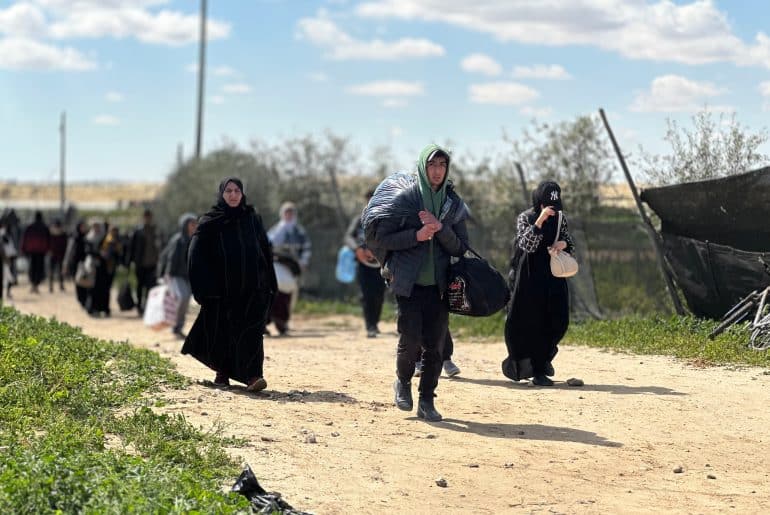
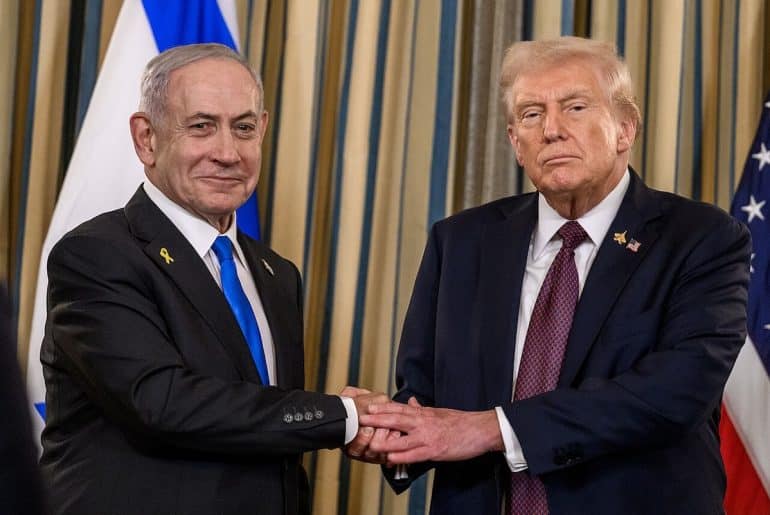
There are many thousands of workers in Western weapons factories, many of them here in the UK. Every working day they turn up to help the US and Israel to violently abuse the bodies of children in Palestine and elsewhere. Ask those workers if they approve of child abuse and of course they will say they do not. Their actions tell us that, when it comes to their well-paid careers and so long as the victims are not their own kids, those workers are entirely content to assist in child abuse. This has been the case since the 19th century but only in recent times has it become impossible for such workers to say they didn’t know what the weapons they produce were being used to do against children.
This is what a sick society looks like.