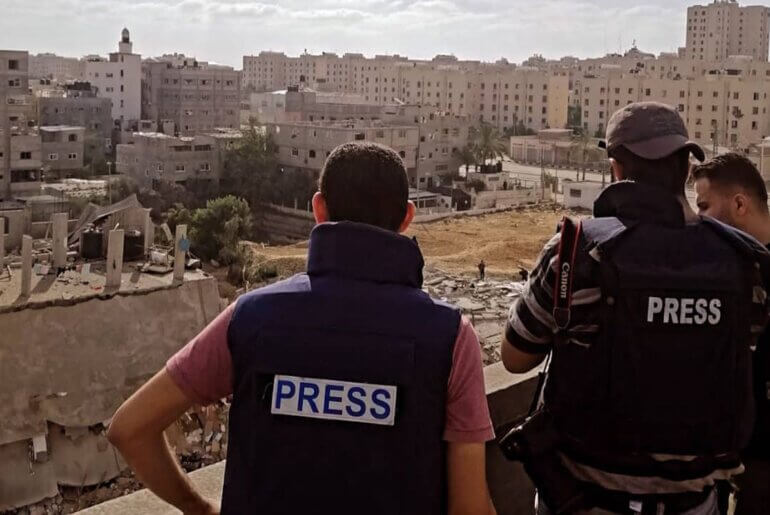
As a journalist from Gaza, I know that there are some things a camera, or a single story, cannot capture. This truth is evident now more than ever in Gaza, where my colleagues and I struggle to capture the slow transformation of ordinary life and how war reshapes the imagination of an entire generation.
In my work, I have been faced with a grim realization about our future generation of Gazan children. After years of genocide, Palestinian children in Gaza no longer dream of becoming doctors or teachers — they dream of working at a food kitchen, handing out aid parcels, or running a school-turned-shelter. Their ambitions have been rewritten by genocide, but they haven’t disappeared.
I remember the school I attended in Gaza. It was a large complex with different spaces: a football field, a basketball court, sandy playgrounds, and trees scattered around the grounds. The classrooms were spacious, their walls covered with educational materials that students spent weeks preparing.
I remember the science laboratories, too. As children in elementary school, we would sometimes compete to catch a bee and bring it into the laboratory. Our teacher would place it under a microscope, and we would watch it enlarged before our eyes.
Every child who attended a school in Gaza probably remembers something similar: a small bean plant we grew in a plastic cup and placed on the classroom windowsill, where it could catch the sunlight. Once it sprouted, some of us would move it outside, to a space behind the classrooms where green trees grew. These were lessons and experiments we had the space to experience.
These are not extraordinary memories, but that’s why they matter so much now. Because when I see children today attending what is called a school — though it’s actually just a collection of tents — I understand what has actually befallen the place where I spent my entire life.
The children now sit on the ground. Some sit on pieces of cloth or plastic sheeting. In front of some of them are stones supporting a piece of cardboard, with a notebook and a pen placed on top. There is no playground, no laboratory, no trees — just sand, rubble, and tents.
This is where the deeper dimensions of the genocide begin to emerge. The destruction is not limited to homes, buildings, or individual lives, but into an entire way of life. It reaches into the smallest structures that make a society feel like a society: the routines, relationships, and shared spaces that give people a sense of security and belonging.
When a tent becomes a home, displacement becomes a new normal to which people become acclimated, and the temporary becomes permanent. That condition can begin to pass from one generation to the next.
A child born after October 2023, or one who spent their formative years growing up in the shadow of genocide, may never know what existed before it. They may never know that a school was once a place to learn, instead of another site of displacement.
And that is already happening. Poverty, hunger, theft, crime, the proliferation of weapons, and the normalization of death are part of the fabric of everyday life. It leaves a society in which almost everyone has experienced loss, where few families have emerged untouched.
But perhaps one of the most devastating indicators of what has been destroyed is the way the war has altered children’s dreams. During an interview in an educational tent, my colleague asked the children a familiar question: “What do you want to be when you grow up?”
The children were sitting on the hard ground, on pieces of cloth or plastic, inside an open-sided tent. There were no educational posters on the walls, no drawings, no colorful displays made by students. There was only the physical space of displacement and the hopes, both small and enormous, carried by the children themselves.
A first-grade boy said he wanted to become someone who works at a “takiyya,” a communal kitchen or food distribution point, because it would give them easier access to meals.
One girl says she wants to become a humanitarian volunteer. A boy says he wants to distribute food parcels. Another girl says she wants to become the director of a school-turned-shelter, not simply a school principal.
Despite the occupation’s enormous effort to eliminate successive generations of Palestinians, it continues to fail in achieving the total submission it seeks. The bet is that generations raised in deprivation, in conditions approaching less than nothing, will eventually break.
But they do not break completely. They change. Their dreams change. Their language changes. Their understanding of the world changes. Yet they continue to produce new forms of consciousness.
Even under the harshest conditions, even when people are systematically deprived of food, water, safety, education, and the basic conditions necessary for a dignified life, they continue to survive. They continue to rebuild themselves. They continue to resist becoming entirely what the occupier wants them to become.
Look closely at the dreams of these children, and you can still find a desire to change their reality. Their dreams may have been shaped by war, and they may look radically different from the dreams of those of us who knew Gaza before the genocide. But they still contain a desire to create something different.
Tareq S. Hajjaj
Tareq S. Hajjaj is the Gaza Correspondent for Mondoweiss and a member of the Palestinian Writers Union. Follow him on Twitter/X at @Tareqshajjaj.