

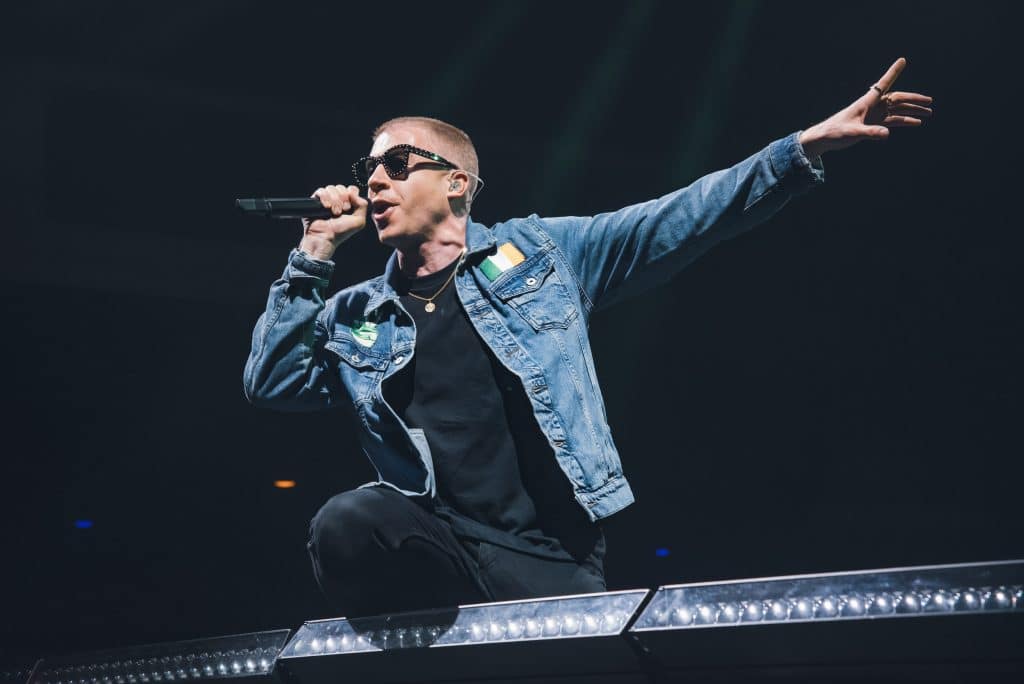
Ed Sheeran thought he was taking the safe route. Prioritizing personal gain over principle, he thought he had more to fear from the corrupt, pro-genocide billionaire Robert Kraft than he did from the general public.
It turned out he was wrong.
Sheeran’s decision to bow to the billionaire and kick Macklemore off his tour was met with a resounding howl of condemnation. And that response has been so strong that it is swiftly turning into a major, and very important victory for the struggle for Palestinian rights.
While the importance of the response must not be understated, the decision by Kraft to shut down speech about the genocide in Palestine does not stand alone.
Palestine is both a major issue for right wing forces and the vanguard issue for their assault on free speech and dissent more broadly. Robert Kraft’s ability to control speech in the public sphere is a problem we must address more broadly.
A billionaire can call a few of his friends and slam the door on an artist who wants to use his stage to express solidarity with people suffering genocide and apartheid. In other areas, politicians try to use state power to silence critics of Israel’s actions and the United States’ support for it.
They do all of this because Palestine is an exception to the principles of free speech and the right to dissent. But if it is not successfully challenged, the assault on free speech will not end with Palestine, it will only begin there.
What Macklemore said
It all began in New Jersey, where Macklemore was opening for Sheeran at MetLife Stadium. Introducing his song, “Hind’s Hall,” the rapper explained to the crowd what the song was communicating. It’s worth examining what he said in full.
I’ve been trying to figure out a way to say this all day. One of the reasons why I wanted to come on this tour was because I wanted to stand up here on stages and stadiums across America and say two words that are very near and dear to my heart: Free Palestine.
I said, Free Palestine.
I want those words to be loud and clear, so the people from Gaza, all the way to the occupied West Bank, know that we have not forgotten them.
And this next song was inspired by the bravery of Columbia University students who led an encampment movement that mobilized the entire world; open up hearts, myself included, so thank you to those students that risked their diplomas, that risked their tuition, that risked their scholarships, that stood up and said, no. CUAD students, Students for Justice in Palestine, and Jewish Voices for Peace. Thank you, guys.
To all of my Jewish brothers and sisters: criticism of Israel, criticism of apartheid, being against genocide in no way is a criticism of you. My message is for peace; love for all human beings to be treated with dignity, respect, and equality.
So I say Free Palestine, I say Free Lebanon, I say Free Cuba, I say Free Congo, Free Sudan, I say Free all people in America living in fear of this terrorist organization, ICE. None of us will be free until we are all free.”
It was a genuine call for freedom, for equality, for justice and respect for the rights of all at the expense of, and with the exception of no one.
Somehow, Bob Kraft twisted that into what he called “hate speech.”
Kraft himself is a leading sponsor of propaganda trips to Israel, and for anti-Palestinian advocacy in the United States. He has been a leader in conflating criticism of Israel with antisemitism, while supporting initiatives that strengthen the apartheid economy, sometimes under the guise of creating “opportunity for Palestinians”.
He is, unsurprisingly, a major donor to AIPAC, an actual hate group with the power to act on their agenda, unlike Macklemore.
When Columbia University students protested their university’s involvement in Israel’s genocide, Kraft withdrew support from Columbia because it was too slow, in his view, in stifling the dissent from students. Israeli Prime Minister Benjamin Netanyahu once said that “Israel has no greater friend than Robert Kraft.”
What is perhaps most distressing is that we have a system where someone like Kraft can own the public sphere, and thus can dictate what is permitted in that sphere.
Control of the public sphere
While Massachusetts case law says that Kraft cannot cancel an existing contract over constitutionally protected speech, federal law does not. But this is also one reason that Kraft went out of his way to claim that Macklemore was engaging in “hate speech.”
Macklemore might have grounds to sue Kraft in Massachusetts, and we can hope that he would. The idea that “Free Palestine” is hate speech must be challenged in court, and this would be the perfect opportunity to do so.
Yet as egregious as Kraft’s action is, it is far from an isolated incident.
In Texas, the University of Texas, Austin is facing controversy over hosting pro-Palestine Twitch streamer Hasan Piker.
That appearance, scheduled for the end of this month, was condemned by Texas officials and members of Congress from both parties, including Governor Greg Abbott, Senator Ted Cruz, Senate candidate Ken Paxton (all Republicans) and Democratic Congressman Henry Cuellar.
Their condemnation came with calls for the university to cancel Piker’s appearance.
While the university has not, thus far, agreed to force the cancellation of the event, the students who organized it report that the school has refused to give them a space for it that can accommodate the much larger than anticipated number of people that signed up to attend Piker’s September 30 talk. This could put the event at risk based on safety concerns.
While Piker’s public persona has generated a lot of attention and overhyped controversy, it cannot go without notice that the University of Texas is a public institution. It is not owned by a billionaire like Robert Kraft, but rather by the state. As such, First Amendment protections are unequivocal.
Despite this, a bipartisan group of legislators have called for the university to cancel the Piker event. While I can’t claim to be a constitutional lawyer, I can certainly state that this violates the spirit of the First Amendment, if not the letter.
This is hardly new. Free speech is treasured in the United States like nowhere else in the world, one of the few truly positive claims the U.S. can still cling to. But, like any expression of popular will, it is inconvenient for those with power.
That’s where the Palestine Exception serves such a useful purpose.
Palestine stands above and beyond other controversial issues in its ability to stifle free speech because it can so readily be manipulated to be presented as antisemitism. Where the focus of pro-Israel advocacy has long been to equate criticism of Israel with antisemitism, now any expression that affirms Palestinian rights has been twisted into an attack on Jews.
Across the country, in local, state, and federal courts and legislatures, the battle is being waged. Even the online world has become a battlefield.
But in the face of the supremely cynical effort to portray “Free Palestine” as antisemitic, it’s impossible not to recall the chant, made into a song in the 1980s to “Free Nelson Mandela.” An Afrikaner of the day might have argued that this was hate speech because it called for the freeing of a convicted terrorist, thus making them feel “unsafe.”
The idea seems absurd. But if so, is not calling “Free Palestine” hate speech even more insane? That is an explicit call for restoring the human, civil, and national rights of an entire people, the overwhelming majority of whom cannot, even in the harshest, most prejudiced view, be accused of being guilty of anything except the “crime” of being Palestinian.
By labeling Palestine solidarity as hate speech, pro-Israel forces open a door to quash political speech they disagree with. The same could have been done with South African apartheid if Afrikaners were perceived as a group targeted for hate. That was impossible; so much so that when, more than three decades after apartheid, Afrikaners still weren’t treated like minorities in western (and other) states so often are, white supremacists like Donald Trump and Elon Musk had to make up stories of their persecution.
Jews, of course, have a horrific history of persecution, and there is real and growing antipathy and bigotry against us today. That circumstance is cynically used to quash not just the rightful accusations of genocide and other crimes against humanity that Israel commits as a matter of course—and has done since long before October 7, 2023—it is used to silence even the claim that Palestinians deserve the same rights as every other human being on Earth. Indeed, it is meant to send the message that Palestinians are less than human.
The idea that “Free Palestine” is threatening to supporters of Israel is probably true, and not limited only to Jewish supporters. But why is it threatening?
For the same reason that “Free Nelson Mandela” was threatening—oppressors fear that if the oppressed escape from under their boot, they will seek retribution. Not just accountability, but vengeance.
It is the same racist fear that always reinforces supremacist thinking.
But the response to Ed Sheeran dropping Macklemore from his tour shows that the force needed to stand against that weaponized fear is here. Even when that weapon is used by powerful billionaires or politicians, more and more people are resisting.
There has been a realization among people everywhere that Palestinians are suffering unspeakable cruelty and that this must be confronted. First they will try to eliminate the Palestinian people, but it will not stop there. As more people realize that fact, the numbers in support of Palestinian rights will grow even more quickly.
Whether it’s Macklemore, Hasan Piker, Palestinian-American human rights lawyer Prof. Noura Erakat (who was just arrested for insisting on public debate about Florida’s intention to invest in Israel bonds), or your neighborhood activist, this is a fight to make sure billionaires and politicians cannot stop free speech and will have to hear the calls to “Free Palestine” whether they like it or not.

It is interesting to look at the reactions to this story in relation to the awakening that is going on in America and around the world about the injustice Israel has been perpetrating against the Palestinian people for decades.
Senator Chris Van Hollan’s message yesterday about Bibi Netanyahu and his war crimes and perpetual lies is something that no member of Congress would have said publicly 3 years ago.
A big source of the problem has been the silence of the MSM media, especially in the United States, about the endless cruelties imposed on the Palestinians by Israel, and its complicit partner the United States. The MSM is much smaller now and it is more tightly controlled by the billionaire ownership class, led often by zionists such as the Ellisons, the Adelsons and the Krafts.
Censorship has been the result in the MSM. Recent objective studies have shown how the stories of Israeli deaths versus Palestinian deaths have been described very differently in this 3-year Gaza War. The MSM “word empathy” has been biased in favor of those Israeli Jews who were killed; and far less empathetic in describing the 100,000 or more Palestinians Israel has killed in the same conflict.
This is changing, but it is still far too slow a process.
Macklemore’s removal from Ed Sheeran’s U.S. tour has caused an unexpected fallout. Several supporting acts left in solidarity with him, including Beoga, Sheeran’s own touring band.
Sheeran was left performing with replacement musicians and addressed the controversy on stage, calling the situation in Gaza “catastrophic and unjustifiable.”
Macklemore has also pledged $1 million from his tour earnings to Palestinian relief.
What began with one artist’s political statements has now become a wider debate over free expression, politics and the music industry.
Thank you, Zionists for shooting yourself in the foot, again.