

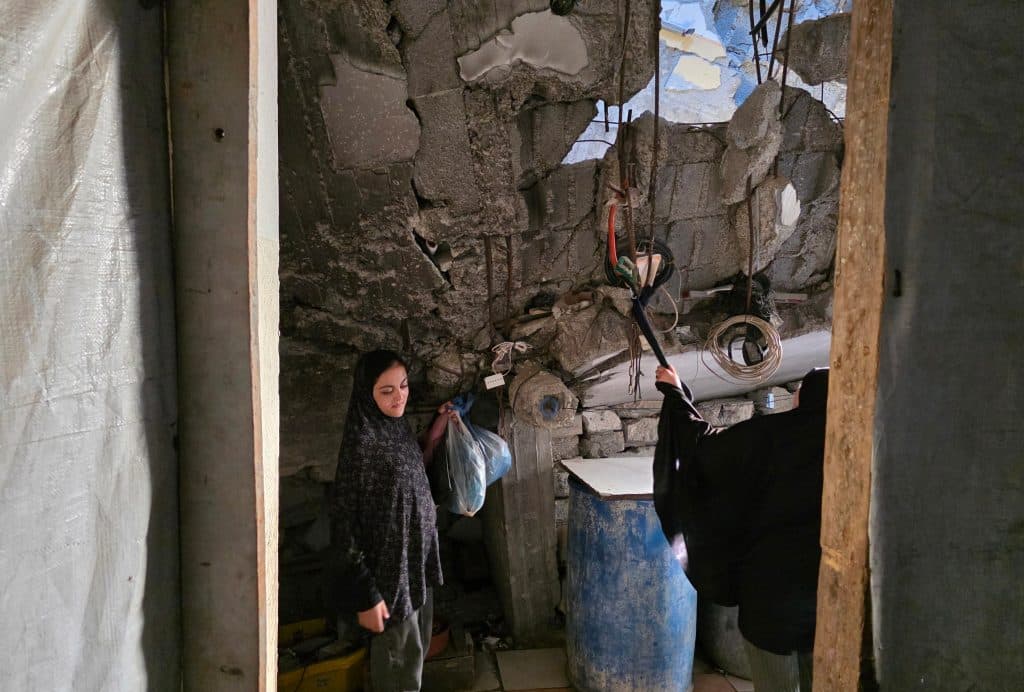
Amr Adas pulls the remains of his family’s clothes from the rubble of the Al-Sa’ada building, friends steadying him so he doesn’t collapse. The structure fell onto the displaced families sheltering inside it, including his wife and five children. He places each item into an empty flour sack. When he reaches the clothes of his two children — Bilal, 6, and Dunia, 12, who died when the building collapsed before dawn on Wednesday — he breaks into wails.
His screaming rises from the eastern side of the site, mixing with bulldozers clearing rubble from the west for a second consecutive day. Friends and neighbors try to calm him, some with words, some with Quranic verses on patience.
“This is not God’s will,” he shouts, to no one. “This is the world’s silence over our annihilation. It’s the lack of even the most minimal support in finding a safe shelter. It forces us to accept any place to stay in, no matter how dangerous.”
Adas, 37, kneels at the site where he was rescued, amid rubble and dust. He points to what was his children’s room. Two are dead; three survived: Sama, 14, with multiple injuries; Malak, 10, with a pelvic fracture; and Mennatullah, a year and a half old.
He recalls that when the collapse began at 2:45 a.m., he jumped to shield the infant, but his wife, Nawal, 32, had already covered her with her own body. He embraced them both as the building fell around them, screaming to his other daughters in the next room: “Come here, come here.”
“The building kept collapsing for a few minutes, and everything was falling on us, and I heard nothing but the sound of bricks and concrete,” Adas said. “I could hear the screams of my four children in the next room, but I couldn’t move, and I could barely say a few words hoping to reassure them.”
“Suddenly, the place went silent after the collapse finished, and the voices of my children calling for me went silent, too, especially the two who died,” he said. “When my children’s voices stopped, it was the harshest moment of my life — that I was meters away from them and couldn’t save them.” The collapse of the Al-Sa’ada building is not an isolated incident. According to the most recent UNOSAT satellite analysis, based on imagery from July 2026, approximately 78 percent of all structures in Gaza have been damaged or destroyed since October 2023 — including an estimated 282,904 damaged housing units.
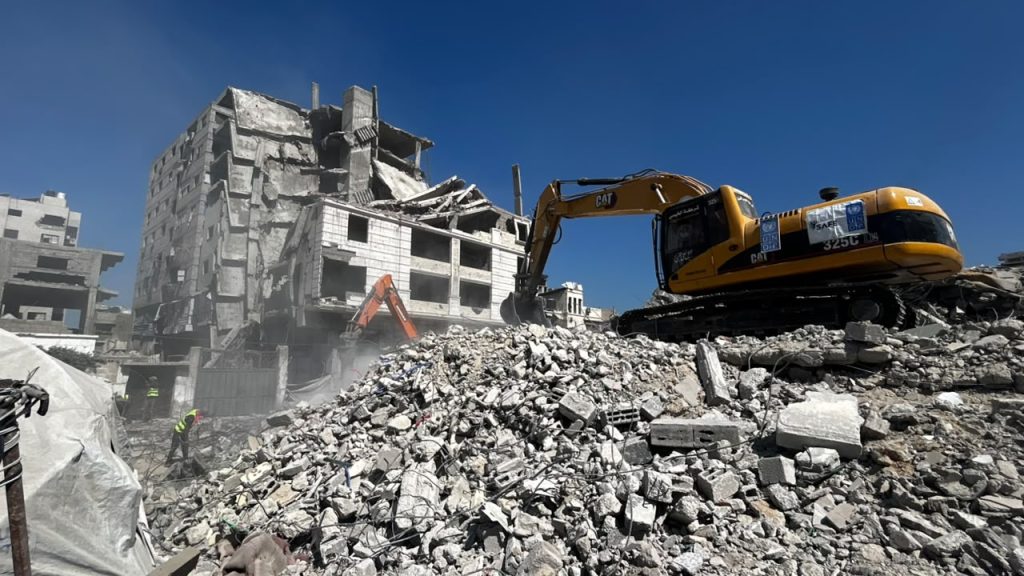
As the Al-Sa’ada building crumbled, Adas didn’t know at first whether it was an Israeli strike or a collapse. He heard neighbors calling, “Is anyone alive?” and answered once, “We’re here, save us,” before he could no longer speak. His wife kept calling out until rescuers arrived, directed light toward them, and lifted the rubble with their hands and simple tools. Adas said he had been pinned under stones and a concrete pillar.
Adas, a motorcycle mechanic before the war and unemployed ever since, said he accepted living in the bombed building because there was no other space. “The occupation destroyed my home in Zeitoun, east of Gaza City, which is now inside the danger zone, and there was no room anywhere else,” he said. “Some specialists told us the place was dangerous and at risk of collapse, but we had no other options. I feel enormous guilt for accepting this choice and losing two of my children, but I swear to God we had no alternative.”
‘A crime that happened with the knowledge of the entire world’
Muhammad al-Sawtari, 30, was also at the site searching for his family’s scattered belongings. His wife suffered moderate injuries and had to leave the hospital because she was nursing their two-month-old daughter, Misk. Their older daughter, Sham, 9, suffered serious injuries and was admitted to intensive care. Their two other daughters were also injured.
“Now some local and international institutions have rushed to clear the rubble and pull out the victims,” al-Sawtari said. “What if they had acted before that, and provided us with dignified shelter? Everyone warned us about the place, but no one offered us any alternative, and they left us in a dangerous building.”
“I don’t know yet whether my older daughter will survive, and I don’t know where we’ll go now, since all our belongings are under the rubble,” he said. “This is a crime that happened with the knowledge of the entire world, and the UN and international institutions operating in Gaza must act now to force the occupation to allow mobile homes in, so we can live with at least a minimum of dignity. There are no alternatives, and if any exist, they’re just worn-out tents made of fabric or plastic. Now we dream of nothing but a roof and walls, even if they’re collapsing.”
With conventional building materials blocked by Israel’s blockade, there is no practical pathway to rebuild. And with displacement ongoing, the only shelter available to tens of thousands of families is the ruins of what was already destroyed.
‘Every detail points to death, but we cling to life’
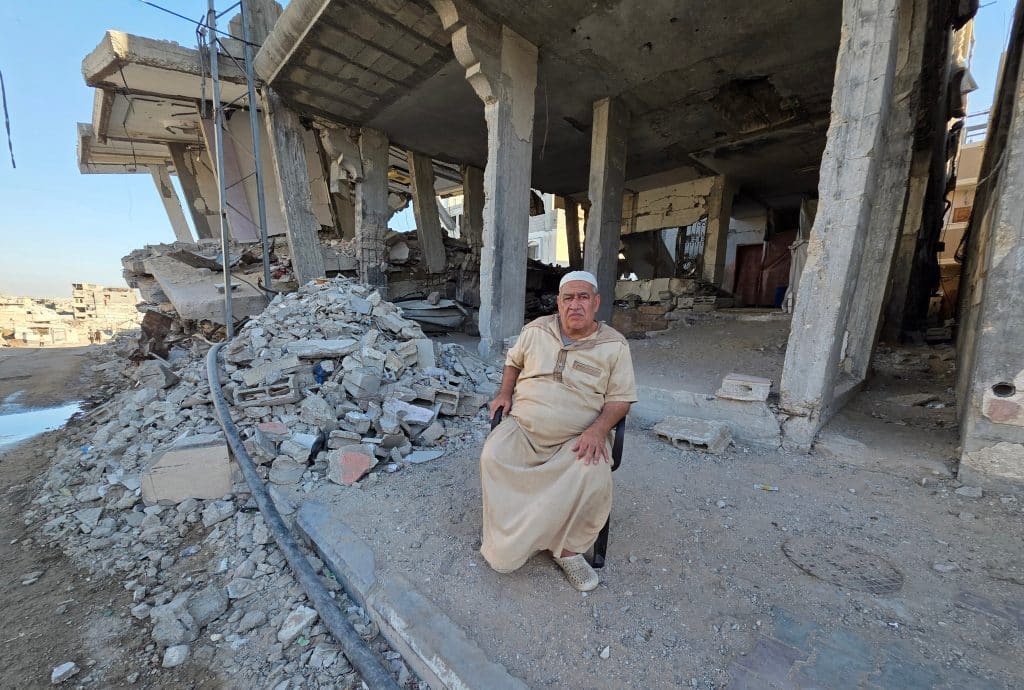
Several hundred meters away, Khaled Shabat, 33, ate food from a nearby communal kitchen with his wife, sister, and four children: Abd al-Hai, 10; Asala, a year younger; and twins Lana and Dana, 5. Shabat, unemployed, lives on the fourth floor of a bombed Islamic University building, separated from an internal corridor by a wall at risk of collapse, with a cracked ceiling, dangerous open floor edges, and an unexploded rocket nearby.
Displaced since the war’s first days, Shabat moved 11 times across the Strip before ending up here — the only unoccupied place available when he returned from al-Mawasi with the last truce in October 2025. “Our homes in Beit Hanoun were destroyed, and that area is now behind the Yellow Line,” he said. “This deadly option was all that was available to us. We’re ready to leave if the relevant institutions provide us with mobile homes. But tents? God forbid! We lived our harshest days in them.”
Shabat believes death in a building is more bearable than life in a tent, and would still prefer death by bombing over death by collapse. “We don’t want to spend moments feeling like we’re in a graveyard called a bombed building,” he said. “Every detail points to death, but we cling to life, and we consider staying in any building to be life, and the tent to be real death.”
A ‘nightmare’ winter approaches
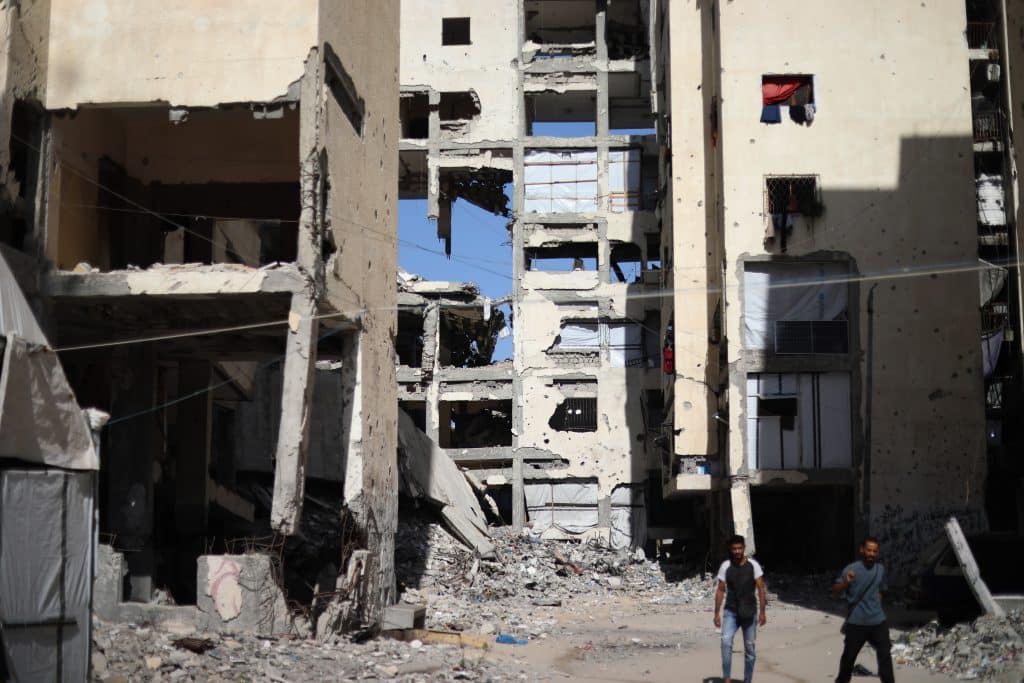
Mahmoud Basal, spokesman for Gaza’s Civil Defense, said the coming winter will prove to be a “nightmare,” since bombed buildings become more prone to collapse with rain and wind. He warned that more than 40,000 Palestinians are living in over 2,000 destroyed, collapse-prone buildings whose structural condition requires demolition, not habitation.
The al-Sa’ada building, he said, had been bombed by Israeli aircraft in November 2023, and more than 100 people had taken up residence inside it over the past year. “Some of the displaced left, and the rest were asleep until the major collapse occurred at 2:45,” he said. “Some managed to flee within moments, while the rest were trapped among the rubble. Some died, others were injured.”
“We pulled out 45 survivors since we arrived at the site only minutes after the collapse, using our hands and primitive tools, without any machinery. Then we requested help from the Egyptian delegation, which provided excavators, and the Red Cross brought in an excavator at 7 a.m.,” Basal said.
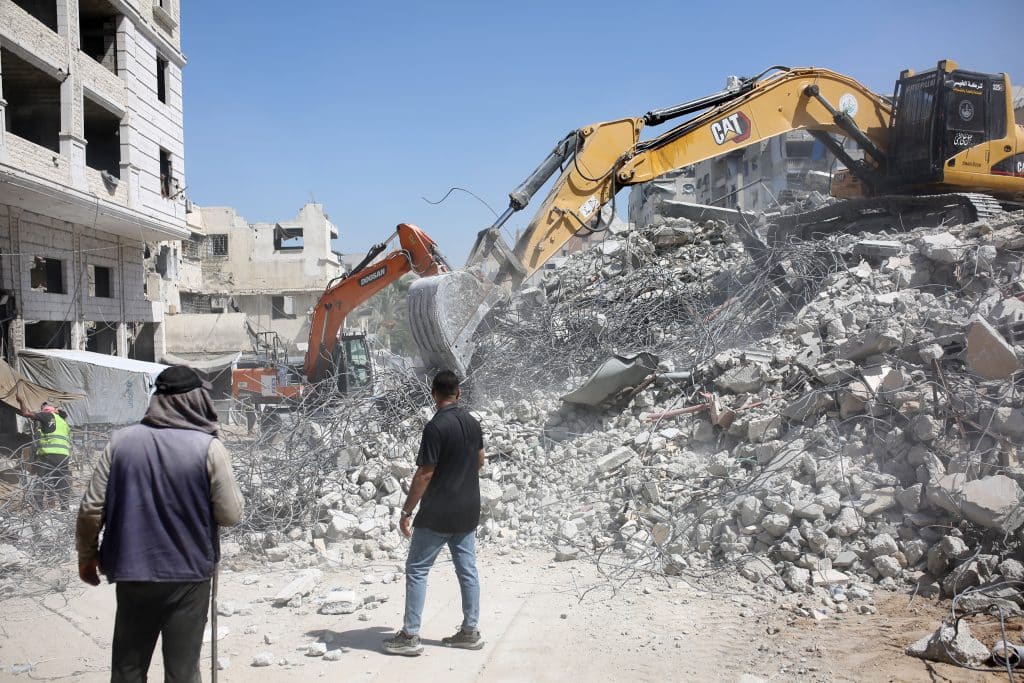
Civil Defense currently operates only 15 ambulance, firefighting, and rescue vehicles, down from around 75 before the war. It owns no bulldozers or heavy machinery. UN institutions have no alternative shelter to offer residents beyond tents, which residents consistently refuse. Civil Defense holds a detailed list of collapse-prone buildings, nearly all inhabited, whose residents refuse to evacuate without mobile homes, an alternative Israel refuses to allow into Gaza, according to UN institutions.
He said removing the collapse-prone buildings requires capabilities entirely unavailable now, but described a one-year plan achievable with around 50 pieces of heavy machinery, alongside a suitable alternative for the displaced families living in them.
Basal described the international community’s inaction as complicity. “Aren’t we in Gaza human beings who deserve life like everyone else?” he asked. “Why the silence and weakness in the face of the occupation? The world is complicit in these crimes.”
This story was published in collaboration with Egab.
Mohamed Al-Astal
Mohamed Al-Astal is a Gaza-based journalist, reporting across radio, print, and digital for regional and international outlets. His work focuses on humanitarian and environmental issues, bringing ground-level reporting from inside Gaza to audiences worldwide.

Remembering the more than 20,000 children Israel has killed in Gaza
Democracy Now!
14,814 views Sep 17, 2026
“An interfaith coalition on Wednesday in New York City unveiled a 330-foot memorial shroud bearing the handwritten names of more than 20,000 children killed in Israeli attacks on the Gaza Strip since 2023. Groups including Priests Against Genocide and Doctors Against Genocide presented the “Gaza Children’s Shroud” at the Church Center for the United Nations across from U.N. headquarters.”
https://www.youtube.com/watch?v=m78B9K6cpfc
Sami Hamdi : Destroys Entire Zionist Panel in Explosive Oxford Union Debate!
How to Steal a Country: The 1947 UN partition of Palestine
Here’s a Palestinian-American from Gaza: He should be heard:
https://www.timesofisrael.com/ahmed-fouad-alkhatib-hamas-is-to-blame-for-october-7-and-gazas-collateral-damage/
https://jewishquarterly.com/essay/2026/07/hamas-and-its-two-million-hostages
https://www.haaretz.com/opinion/2024-01-22/ty-article-opinion/i-grew-up-in-gaza-this-is-what-i-hope-for-its-future/0000018d-304c-db77-ad9f-ff7e89f50000