

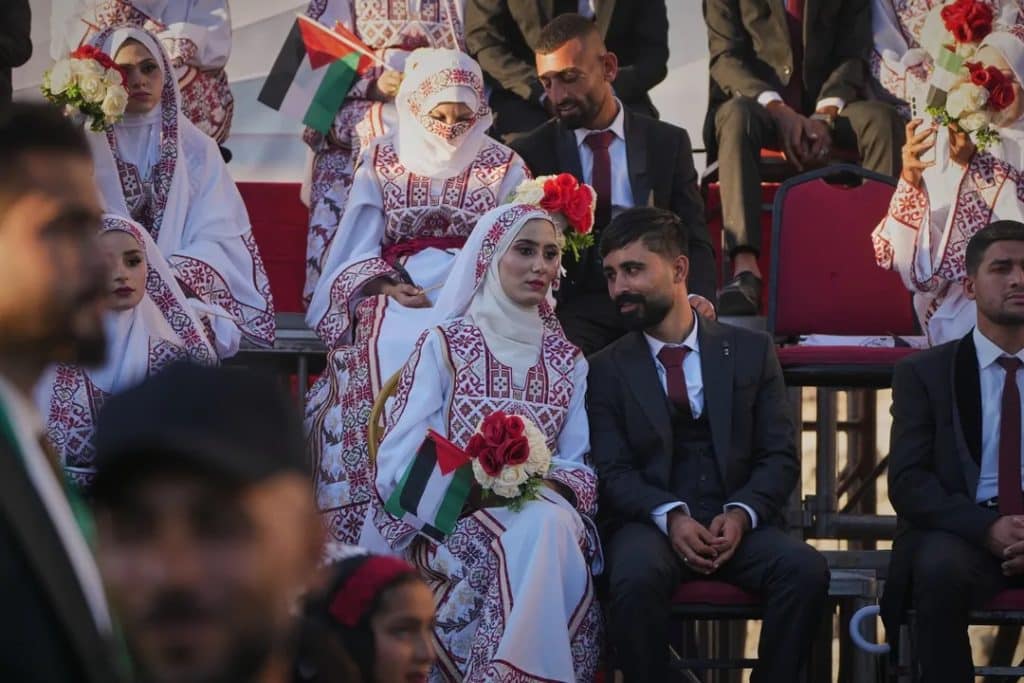
Karam Shaheen, 27, spent months furnishing the apartment. He painted the walls, carefully chose the furniture, and prepared a children’s room before there were any children. He married Janeen, 23, on September 21, 2023. Two weeks later, the war began.
“Everything we had dreamed of was gone,” he said. “From the first hours of the bombing, I had to leave. I took only the clothes I was wearing.”
What followed was a series of displacements that pulled the couple across the Gaza Strip: from al-Karama in northern Gaza to his family’s home, then to al-Nasr neighborhood, then south toward Khan Younis, where 48 people from their extended family were packed into two apartments; men in one, women in the other.
“I would see my wife by chance,” Karam told Mondoweiss. “Privacy was completely gone.”
In May 2024, Janeen obtained “travel coordination” and crossed into Egypt via the Rafah border crossing. Karam was supposed to follow three days later. On May 6, the Israeli army seized the Rafah crossing. He has not left since.
“Suddenly, I was in one place, and Janeen was in another country. Everything stopped,” Karam said.
Kareem and Janeen are just one example of thousands of couples in Gaza whose lives have been upended by the genocide. Prior to October 2023, Palestinians wishing to exit Gaza via the Egyptian border had to register with local Palestinian authorities two to four weeks in advance, or apply to Egyptian authorities through a private company, a process which lacked transparency and required a steep payment, according to OCHA. Today, that administrative system no longer exists. Israeli forces seized the Rafah crossing in May 2024 and have since kept it largely shut. In the past year, only medical patients and their companions have been allowed to evacuate with permission from the Israeli army, with limited reentry for Palestinians who were forced to leave during the war. Ordinary travel in and out of Gaza has not resumed.
More than a year has passed since the couple was forcibly separated. Internet cuts and a lack of electricity inside Gaza have made it difficult to communicate. Karam has been married for nearly two years and has spent most of that time without his wife.
“All I want is for us to be together again and live the life we planned before the war took it,” he said.
‘We thought the separation would be days‘
Shaimaa Ryan, 41, came to Gaza for a wedding. She did not plan to stay.
In August 2023, she flew in from Turkey, where she has lived for years, to attend her brother’s wedding and spend time with her family. Her husband, a Turkish national, returned to Turkey three days before October 7. She was supposed to follow a few days later.
“We thought the separation would be days or weeks,” she said. “It is still ongoing.”
Shaimaa’s husband contacted the Turkish consulate and several human rights organizations to seek help. She was given multiple appointments for potential evacuation, but each one was canceled or postponed. She explained repeatedly that she wasn’t a Gaza resident, that she had come for a short trip to attend a wedding, but to no avail.
“I was displaced 13 times,” she said. “Every time we looked for somewhere safer. The fear followed us everywhere.”
Shaimaa is still in Gaza today, while her husband is in Turkey. Before the war, she was undergoing fertility treatments that were scheduled to continue upon her return. To this day, Shaimaa’s plans to have a family remain on hold.
“Wives who are trapped have the right to be reunited with their husbands. All I want is to go back to my husband and the life that stopped when the war began,” Shaimaa said,
A father who never met his newborn son
Palestinian journalist and father of three, Muhammad Abu Safia, 36, made a different kind of choice. Fearing for his family’s safety and concerned about his children’s education, he evacuated his wife and children out of Gaza while he stayed behind.
One of the hardest days of the war for Muhammad was February 14, 2024, the day he watched his family leave without him for a country where neither of them had ever set foot.
“No one takes the place of another person in this life,” he said.
The grief returns to him unpredictably, sometimes triggered by nothing more than seeing a child in front of him. As Gaza’s starvation crisis worsened, Muhammad found himself especially affected by the women and children he saw waiting in line at communal kitchens. He began keeping small gifts in his car to hand to children he encountered while working.
Muhammad conceals much of his own psychological exhaustion from his own children, avoiding phone calls during difficult periods so as not to reveal the scale of his suffering to his family. Instead, he posts photos of himself laughing and spending time with friends, even though the photos do not reflect his reality.
Two months after his son, Youssef, was born, Muhammad’s wife mentioned buying new clothes for the baby. Muhammad asked her, “Who’s Youssef?” At first, she thought he was joking, but he had genuinely forgotten his newborn son’s name, having never seen him, held him, or witnessed any of his early milestones.
‘Caught between grief and hope‘
Dr. Hala Sukkar, a psychotherapist, says what these three families are experiencing doesn’t resemble ordinary separation or grief. It’s closer to what’s clinically known as ambiguous loss: the partner is alive and present in the world, but physically absent, with no fixed date for when that will change.
“The hardest thing psychologically in this situation is the absence of a fixed date,” Sukkar said. “The person stays caught between grief and hope. They can’t fully mourn what they’ve lost, and they can’t settle into trusting when life will return to normal.”
She added that this kind of separation often produces a chronic grief that goes unrecognized by others, since the typical response is simply, “at least he’s alive,” while the psychological reality is far more complicated. A shared life is suddenly reduced to intermittent calls, messages, and photos, leaving a persistent emotional void.
Abdullah Sharshara, chairman of the board of the Ajyal Association for Creativity and Development in Gaza, says that separating spouses through movement restrictions cannot be treated as a simple travel problem, as it is a direct violation of the right to family life and family unity.
Preventing one spouse from reaching the other, Sharshara explained, or imposing restrictions that make their reunion arbitrarily or disproportionately impossible, can constitute a breach of that right, though the exact legal characterization varies case by case, depending on the authority imposing the restriction, its legal basis, and whether it is necessary, proportionate, and open to challenge.
That right draws on Article 17 of the International Covenant on Civil and Political Rights, which protects against arbitrary interference in private and family life, and Article 23, which recognizes the family as society’s fundamental unit, alongside the freedom of movement. In armed conflict, the Fourth Geneva Convention affirms the family rights of protected persons; Article 26 specifically obligates parties to facilitate the search for family members dispersed by war, with a view to restoring contact and enabling reunion. A 2025 interpretation by the International Committee of the Red Cross treats the preservation of family unity as central to respecting these rights.
But Sharshara was careful to note that this doesn’t create an absolute right for spouses to choose which country they live in. States may impose entry or travel restrictions for security reasons, but that authority isn’t unlimited. Restrictions must rest on a clear legal basis and be tied to a legitimate, necessary, and proportionate purpose.
“A marriage may be entirely valid, civilly and religiously,” Sharshara said, “while the two spouses remain practically unable to be together, because of a chain of separate procedures and decisions, from legal status and residency registration, to permits, to the crossing itself, to entry visas in whichever country the other spouse lives.”
The Rafah crossing did not just seal Gaza from the world. It drew an arbitrary line through the middle of marriages, families, and lives that had been planned with care and interrupted without warning. Karam, Shaimaa, and Muhammad are three people among thousands on either side of the border who have been separated against their will.
This story was reported in collaboration with Egab.


Gaza is literally (i.e. not metaphorically) a prison/internment camp.