

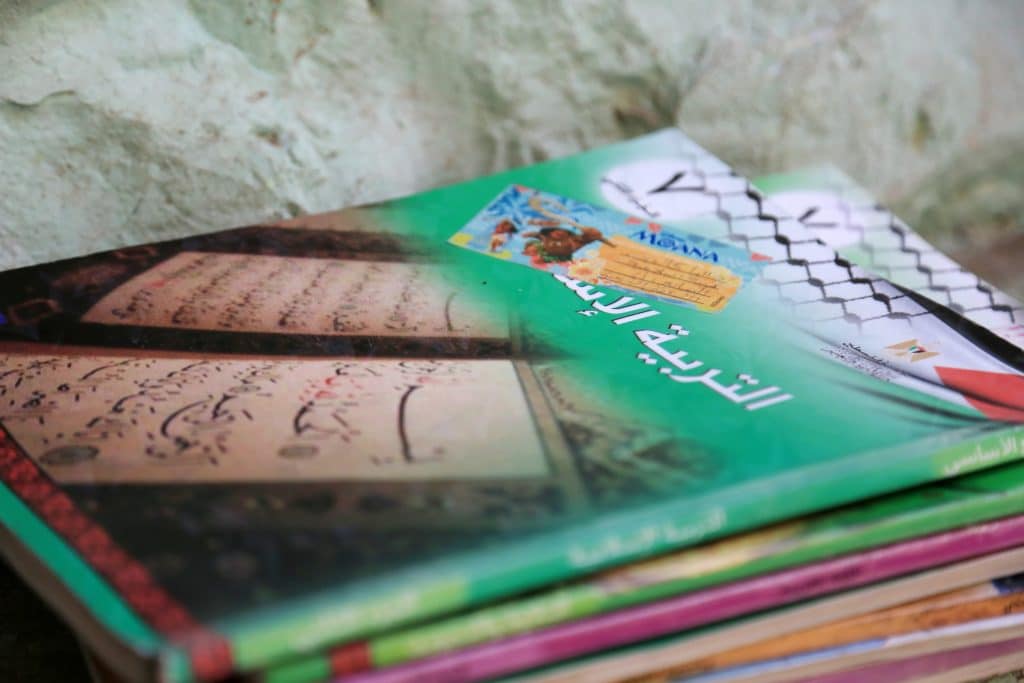
Sally Assi, 34, recalled watching her 11-year-old daughter, Aline, a third-grader at Nour al-Huda School in the town of Beit Hanina in occupied East Jerusalem, arrange her drawing supplies before asking her, “Do you know why we draw Jerusalem?”
“Because it’s beautiful… right?” Aline answered.
Assi smiled, but her question to her daughter wasn’t really about drawing. “Jerusalem isn’t just walls and the Dome of the Rock,” Assi told Mondoweiss. “Jerusalem, to our generation and the generations before us, is a living history. It has cities, people, prisoners, stories, dreams.”
What Assi is describing from her kitchen in the town of Betunia, adjacent to Ramallah, is not an isolated worry among Palestinian parents whose children attend schools in East Jerusalem, under the control of the Israeli Ministry of Education. It is the front line of a rapid, Israeli-driven transformation of Palestinian education in the occupied city, where the Israeli curriculum has become mandatory for every first- and seventh-grade class as of this school year, affecting well over a third of Palestinian students in East Jerusalem.
Now, these tens of thousands of Palestinian children, for the first time since Israel illegally annexed and occupied the city in 1967, are using the Israeli curriculum as part of an effort to “Israelize” the schools. In addition, the remaining two-thirds of the Palestinian student body have been subjected to invasive Israeli alterations to the existing Palestinian curriculum, which has included the wholesale deletion of phrases, images, and symbols that denote Palestinian national identity, most significantly references to the Nakba of 1948 and altered phrasings around themes such as Jerusalem, prisoners, and Palestinian heritage.
It’s this quiet encroachment on Palestinian textbooks, as much as the wholesale replacement, that worries Assi most. “We don’t want our children to learn hatred, and we don’t want them to carry pain without meaning,” she said in an indirect reference to Israeli claims that Palestinian textbooks teach children to “hate.”
“But we want them to know the truth,” she added.
For Assi, the issue isn’t one deleted page, one cut poem, or one changed word, but the collective memory of the Palestinian people that is being altered. “Whoever deletes a page from an entire history is asking children to deny a part of themselves,” she said.
A conflict that moved inside the classroom
In East Jerusalem, the fight over education is no longer about the number of schools or classroom seats alone. It has moved into the classroom itself, into the book students open each morning, the terms their eyes land on, the images they study, the history they’re taught, and the narrative that will shape how they understand themselves in their city for years to come.
With the start of the 2026-2027 school year, the Israeli curriculum was imposed on all new first- and seventh-grade classes in municipal schools located in areas under the jurisdiction of the Israeli-run Jerusalem Municipality.
Israel’s own data shows the scale — the share of Palestinian students studying the Israeli curriculum rose to roughly 36% in 2025-2026, and more recent figures put this year’s number at close to 45,000 students, about 38% of all East Jerusalem students.
The Palestinian Authority (PA) Minister of Education and Higher Education, Amjad Barham, detailed to Mondoweiss a set of edits documented in correspondence and circulating records.
“In the first-grade civic and life education textbook, the Palestinian national anthem is marked for deletion,” Barham said. “The documents also describe the removal of a second-grade page containing an image of a prison and an attempt to break free from it, along with the deletion of prisoners’ names”.
In third grade, the poem “Ala Dalauna”, a traditional Palestinian folk song that often appears in nationalist anthems about the homeland, is among the material reportedly cut from the Arabic curriculum. The lesson, “Bride of the Sea,” the commonly used nickname for the coastal Palestinian city of Jaffa, now occupied by Israel, was also altered, its questions rewritten.
The edits surface even where they seem furthest from politics. In mathematics, Barham said, a reference to the “separation and annexation wall” was struck, along with a map of Palestine showing Jerusalem as its capital.
The changes intensify with grade level. From fourth through ninth grade, the documents describe substituted terminology — “mujahid” (freedom fighter) replaced with “defender,” “aseer” (prisoner) replaced with “the wronged” — alongside deleted or revised material on Jerusalem, prisoners, the Palestinian revolution, resistance, settlement, strikes, and select historical events.
“In their place”, Barham said, “content on peace, coexistence, and cooperation has been introduced.” References to the Palestinian village of Umm Khalid were recast in light of its proximity to present-day Netanya, an Israeli city. Language on the Judaization of Jerusalem was rewritten toward a vocabulary centered on peace rather than confrontation,” he noted.
Ma’arouf al-Rifai, spokesperson for the PA-run Jerusalem Governorate — the parts of the West Bank Israel annexed in 1967 and incorporated within the boundaries of Israel’s Jerusalem municipality — warned that Israel’s decision to impose the Israeli curriculum on East Jerusalem’s municipal schools represents “a dangerous and unprecedented escalation,” the most serious since 1967.
In a statement, al-Rifai described the move as a direct assault on the national and cultural identity of generations of Jerusalemites. “The decision is part of a systematic policy targeting Palestinian education in Jerusalem, one aimed at replacing the curriculum with the Israeli narrative in full,” the statement read.
Al-Rifai cited figures showing the scale of that replacement: nearly 45,000 students, around 38% of the roughly 120,000 Palestinian students in East Jerusalem, are now enrolled in the Israeli curriculum. The trajectory, he said, reveals a rapid and dangerous escalation — from 10,347 students in the 2020-2021 school year, to 19,402 in 2024-2025, to 27,041 in 2025-2026.
Six years ago, he noted, the number stood at under 13,000. Fifteen years ago, it was a few hundred.
A trajectory decades in the making
Israeli affairs analyst Esmat Mansour says this shift didn’t begin this year, nor was it imposed by sudden decree. It’s a trajectory that has accumulated for decades, starting with early attempts to impose the Israeli curriculum after the 1967 occupation of East Jerusalem, which was blocked by parent and teacher resistance, keeping the Jordanian curriculum in place for years.
“When the Palestinian Authority was established, the Palestinian curriculum became the city’s reference text,” Mansour told Mondoweiss. “But it never entered classrooms without passing through Israeli review. Books were revised before approval, so the cover stayed Palestinian while the content was reshaped from within. Today, that has escalated into something bolder: direct expansion of the Israeli curriculum itself, not as a marginal alternative but as a primary track competing for the city’s children”.
That pattern of internal revision is exactly what Hebrew University researcher Samira Alian documented in a recent academic study examining 28 social studies textbooks for grades three through ten. She found substantive changes to material on Jerusalem, Palestinian identity, colonialism, Zionism, and the Nakba: altered wording about Jerusalem itself, deleted or amended references to the occupation, changed lesson titles, and removed images tied to the wall and settlements. One textbook, the study found, excluded entire lessons on Palestinian political history, replaced with material carrying none of the same weight.
Imad Hawas, an Arabic teacher at a municipal school in Anata under Israeli jurisdiction, says the change can’t be reduced to a passing word.
“A textbook doesn’t just transmit information,” Hawas said. “It determines how a child learns to name a place, understand events, and connect the past to the present he lives in every day. When the word ‘Palestine’ changes, or a reference to the occupation is deleted, or the image of the wall a child sees with his own eyes on his way to school is altered, the material no longer stays what it was in its original version. It becomes another text, carrying a Palestinian title but different content.”
This story was reported in collaboration with Egab.
“Because it’s beautiful… right?” Aline answered.
Assi smiled, but her question to her daughter wasn’t really about drawing. “Jerusalem isn’t just walls and the Dome of the Rock,” Assi told Mondoweiss. “Jerusalem, to our generation and the generations before us, is a living history. It has cities, people, prisoners, stories, dreams.”
What Assi is describing, in her kitchen in the town of Betunia, is not an isolated worry among Palestinian parents whose children attend schools under the control of the Israeli Ministry of Education. It is the front line of a rapid, Israeli-driven transformation of Palestinian education in occupied East Jerusalem, where the Israeli curriculum has become mandatory for every first- and seventh-grade class as of this school year.
Now, thousands of Palestinian children in East Jerusalem, for the first time since Israel illegally annexed and occupied East Jerusalem in 1967, are using the Israeli curriculum, as part of an effort to “Israelize” the schools.
It’s this quiet encroachment, as much as the wholesale replacement, that worries Assi most. “We don’t want our children to learn hatred, and we don’t want them to carry pain without meaning — but we want them to know the truth.”
For Assi, the issue isn’t one deleted page, one cut poem, or one changed word. It’s the memory being shaped for the first time.
“Whoever deletes a page from an entire history is asking children to deny a part of themselves,” she said.
A conflict that moved inside the classroom
In East Jerusalem, the fight over education is now no longer about the number of schools or classroom seats alone. It has moved into the classroom itself, into the book students open each morning, the terms their eyes land on, the images they study, the history they’re taught, and the narrative that will shape how they understand themselves in their city for years to come.
With the start of the 2026-2027 school year, that shift entered a more decisive phase: the Israeli curriculum has been imposed on all new first- and seventh-grade classes in municipal schools, located in areas under the jurisdiction of the Israeli-run Jerusalem Municipality.
Israel’s own data shows the scale — the share of Palestinian students studying the Israeli curriculum rose to roughly 36 percent in 2025-2026, and more recent figures put this year’s number at close to 45,000 students, about 38 percent of all East Jerusalem students.
Palestinian Minister of Education and Higher Education Amjad Barham detailed to Mondoweiss a set of edits documented in correspondence and circulating records.
“In the first-grade civic and life education textbook, the Palestinian national anthem is marked for deletion,” Barham said. “The documents also describe the removal of a second-grade page containing an image of a prison and an attempt to break free from it, along with the deletion of prisoners’ names”.
In third grade, the poem “Ala Dalauna” — a traditional Palestinian folk song that often appears in nationalist anthems about the homeland — is among the material reportedly cut from the Arabic curriculum. The lesson, “Bride of the Sea” — the commonly-used nickname for the coastal Palestinian city of Jaffa, now occupied by Israel — was also altered, its questions rewritten.
The edits surface even where they seem furthest from politics. In mathematics, Barham said, a reference to the “separation and annexation wall” was struck, along with a map of Palestine showing Jerusalem as its capital.
The changes intensify with grade level. From fourth through ninth grade, the documents describe substituted terminology — “mujahid” (freedom fighter) replaced with “defender,” “aseer” (prisoner) replaced with “the wronged” — alongside deleted or revised material on Jerusalem, prisoners, the Palestinian revolution, resistance, settlement, strikes, and select historical events.
“In their place”, Barham said, “content on peace, coexistence, and cooperation has been introduced. References to the Palestinian village of Umm Khalid were recast in light of its proximity to present-day Netanya. Language on the Judaization of Jerusalem was rewritten toward a vocabulary centered on peace rather than confrontation,” he noted.
Ma’arouf al-Rifai, spokesperson for the Jerusalem Governorate, warned that Israel’s decision to impose the Israeli curriculum on East Jerusalem’s municipal schools represents “a dangerous and unprecedented escalation” — the most serious since 1967 — and a direct assault on the national and cultural identity of generations of Jerusalemites.
The Jerusalem Governorate is split into two sub-districts, known as J1 and J2. J1, commonly referred to as East Jerusalem, encompasses parts of the West Bank that Israel annexed and incorporated into its Jerusalem municipality. J2 covers the rest of the governorate, which lies outside that municipal boundary and is under the Jerusalem governorate run by the Palestinian Authority (PA).
“The decision is part of a systematic policy targeting Palestinian education in Jerusalem, one aimed at replacing the curriculum with the Israeli narrative in full,” al-Rifai said in a statement. He described it as an assault on Palestinian students’ right to an education that reflects their own history, identity, and national culture.
Al-Rifai cited figures showing the scale of that replacement: nearly 45,000 students, around 38 percent of the roughly 120,000 Palestinian students in East Jerusalem, are now enrolled in the Israeli curriculum. The trajectory, he said, reveals a rapid and dangerous escalation — from 10,347 students in the 2020-2021 school year, to 19,402 in 2024-2025, to 27,041 in 2025-2026.
Six years ago, he noted, the number stood at under 13,000. Fifteen years ago, it was a few hundred.
A trajectory decades in the making
Israeli affairs analyst Esmat Mansour says this shift didn’t begin this year, nor was it imposed by sudden decree. It’s a trajectory that has accumulated for decades, starting with early attempts to impose the Israeli curriculum after the 1967 occupation of East Jerusalem, which was blocked by parent and teacher resistance, keeping the Jordanian curriculum in place for years.
“When the Palestinian Authority was established, the Palestinian curriculum became the city’s reference text,” Mansour told Mondoweiss. “But it never entered classrooms without passing through Israeli review. Books were revised before approval, so the cover stayed Palestinian while the content was reshaped from within. Today, that has escalated into something bolder: direct expansion of the Israeli curriculum itself, not as a marginal alternative but as a primary track competing for the city’s children”.
That pattern of internal revision is exactly what Hebrew University researcher Samira Alian documented in a recent academic study examining 28 social studies textbooks for grades three through ten. She found substantive changes to material on Jerusalem, Palestinian identity, colonialism, Zionism, and the Nakba — altered wording about Jerusalem itself, deleted or amended references to the occupation, changed lesson titles, and removed images tied to the wall and settlements. One textbook, the study found, excluded entire lessons on Palestinian political history, replaced with material carrying none of the same weight.
Imad Hawas, an Arabic teacher at a municipal school in Anata under Israeli jurisdiction, says the change can’t be reduced to a passing word.
“A textbook doesn’t just transmit information,” Hawas said. “It determines how a child learns to name a place, understand events, and connect the past to the present he lives in every day. When the word ‘Palestine’ changes, or a reference to the occupation is deleted, or the image of the wall a child sees with his own eyes on his way to school is altered, the material no longer stays what it was in its original version. It becomes another text, carrying a Palestinian title but different content.”
This story was reported in collaboration with Egab.
From earlier this year:
Trump orders removal or changing of Native American signage at national park
BIG HORN COUNTY — The Trump administration has flagged two exhibits at Montana’s Little Bighorn National Monument as non-compliant, targeting displays that honor tribal sacrifices and reflect on the historic battle known as Custer’s Last Stand….The order follows President Trump’s promise to restore “truth and sanity to American history,” but critics view it as an attempt to silence important Indigenous perspectives from the nation’s historical narrative.
And let’s do the time warp:
How Boarding Schools Tried to ‘Kill the Indian’ Through Assimilation | HISTORY
As part of this federal push for assimilation, boarding schools forbade Native American children from using their own languages and names, as well as from practicing their religion and culture. They were given new Anglo-American names, clothes and haircuts, and told they must abandon their way of life because it was inferior to white people’s…..
Unfinished business: how many tons of explosives have been dropped on Gaza? These are some remarks from the first few months of the ‘war’ – you will have to decide for yourself how to extrapolate these findings:
From the Explosive Weapons Monitor, June 2023:
Unprecedented Harm to Civilians in Gaza – Explosive Weapons Monitor
Israeli armed forces have dropped at least 29,000 explosive munitions in Gaza since the start of the conflict, according to US intelligence.6 During the first two weeks of the conflict, about 90 percent of these were 1,000-pound and 2,000-pound satellite-guided bombs.7 A 2,000-pound bomb, with an estimated crater size of 14 meters,8 was used in the Jabalia refugee camp airstrike that killed at least 126 civilians, including 69 children, on 31 October 2023, according to Airwars.9
Exclusive: Nearly half of the Israeli munitions dropped on Gaza are imprecise ‘dumb bombs,’ US intelligence assessment finds | CNN Politics
Dec 14, 2023
The assessment, compiled by the Office of the Director of National Intelligence and described to CNN by three sources who have seen it, says that about 40-45% of the 29,000 air-to-ground munitions Israel has used have been unguided. The rest have been precision-guided munitions, the assessment says.
Correction: the date on the Explosive Weapons Monitor article is Dec 2023, not June 2023 – that would have been before the war started.