

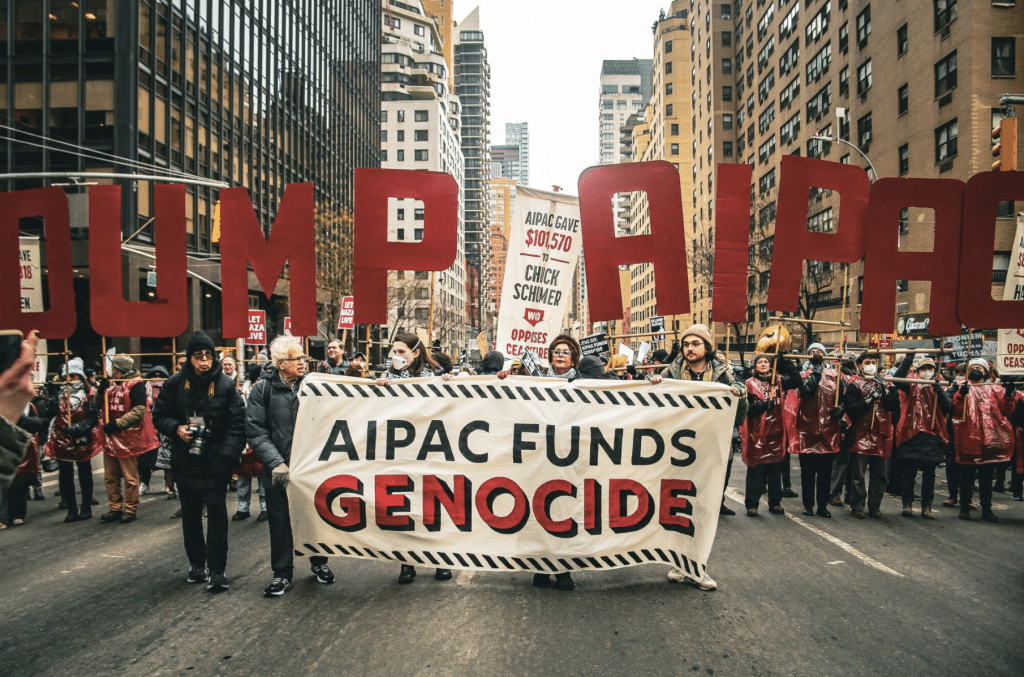
The American Israel Public Affairs Committee (AIPAC) has already spent nearly $70 million on the upcoming midterms, and there’s no indication that they’re slowing down, but is their money having the same impact that it once did?
As public opinion has turned on Israel amid the genocide, so too has it turned on the Israel Lobby, which is being exposed to more and more scrutiny. Not long ago, criticism of Israel was regarded as a third rail issue in political discourse, but now even centrist Democrats and Republicans are distancing themselves from AIPAC over fears that its toxic brand will hurt them.
Israel’s Lobby: America in the Grip of a Foreign Power, a new book by investigative journalist Eli Clifton and political scientist Ian Lustick, tracks the rise of groups like AIPAC, their shifting strategy in defending Israel, and their influence over U.S. policy, foreign and domestic.
Mondoweiss U.S. correspondent Michael Arria spoke with Clifton about the book, the midterms, and whether AIPAC’s days are numbered.
Mondoweiss: Can you talk about the origins of the Lobby? The modern state of Israel was created in 1948. How soon after do we start to see this ecosystem develop, and what’s the impetus for it?
Eli Clifton: AIPAC is the largest pro-Israel organization. It was founded as the American Zionist Committee for Public Affairs in the early 1950s. What’s pretty interesting is that this institutionalization of pro-Israel lobbying came, at least partially, in response to criticism arising from reprisal raids being conducted against Palestinian villages during the 1953 massacre of almost 70 Palestinian civilians, most of whom were were women and children [in Qibya.] That massacre was led by future Israeli Prime Minister Ariel Sharon.
In 1959, the group changed its name to the American Israel Public Affairs Committee, and it emerged as a dominant voice within the pro-Israel community.
I think it’s really important to note that this formation of the institutional, pro-Israel lobby was to defend Israel from criticism.
One of the central themes of your book is the Lobby changing. It seemingly relied on persuasion for years, but now it seems primarily devoted to attacking and smearing Israel critics. Can you talk about that shift?
I think a lot of these changes accelerated in the wake of the Gaza genocide and during it, but all of these trends were happening slowly before the genocide.
I would turn back to the late 1990s and early 2000s as a turning point of sorts, and to the death of the Oslo Accords, which seemed like a last-ditch attempt to negotiate or impose a peace process on the Israelis and the Palestinians.
I think the failure of Oslo leads to a steady, but slow decline in pro-Israel sentiments. This happens alongside the global war on terror and greater American scrutiny and shifts in public opinion about what is the role that the United States should be playing in the world and whether having this massive presence in the Middle East is actually in our interest.
I think you see successive U.S. presidents during this time. You see Obama, you see Trump, you see Biden, you see Trump again, all talking about the desire to pivot to Asia to manage a rising China. Saying that, hey, American diplomatic and military efforts really need to be focused elsewhere in the world, and they are unable to extricate themselves from the Middle East.
I think this goes alongside the shift in public opinion as people start to observe it. Obviously, Donald Trump’s success in getting elected was largely rooted in telling Americans they weren’t getting a foreign policy that served their interests. What this means for the lobby is a slow erosion, at least slowly, of the grassroots support. that had really made them powerful and allowed them to hold sway with pretty much every member of Congress. They were able to say that, hey, there is a pro-Israel consensus in this country, which indeed, in many ways, there was.
As that consensus starts to drip away, the methods they use have to change, because, as you pointed out earlier, the methods they used earlier were persuasion; they were engaging with critics. They were advocating for debates where they could make a “pro-Israel” argument and they thought that they could beat their opponents on the facts. Whether that was true or not, the point is that they clearly believed that they could.
Something fundamentally changes over the years, where they shift towards trying to shut down debate, trying to suppress criticism, no longer engaging with critics, and becoming a speech police, very much trying to even use the powers of the state to suppress language and criticism of Israel.
We see a lot of this begin under Biden, but it really took off under Trump, and you had the attacks on American universities, threatening to withhold hundreds of millions of dollars of federal funding in some cases, unless they effectively shut down speech that was critical of a foreign country on their campuses.
I think that’s where the Lobby is today, and this was accelerated after October 7, when U.S. public opinion shifted. It followed the trend it was already on, but things accelerated. Now you have three-quarters of Democrats saying that they oppose further aid to Israel, and something like a third of Republicans feel that way as well. So, the Lobby has fundamentally lost the public opinion battle that they had engaged in for decades. All they’re left with now is a [strategy] of trying to suppress speech that is critical of them and of Israel. All of this is in service of trying to prevent the transmission of public opinion into public policy.
John Mersheimer and Stephen Walt published their seminal book The Israel Lobby and U.S. Foreign Policy almost 20 years ago. I wanted to talk about the reaction to that book. It was attacked or dismissed across mainstream media by and large.
Your book has been out for a short time, but I’m wondering if you’ve reflected on the differences in reactions. How has your book been received so far, and how has that reaction changed over the past two decades?
It’s very much a different era. What went down 20 years ago was a debate about whether you could even say that the Israel lobby exists. Steve Walt and John Mearsheimer were trying to make the case that this lobby exists and that it seeks to, and often succeeds in, influencing U.S. foreign policy.
That is what their book established at its core, and they deserve a great deal of credit for making that argument, particularly at that time. That was considered a scandalous thing to say, especially where they took it to, which is to suggest that in some cases what the Lobby may advocate for may not be actually what’s in any sort of definable sense “American interests.”
A lot of the freak-out over it was rooted in this idea that saying the Lobby exists is antisemitic. Now, 20 years later, saying these things is just self-evident. Everybody believes it. Again, public support for Israel is at an all-time low. It’s not controversial to say that the Lobby exists.
I think we do push further by saying that it has actually become a victim of its own success. It has become a danger to American civil society and is seeking to curtail American civil liberties to hold on to the power and influence it has enjoyed for decades.
I think a way that the response has also been very different is that the Lobby does not want to engage with our book. They’re fearful, and they don’t want to engage with this debate anymore. They’re on the back foot and they would rather operate behind Super PACs that are pummeling states like Michigan with tens of millions of dollars in spending. They would rather use money to try to influence the outcomes of political races and policy debates without having to defend themselves or defend Israel.
That’s why the ads they run don’t mention Israel. They don’t want to talk about their central issue. They don’t want to talk about the role of the Lobby they’re part of. They don’t want to talk about the U .S.-Israel relationship. They would rather suppress that debate, not have it at all, and instead speak with their money.
I want to talk about AIPAC. They’ve obviously received the bulk of the criticism. They’re the group that’s kind of most often cited when we talk about the Lobby, and people are more aware of them than any other group. We’ve seen mainstream Democrats actually push back on them in recent years, even some who have taken AIPAC money.
I’m wondering how important APAC is to this ecosystem because the reality is that if people like Miriam Adelson or Jeffrey Yass want to spend money on an election, they don’t need to do it through a pro-Israel organization. Connected to that, I am wondering if there are other organizations in the Lobby that you think should be getting more attention for their influence
That’s a really interesting question. I do think that the center of power for the Lobby has probably shifted toward mega donors like Adelson and Yass because of the change in our campaign finance laws that allows these mega donors to have this outsized influence and ability to to pump money into our elections.
When you look at where they put their money, they don’t always run it through AIPAC. I’m not sure, actually, if either of them does through the United Democracy Project. They very often give to Republican Party super PACs, to leadership PACs, to a variety of vehicles for their money, including sometimes setting up their own. There’s nothing stopping you from setting up your own Super PAC and spending the money. So I think that they certainly hold a far bigger role than they did in the past.
AIPAC probably plays a smaller role than it used to, because it used to be able to bundle campaign contributions and have a centralized authority within the pro-Israel community, but it has less of that now because these mega donors have an outsized influence felt by everybody. I think when Miriam Adelson picks up the phone to Donald Trump, she probably has greater immediate access and influence than AIPAC does, so some things have changed.
I do think that a major organization in the pro-Israel space that doesn’t get enough attention is the Foundation for Defense of Democracies (FDD). If you’re trying to understand where a lot of the policy-making comes from, where a lot of the policy advocacy occurs, AIPAC does that to some degree, but FDD is really effective, really out there in front of the media.
I think something that deserves more attention is the fact that FDD is often characterized as just a think tank. The assumption is this is an American think tank focused on U.S. national security, but their own filings for nonprofit status say something different. They say that part of its mission is to promote Israel’s image in North America, and that its initial name was Emet, Hebrew for “truth”.
So this is explicitly a pro-Israel organization that is very rarely identified as such, and I think that that gives it a unique position in being able to promote and spread policies that are more beneficial to Israel than to the United States.
You saw its head, Mark Dubowitz, recently advocating for greater U.S.-Israeli defense integration through the NDAA effort, which is very unpopular right now. The reason he gives for this is that it would be very costly for the United States to try to unwind or disentangle itself from its relationship with Israel Now, obviously, that is something that is very much in the interest of Israel and very much not in the interest of the United States to have that sort of relationship with any country, let alone with Israel.
We’ve talked about the shift in polling, but there’s also the wave of recent progressive wins in the primaries, where a number of candidates were critical of Israel and won. Does this reality shift the way a group like AIPAC to shift its electoral strategy in any way, since they’ve become so toxic?
I think one way they’ve clearly adapted is that they don’t talk about Israel in the ads that they run. That’s a very clear indicator of how they’ve adapted.
There was early reporting suggesting they wouldn’t be as active with their Super PAC, the United Democracy Project (UDP), this cycle, and would funnel the money through other, more nondescript super PACs, which might make it harder to tie the money back to the Israel Lobby.
That seems like it’s gone on to a limited degree, but it’s really striking to me how active the UDP continues to be in this cycle, and it’s certainly been interesting to watch how the UDP’s activities in individual races have been used to tarnish candidates who are beneficiaries of that spending. I’m specifically thinking Michigan. I don’t think UDP’s involvement did Haley Stevens any great favors, as Abdul El-Sayed was able to utilize that to turn it into a negative. for her.
The messaging coming out from some of the Lobby groups was, basically, yes, we lost Michigan, but maybe another $5 million could have made the difference. Certainly from a fundraising standpoint, that’s a smart thing to say, but whether that’s actually substantiated in fact, I think it’s probably a different matter.
I think that in the short and medium term, the message they will send is that we simply need to spend more money. We’re deep in horse-race politics season, so the media is covering it at the level of individual races. It’s very tempting and appealing to assess success or failures based on the outcomes of individual races, but I think the big takeaway already from this cycle, regardless of how the races go, is the price that AIPAC and the Lobby have had to pay to be competitive. It’s gone up.
They have to spend an enormous amount of money in order to plausibly have a chance at winning a race, not necessarily winning it even but just being competitive enough to tell their donors that they had a good chance. of swinging an outcome.
I think AIPAC and the broader pro-Israel lobby groups are going to end up having spent somewhere in the vicinity of a quarter of a billion dollars on these midterm elections when they’re all said and done. That’s a lot of money to end up with a mixed bag of wins and losses.
So I think it’s important to zoom out just a little bit away from the horse race politics of it, which I’m susceptible to as well. It’s a lot of fun to watch the races themselves, but look at how much money is being spent to produce a mixed scorecard.
That’s actually a good segue to my final question, which is, is the Israel Lobby in trouble? They’re viewed as having a certain level of force and influence, but, as you say, they’re spending more and more money to win fewer and fewer races, and their brand has completely tanked with the public. Do you think there’s internal anxiety about the longterm viability of their project?
I think there is probably enormous concern within AIPAC and within the broader pro-Israel world. They face an existential threat here.
They have largely enjoyed being able to function behind the scenes and do so with the benefit of knowing that Americans are largely pro-Israel. Again, the trends were already in place that were going to change that, but it accelerated really, really fast, probably faster than the Israel Lobby had anticipated.
So the Lobby itself faces a really serious challenge here. In our book, we say this is heading in the direction of the National Rifle Association, the NRA. Most Americans across the political spectrum actually support various forms of gun control. Assault rifle bans and heightened background checks are broadly pretty popular, and the NRA is very clearly working against public sentiment.
That might be where AIPAC and the pro-Israel lobby are headed. The danger for them is that it’s really hard to do that when your issue is front and center in the news media and front and center in elections. So it’s hard to disappear the issue, I would expect going forward. I’d be shocked if they do not start to redirect money into PACs that are harder to identify. What tactics can they use? Will they have new ones that will work better? How can they shift? How can they adapt?
I think some of this is out of their control. Images of dead children and civilians continue to flow out of Gaza. The mainstream media hasn’t been the best at covering it, but with social media now, it’s very hard to suppress the scale of what is going on in Gaza, or the settler violence in the West Bank, or the violence against various communities, including Christians in Lebanon. This stuff horrifies people and it’s significantly responsible for shifting public opinion. People get facts on the ground in a manner that they had previously been denied and I think as long as the facts continue to be this way where Israel is occupying lands, people don’t have equal rights in Israel, they continue to engage in these wars on multiple fronts, they continue to engage in genocide in Gaza, there’s a limited amount that AIPAC can do.
They are deeply, deeply unpopular with Democrats and increasingly unpopular with Republicans and even with Christian evangelicals. That poses a nearly insurmountable challenge for them.

Michael did you ask Eli whether he had ever been in support of Israel during his lifetime? Have many friends who are Jewish. Most secular. Tried to talk with many of my friends (Jewish and not) over the decades as I became more and more aware of what was really going on in that conflict starting in mid 70’s. Most of my Jewish friends had mental road blocks up about the facts on the ground. Most did not want to read or know about the facts on the ground. Many donated $ to Israel in one form or another.
Since Israel’s most recent war crimes ( genocide ) most people have become far more open to the facts than over the decades when I would try to talk with friends etc. We know the U.S. MSM covered Israel’s most recent war crimes since the horrific attack on Oct 7 more so than any of Israel’s crimes against humanity and war crimes over the decades. Has been so interesting being aware of many people’s willingness to open up to the facts and their own personal evolution’s.
Wondering if Eli Clifton has ever been in support of Israel during his lifetime ? Did he donate funds to Israel at any time of his life ?