The intrigue of an Israeli election routinely extends far beyond election day, and the current election is no different.
The alignment of the opposition bloc has turned the avowed racist, Avigdor Lieberman, into something of a kingmaker.
Lieberman refuses to sit in coalition with the “Arab parties,” or even allow a coalition to form that depends on the votes of parties that represent Palestinian citizens of Israel. That means Gadi Eisenkot, tasked with forming a government, will have to find another way to reach a majority in the 120-seat Knesset.
The math is difficult. Lieberman has left Eisenkot with two options: either finding a compromise with the ultra-orthodox Haredi parties that will entice them into the coalition or forming a ‘government of national unity’ with Benjamin Netanyahu’s Likud party or at least some members of his coalition.
Either path is fraught. To get 61 seats, Eisenkot needs both Haredi parties, and one of them, Shas, has vowed not to leave Netanyahu. And while Eisenkot has explored the idea of a unity government, it brings another election-related scandal for Netanyahu, and the public exchanges between the two have been so vitriolic, even by Israeli standards, that the prospect of unity is remote.
Yet at the same time, Eisenkot does not want to miss his opportunity to form a government, and Netanyahu is unlikely to be able to form one either. Since neither man relishes the idea of new elections, it is more likely than not that some government will be formed.
Any such government is going to be right-wing in nature, especially when it comes to the questions of Palestine, Iran, and Israel’s occupations of Lebanon and Syria. But it will also be free of Netanyahu’s corruption and the power of the most extreme forces in Israel—Bezalel Smotrich and Itamar Ben Gvir—will be nullified.
So, what does that mean for American policy in a hoped-for, post-Netanyahu world?
What the United States is watching
With Donald Trump largely checked out of his job, at least for the moment, there is less pressure on Gadi Eisenkot to find an accommodation with the erstwhile Prime Minister who is hanging on to the job for dear life.
Still, less pressure doesn’t mean no pressure. The secret meeting last week between Mossad chief Roman Gofman and CIA Director John Ratcliffe cannot be seen in isolation from the ridiculous propaganda that cropped up this week in the American media about Iranian dirty bombs aimed at Washington, DC and the even more bizarre New York Times story about Iran building dams to power their vast, underground missile storage facilities.
It is no coincidence that around the same time as Gofman was being dispatched, Eisenkot opened talks about a unity government with Netanyahu. Doubtless that was the result of some pressure from Washington, which, at least for the moment, wants to see an end to the Israeli election season in order to move forward with whatever plan might be cooked up against Iran.
But those talks were quickly buried under Netanyahu’s ongoing attacks on the Palestinian citizens of Israel. While Eisenkot and most of his partners are steadfast in refusing to allow the Palestinian parties, the United Arab List (Ra’am) and the Joint List (a coalition formed by the communist Hadash party and the Palestinian nationalist Balad and Ta’al parties), they want to keep the support of those parties and maintain the sense among the more liberal Jewish Israelis that they are somehow not pursuing an apartheid path.
Assuming Eisenkot does find a way to obtain the prime minister role, he is likely to have a vastly different relationship to Washington from Netanyahu.
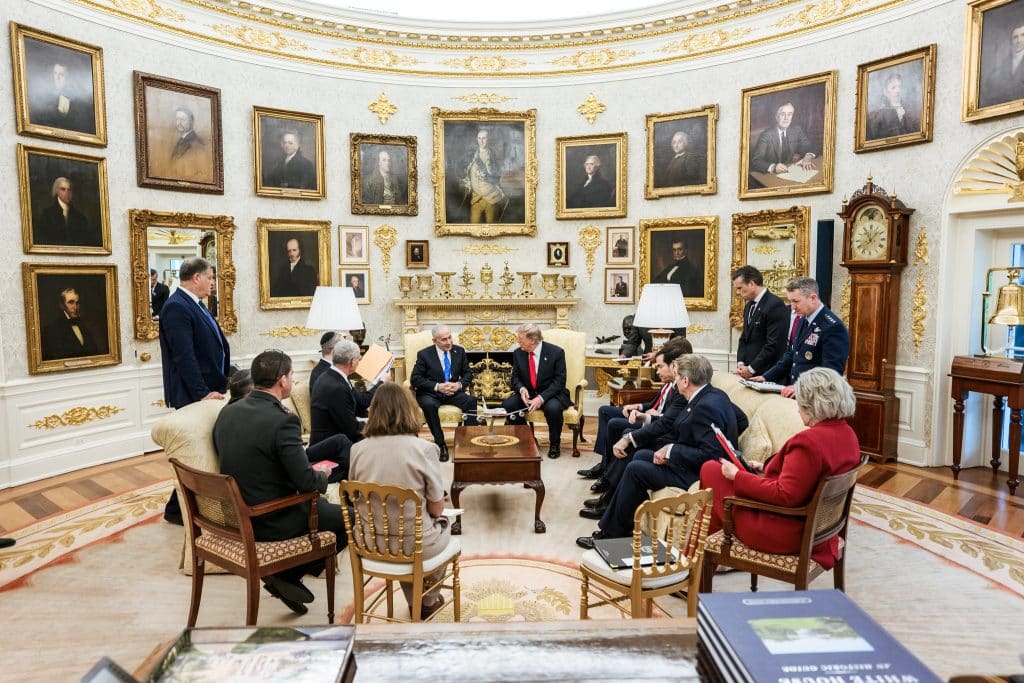
Netanyahu is very close to the Republican Party and to the top members of the Trump administration. Or at least he was until he became so reviled by Americans of both parties that Trump has tried to put some distance between himself and him, despite continuing to take Netanyahu’s calls and clearly continuing to have at least some official coordination with him. Such a schizophrenic approach is all too typical of the American president.
Eisenkot also has friends in Washington, but most of them are at the Pentagon. He is a military man who rose to prominence as the IDF Chief of Staff, in stark contrast to the consummate politician Netanyahu.
Ironically, that gives Eisenkot a more measured outlook.
In Iran, for example, he is certainly willing to continue the war, but he has been sharply critical of the way Netanyahu has gone about it. Those criticisms centered on the lack of a strategy, which means he was implicitly criticizing the United States’ approach as well.
Eisenkot has made it clear that he wants a strategy and a detailed plan if Israel is to resume the war. Most of all, he wants to pursue the war in a unified partnership with the United States, in contrast to the parallel tracks that characterized the early days of the war before Trump effectively sidelined Israel.
Eisenkot has also stated that he doesn’t think regime change is a realistic goal. Instead, he favors tactical strikes to contain Iran, limit its regional influence, and to thwart any nuclear ambitions.
Under those conditions, Eisenkot believes it is possible that Iran’s internal opposition could change the political conditions in the country, but he is primarily concerned with the military aspect.
In essence, Eisenkot favors the approach Israel has taken with Iran for decades.
In both Lebanon and Syria, Eisenkot differs little from Netanyahu. He might not have invaded as Netanyahu did, but now that Israel is occupying territory in both countries, he is unwilling to leave. He is determined to prevent Syria from strengthening itself and is clearly as skeptical about the new rule of Ahmed al-Sharaa in Damascus as Netanyahu.
That isn’t surprising, as Eisenkot is very mistrustful of Türkiye, which is closely allied with al-Sharaa. Both Saudi Arabia and Türkiye have been working to strengthen Syria, but Israeli occupation and periodic strikes have limited Syria’s recovery.
While Eisenkot is unlikely to be as provocative as Netanyahu, he sees Türkiye and its growing regional influence as a threat as much as Netanyahu does. The U.S. has looked favorably on al-Sharaa, but his past ties to al-Qaeda makes many Americans and Europeans suspicious of him, so they are not ready to press Israel to try to find the accommodation with Syria that al-Sharaa has repeatedly offered.
In Lebanon, Eisenkot might be a bit more flexible when it comes to the possibility of diplomacy with the Lebanese government, but he maintains that Israel will not budge until Hezbollah is disarmed, and he is knowledgeable enough about Lebanon to know that the government will not be able to disarm Hezbollah, especially while Israel remains in occupation of the southern part of the country.
Still, Netanyahu has dragged his feet in U.S.-brokered talks between the Lebanese government and Israel, and Eisenkot might be more cooperative. In time, he might even be willing to allow the Lebanese government to find an arrangement with Hezbollah that the U.S. seems to be envisioning, whereby Israel would withdraw, and Hezbollah would be brought into the Lebanese military. Such a process would likely take years, however.
On Gaza, Eisenkot has been blasting Netanyahu for the lack of an “exit plan” for two years, and has vowed to end Hamas rule, but has rejected the “total victory” narrative. That gives the impression that he might be willing to pursue Trump’s “peace plan,” which Netanyahu has obstructed despite its obvious benefits for Israel and the insufficiency of what it offers the people of Gaza.
He opposes a Palestinian state of any kind but also opposes outright Israeli annexation of the West Bank and, much like with Iran, essentially proposes to go back to the status quo ante of quiet settlement expansion, a bit more restraint on the worst excesses of the settlers, and an endless “managing” of the occupation.
In other words, from the American perspective, Eisenkot is exactly what they’re looking for: a full partner who thinks about the military in a much more strategic manner than Netanyahu, who is less corrupt and manipulative than Netanyahu, and who understands the need to project an illusion of democracy and peace-seeking even while dominating the region and denying Palestinians their basic rights.
Eisenkot is more aware of both military and political needs for Israel’s partners while maintaining the long-standing Israeli indifference or hostility to the rights of Palestinians and the people of neighboring countries.
How would Eisenkot impact American policy?
While Eisenkot’s own disposition on the questions of Palestine and regional aggression is mostly known, what is less clear is exactly what kind of political pressure he will be under. Will his coalition eventually include some of Netanyahu’s coalition members? Is there a possibility that, if Netanyahu is ousted, he could be replaced as head of Likud, which might open the door to Likud joining the Eisenkot government?
While Itamar Ben Gvir’s Jewish Power party likely wouldn’t be welcome in Eisenkot’s coalition, he has already explored the possibility of Bezalel Smotrich’s Religious Zionism joining a unity government.
Will it be a narrow government that depends on the ultra-orthodox parties? Conversely, might he find a way to hold the coalition together if the Palestinian parties support it?
These are all possibilities, and whichever becomes reality will shape the political pressures that will partially dictate Eisenkot’s decisions.
One thing is certain, and that is that Eisenkot will place an extremely high priority on regaining the support of the people of the United States. This will put him in competition with many of the new members of Congress, as well as some old ones who have been pushing to reevaluate the United States’ relationship to Israel.
How will the new Congress react if, for example, Israel starts to facilitate the distribution of aid in Gaza, allows reconstruction of Gaza to begin, permits the entry of the technocratic Palestinian board that is supposed to administrate Gaza, and deploys troops to prevent settler violence?
These are the most basic things Eisenkot would have to do to begin to rehabilitate Israel’s image in the U.S. and Europe and, while they will certainly be greeted with howls of outrage from many Israelis, they will be supported by most of the Israelis who voted for change. It is entirely possible that Eisenkot will pursue some or all of them.
The U.S. would loudly applaud such measures, and it would put pressure on Congress to slow the momentum toward ending military aid to Israel. It would also affirm the case many mainstream pro-Israel Democrats have made that Netanyahu was the problem.
But on the ground, the changes would be a mixed bag. It is entirely possible that Eisenkot would end the genocide as we have known it for over three years, and would curb the worst excesses of the settlers, and who would not celebrate that?
But Eisenkot has no intention of relieving the conditions that brought on the attack of October 7, 2023, or that proved impossible to resolve for decades, before and after the disastrous Oslo process. And as desperately necessary it is to at least somewhat alleviate the monumental suffering of the Palestinian people, especially in Gaza, there is a grave risk that such relief helps Israel regain the blank check for the crimes it has been committing for decades.
It won’t be entirely possible to go back to the way things were, of course. Too many people have seen the true nature of Israel’s brutality against the Palestinians, and the door has finally been opened for Palestinians to tell their own stories.
But Eisenkot will have a lot of help in Washington—not only from AIPAC and those they have bought, but from the much broader military-industrial complex—in an effort to sell the idea that Israel is on “the road back” to pursuing peace. It’s a sham that can easily reverse at least some of the gains that have been made, especially in this last election.
That’s why it is more important than ever to focus on the nature of Israel’s apartheid and base every argument on the principle that all people from the river to the sea must have equal rights. There must be a simple insistence that Palestinians have the same rights as anyone else, and this argument must be extended to Syrians, Lebanese, and Iranians.
On that basis, we can applaud the baby steps Eisenkot will be willing to take without backing off of the pressure that will be required to push for real solutions, rather than temporary, image-based band-aid measures.
That is the argument that Israel cannot defend against, and it is the one that will withstand Eisenkot’s potential efforts to bring back Israel’s false image as a peace-seeking democracy.