Palestinians in Jaffa, Jerusalem, and across Israel are challenging discriminatory Israeli education policies.


Palestinians in Jaffa, Jerusalem, and across Israel are challenging discriminatory Israeli education policies.

Public discourse about Arabic diglossia has been on the rise as of late, especially as a vindication of colonial praxis when it comes to Palestinian communities in Israel. What this discourse often ignores is the context of Arabic learners, and the need to decolonize Eurocentric frameworks in linguistic research.
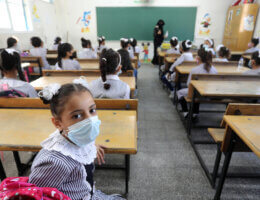
“As perceived by the children, economic conditions had the most influence on their ability to stay in school,” a new report from Al Mezan says.
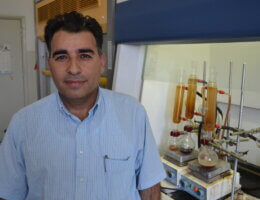
Israel has long had a policy of undermining Palestinian institutions of higher education, and this has had a profound impact on scientific research. “What is easy in Palestine?” asks Yousef Najajreh, an Associate Professor of Medicinal Chemistry at Al-Quds University. “Driving on the road is not easy. Going to the supermarket is not easy. No, doing science in Palestine is something like a miracle, if you manage to do science.”
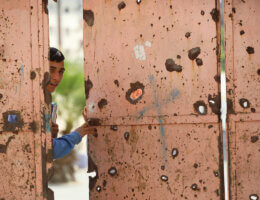
In late August students in Gaza headed back to schools where many are learning in overcapacity classrooms with up to three sharing a desk, as educators grapple to find places for pupils whose schools were bombed during a recent escalation with Israel.
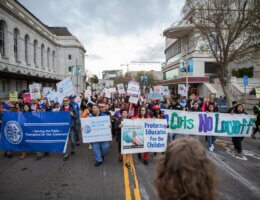
The United Educators of San Francisco has become the first American K-12 public school union to endorse the BDS movement.

Every year, workplaces in Israel distribute thousands of flowers to show their appreciation for their female employees on International Women’s Day. At the same time, these workplaces give women fewer opportunities to succeed compared to men.
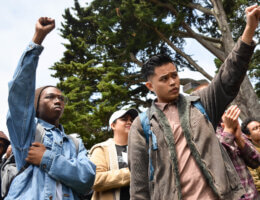
In a struggle that is eerily similar to the battle for the Mexican American Studies a decade ago, teachers, students, and community activists in California are fighting to defend the content and pedagogy of ethnic studies.

We’re excited to introduce the Mondoweiss Book Club. It’s a six-month, go at your own pace program, featuring works of fiction by Palestinian and Arab authors.
Trump’s Education Department lands another blow against free speech.