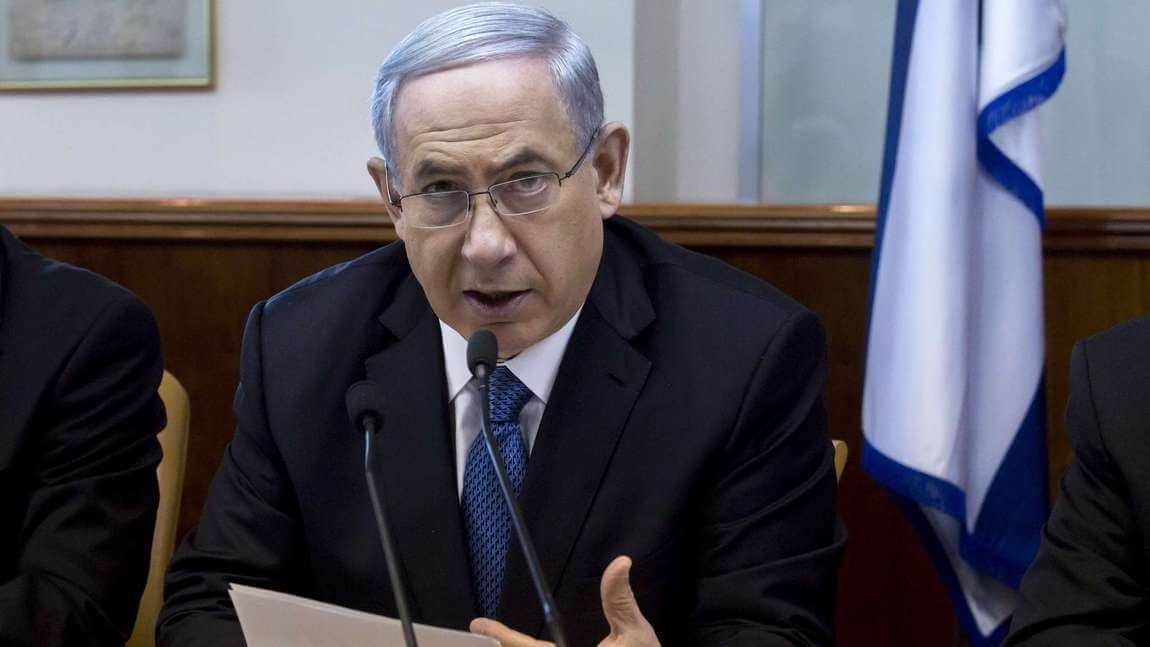
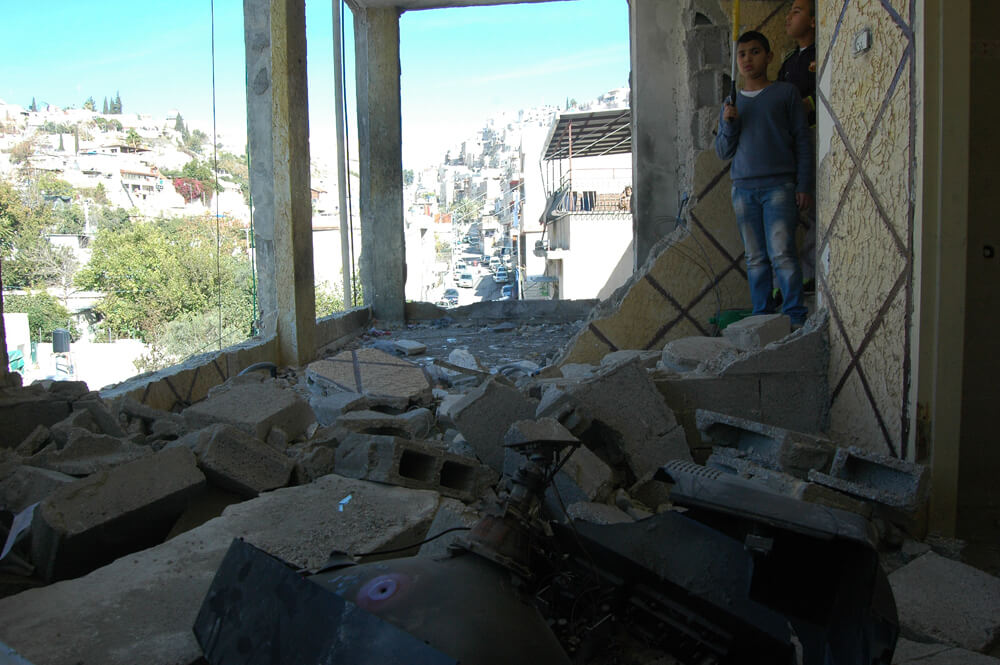
Israel’s renewed policy of punitive home demolitions was challenged in its highest court yesterday. The case comes as the Israeli government has ordered the homes of six Palestinians suspected in a series of Jerusalem attacks to be demolished. In the past judges have heard arguments to overturn demolitions on a case by case basis, but this was the first in Israel’s history to address the legality of the practice as such. And the hearing came with immediate consequences. The homes of five Palestinian families are slated for demolition, and one demolition has already been carried out.
“Swift elections must be held, and a new, united and strong government must be formed,” Israeli Prime Minister Netanyahu announced this evening calling for early Knesset elections hours after firing opposition members Yair Lapid and Tzipi Livni from his cabinet. The move comes after Lapid, Livni and Avigdor Lieberman all announced their parties were leaving the ruling coalition.
Israeli Prime Minister Benjamin Netanyahu had assured that the Jewish democratic state law would not infringe on the rights of its non-Jewish citizens, but two days later his Likud party introduced a Knesset bill to ban the Palestinian flag from protests, deport Palestinians to Gaza, and strip Palestinian citizens of their citizenship or residency, and refuse to return remains of the deceased, in cases of “incitement.”
When news broke of a Palestinian bus driver’s body found hanging by a metal chord in the rear of an Israeli bus in a West Jerusalem parking lot, two separate narratives developed. The death came in the midst of a bitter pattern of attacks on Israeli and Palestinian civilians across the city and the official reason given in the autopsy by Israel was that Yousef Hassan al-Ramouni, 32, had committed suicide. However, the Palestinian media, government, family of the deceased, and witnesses to the body, most importantly a pathologist that sat in on the medical exam, all said otherwise, contradicting, the police’s pronouncement that there was “no suspicion of criminal activity.” Mondoweiss has obtained a copy of a letter authored by the Israeli General Coordinator of the Palestinian territories to the Palestinian Authority, asking them “to stop such incitement and bring the genuine facts regarding the circumstances of death of the deceased, to the attention of the Palestinian public.” In Israel, incitement is a crime punishable with a prison sentence.
Relations between Israelis and Palestinians have descended into a dangerous melee of tit-for-tat attacks and killings, with the violence of the past few weeks centred on Jerusalem. The city, claimed by Israel as its “undivided capital”, has been torn apart by clashes between Israeli police and Palestinian residents since the summer, when 16-year-old Mohammed Abu Khdeir was burnt alive by Jewish extremists. Subsequent attacks by Palestinians culminated last week in a shooting and stabbing spree by two cousins at a synagogue that killed four Jews and an Israeli policeman. In this atmosphere, both sides have warned that the political conflict is mutating into a religious one. By refusing to recognise any Palestinian national claims in Jerusalem, Netanyahu has forced the population to recast the conflict in religious terms. Unable to identify politically with either Fatah or Hamas, Jerusalem’s Palestinians have found powerful consolation in a religious struggle to counter the mounting threats to Al-Aqsa.
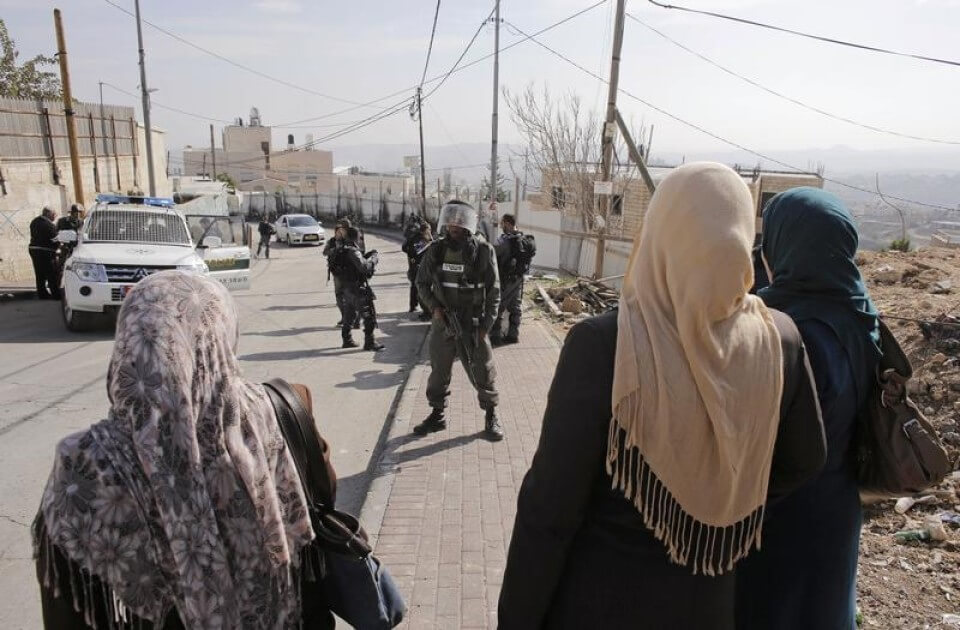
Israeli police ransacked seven apartments and urinated inside one while demolishing the Silwan apartment of Abdel Rahman al-Shaludi, 21, the Palestinian motorist from East Jerusalem who killed a three-month old Israeli-American Chaya Zissel and one Ecuadoran tourist in a light rail attack in Jerusalem on October 22, 2014. “They urinated on the mattresses in my brother’s apartment, said Enas al-Shaludi, 43, the mother of the deceased driver. “You can see the urine on the mattresses.” In addition to the demolition, which the family expected after receiving a demolition order last Friday, all of the other apartments in the four-story residential building were raided.
The alleged killers of 16-year old Palestinian Mohammed Abu Khdeir were in court today for a second pre-trial hearing. The self-proclaimed ringleader of the group, Yosef Ben-David, 29, refused to cooperate. His lawyer told the judge he could not offer a plea on behalf of his client, because Ben-David is no longer speaking.
On Friday Palestinian protesters crossed Israel’s separation wall by Qalandia checkpoint, the artery from the West Bank to Jerusalem, demonstrating for access to the city that has been ensconced in unrest over the past three weeks. Using makeshift ladders tens of protesters walked over the barrier, but Israeli police prevented them from entering Jerusalem.
Monday night, approximately 50 supporters of Yisrael Beiteinu, the right-wing political party headed by Foreign Minister Avigdor Lieberman, demonstrated in Jerusalem outside an exhibition at the Hansen House that featured a video by dancer/choreographer Arkadi Zaides. The fury of the demonstrators was directed at B’Tselem, the Israeli organization that documents human rights abuses in the occupied territories. Zaides’ video included footage from a B’Tselem project titled “Armed with Cameras.” The demonstration was organized by Mothers of Soldiers Against B’Tselem, a group whose mission is “working with legal tools to weaken human rights organizations,” according to the group’s Facebook page. Tensions were extremely high as an Israeli soldier and a settler had been stabbed to death that day in separate incidents. At the demonstration, at least one person was physically assaulted. “Somebody hit me over the head with a flag pole. They called us Nazis and said ‘May you burn in the gas chambers,’” Zafira Stern said.
As tensions seethe in Jerusalem the Israeli government has resurrected polices from the Intifada-era including punitive home demolitions as a measure of deterrence against attacks on its citizens. Even before Tuesday night when Netanyahu declared the return of home demolitions, there were calls inside of the government to bring it back. “Anyone who attacks police or civilians, his home should be demolished,” said Security Minister Yitzhak Aharonovic.