

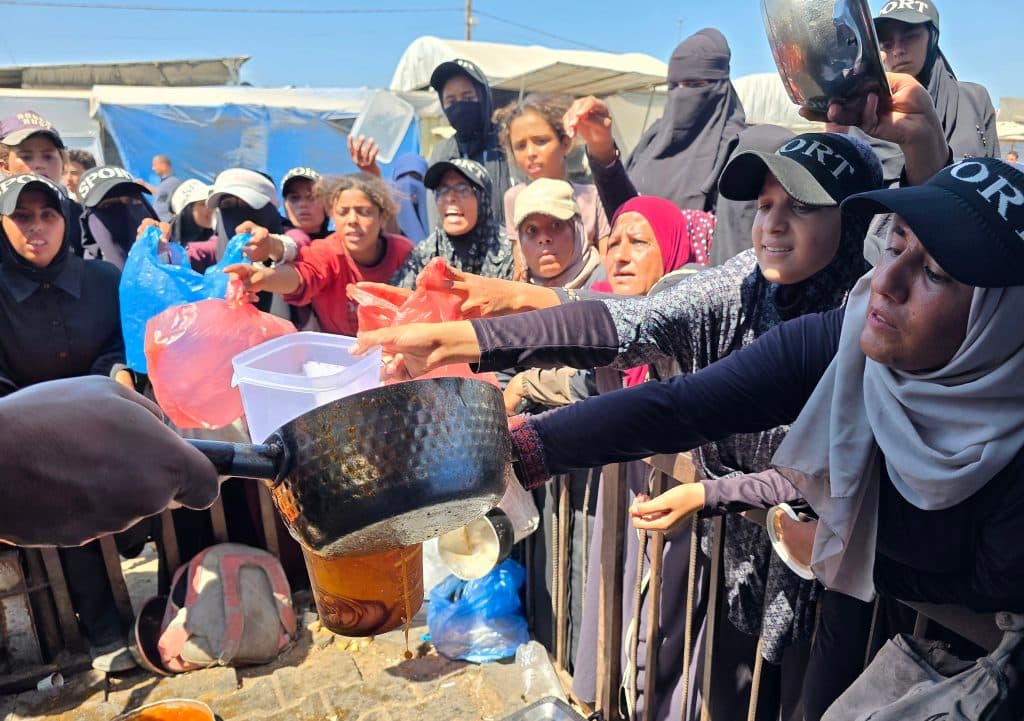
In a tent in Tal al-Hawa, west of Gaza City, 39-year-old Iman Abdel Karim, a mother of six, hands pieces of bread to her hungry children, some of whom are too young to have grown their teeth. Around her are a few empty cooking pots. At the entrance to the tent, the stove has not been lit either yesterday or today.
Abdel Karim and her family live on a single meal a day, usually eaten around noon. When available, it comes from a communal kitchen. When there is no food from the kitchens, they eat bread alone. Sometimes they manage to get a meal from a neighboring tent, or they cook lentils – long among the cheapest foods in Gaza, though even lentil prices have risen beyond what some families can afford.
“My children see some vegetables and fruit with the neighbors, and they start asking me for some,” Abdel Karim says. “But even though some fruit, vegetables, and other foods are available in the markets, we cannot buy anything. We have been living in tents for more than two years. We have spent all our money trying to stay alive, and we have nothing left.”
Food is visible in Gaza’s markets for the first time in years, but hunger is not gone. According to the August 2026 IPC report, more than 1.4 million people, or two-thirds of Gaza’s population, are projected to face Crisis conditions or worse through December 2026. The presence of goods on shelves has not translated into food security for the majority of Gaza’s population, whose purchasing power has been destroyed by more than two years of war, displacement, and economic collapse.
Prices have fallen noticeably compared with last year, when famine was ravaging the population. At the peak of the crisis in mid-2025, a kilogram of flour could cost around 250 to 300 shekels ($70 to $90) in some parts of the Strip. According to a WFP report, wheat flour was being sold at a price 4,900 percent higher than pre-October 2023 tags. Today, a 25-kilogram bag of flour costs around 30 shekels ($10).
Tomato prices have fallen by approximately 81 percent since the ceasefire, potatoes by around 70 percent, and rice by approximately 73 percent, according to a UNICEF humanitarian situation report covering the period from October 2025 to June 2026. Accumulating humanitarian supplies – including commodities such as legumes and flour, which can spoil when stored for long periods in Gaza’s summer heat- drives merchants to sell them fast.
But falling prices have not reached all goods equally. Milk, protein, and fish, which people need, remain difficult to obtain. Cooking gas is regulated by Gaza’s Ministry of Economy, with families allocated an estimated eight kilograms of cooking gas every six months — a quantity far below weekly household needs. And electricity remains unavailable across much of the Strip, making food storage nearly impossible for families and merchants alike.
Abdel Karim remembers the famine with particular pain.
“During the famine last year, I could hear my children crying from hunger day and night, moaning, and there was nothing I could do for them. I could not go to the aid trucks that they described as the road to death. My husband could not either. He has had an injury to his foot since the beginning of the war.
“So instead, I sold my jewelry so I could bring bread to my children. And I was not alone. Many women did the same.”
‘A political game’
Rami Oweis, 56, a father of eight and a retired employee, sees the gap between what is visible and what is accessible as deliberate — part of what he calls “a political game” in which Israel has become highly adept at creating the appearance of normality.
“You see the markets filled with fruit and vegetables in every color and shape,” Oweis says. “But who can afford to buy them every day? Who can bring enough food for himself and his family back to a tent that becomes like an oven in the summer?”
Storage is its own problem. “There are no refrigerators in the tents. Even if there were, there is no electricity to run them.” Cooking what can be brought, he explains, requires firewood, which takes hours to gather and fills the tents with smoke.
“All of this is part of the policy,” Oweis told Mondoweiss. “You see the pictures, but only those who live among the people of Gaza and under the conditions of Gaza know the hell they are living through.”
In Gaza, Oweis says, the markets reflect these contradictions.
A kilogram of meat, which during the Israeli-engineered famine could cost 400 or 500 shekels when it could be found at all, now sells for around 40 shekels.
Potatoes cost around six shekels per kilogram, tomatoes eight, onions six, and cucumbers 12. By pre-war standards, these would be manageable prices. But purchasing power has collapsed.
More than one-third of Gaza’s bread needs are covered by WFP-supported bakeries, where bundles of eight to nine pitas are sold at a capped price of around $1. But the WFP has been forced to reduce flour supplies to bakeries due to Israel’s import restrictions, pushing many families who relied on these bakeries to look elsewhere.
“We no longer have money,” Oweis says. “We are no longer able to buy things the way we did before the war. This war drained everything we had saved for the future, and then destroyed the future itself.”
Permanent state of emergency
Merchants are caught in the same bind. They struggle to store what they buy, watching perishable goods deteriorate in the heat without electricity to refrigerate them, and find themselves forced to sell at reduced prices, sometimes at a loss, to move stock before it spoils..
Abdel Aziz, a small-scale merchant in Gaza who declined to give his full name, says that whenever vegetables and fruit become available, merchants rush to buy them – knowing these are foods Palestinians have deeply longed for. But demand remains limited, even at ordinary prices.
“People are afraid to buy,” Abdel Aziz says. “They always try to keep some cash in their hands in case of an emergency. And Gaza has become a permanent state of emergency.
When people do buy, they buy as little as possible. “Instead of buying two kilograms of potatoes, for example, a father might buy only two potatoes for the family to eat that day.” Families no longer cook full meals every day. They eat at aid kitchens or have sandwiches with cheese or jam instead of preparing a full meal, he adds.
On how the war has impacted Gazans’ eating behaviors, Abdel Aziz describes this as “politics”. “Deliberate politics, so that people remain in a state of need. Even if goods are available, people will not be able to buy them.”
“The Israeli occupation tells the world that it is bringing food into Gaza,” Abdel Aziz says. “The world can see it. But the world does not know how those who survived in Gaza managed to survive, what exhausted them, or what they sacrificed to reach this point, where they can no longer afford to buy vegetables and fruit for their families.”

U.N. report from a few days ag:
Aid reaches hundreds of thousands in Gaza amid severe food insecurity | UN News
In Gaza, about one in five families say that they are eating only one meal a day, and 50 per cent of them reported that they completely ran out of food at least once in the past month, according to latest UN figures….This is because of cash shortages, but also because most food items have become exponentially more expensive since the escalation of hostilities in October 2023.