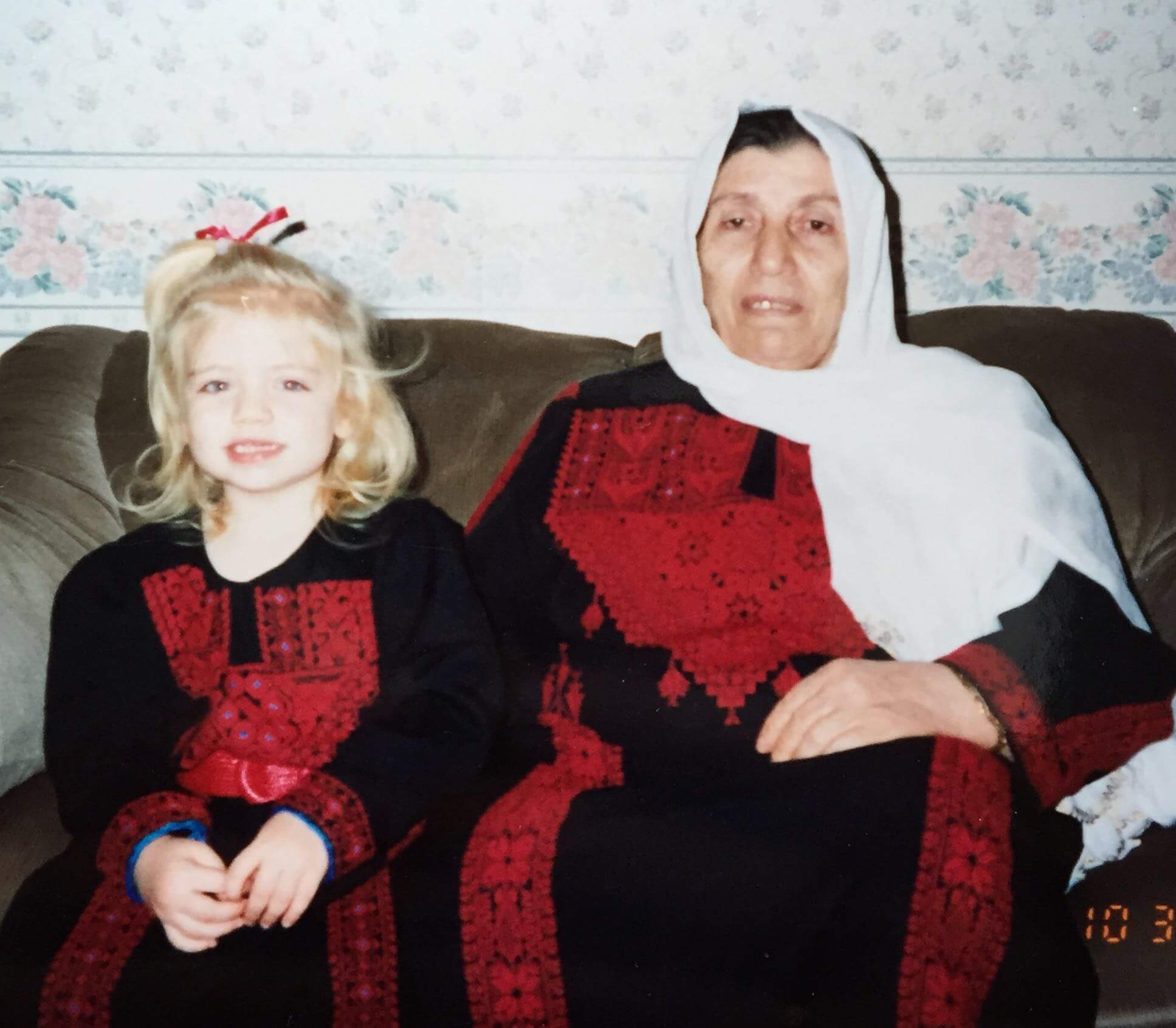
Sarah Aziza shares her family’s story during the Nakba and the importance of Nakba Day as way to remember: “Nakba Day, like all ‘days of remembrance,’ is thus important not simply as an end in itself, but for the difficult and ground-breaking work that faithful reckoning with the past might inspire. May honesty, humility, and imagination lead us forward.”
Tamara Ben-Halim writes about visiting Yafa and searching for the house her grandmother’s family was forced out of during the Nakba. She writes, “I stood on the street that my grandmother once stood on nearly 70 years ago. I listened to the sound of the same waves lapping onto the shore. I saw and touched the same beautiful old Arab, unmistakably Arab, buildings that she had walked past hundreds of times. I told myself it didn’t matter whether I found her house or not, but of course I knew that nothing could replace the feeling and the fact of actually knowing that this was her home, this was the place she had grown up in, the setting of all those stories we had been raised on, this was the place from which her and her father and siblings had fled in terror.”

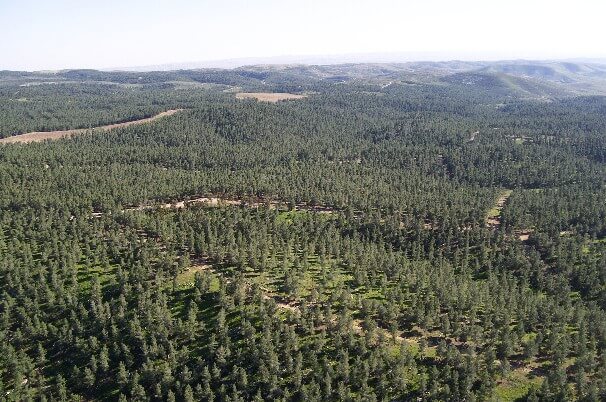
Yesterday, an estimated 5,000 Palestinian citizens of Israel and Jerusalemites participated in the March of Return in an open field overlooking the Sea of Galilee and above a valley where ruins of the village of Hadatha are scattered. Organized annually by the Association for the Defense of the Rights of the Displaced People, the March of Return commemorates the ethnic cleansing of Palestine by pre-state Zionist forces in 1947-1948 — what is known as the Nakba.
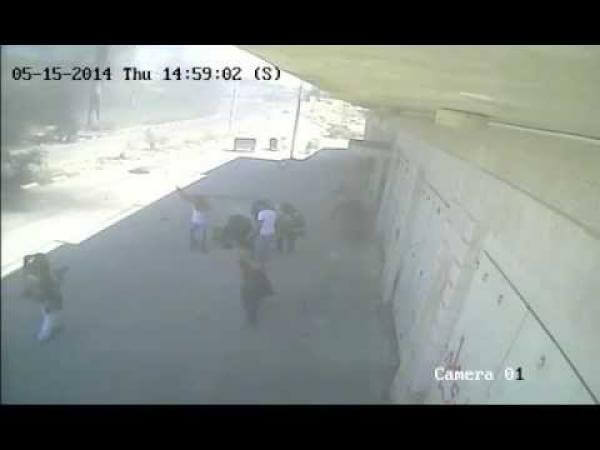
Denial is an important and often underemphasized dimension of Israel’s violence toward Palestinians. The Forensic Architecture team explains how the Nakba day killing of 17-year-old Nadeem Nawara and 16-year-old Mohammad Abu Daher in 2014 is a microcosm of how Israel denies historical crimes and daily incidents equally. The Nakba day massacre was denied, just like the Nakba of 1948 it was commemorating.
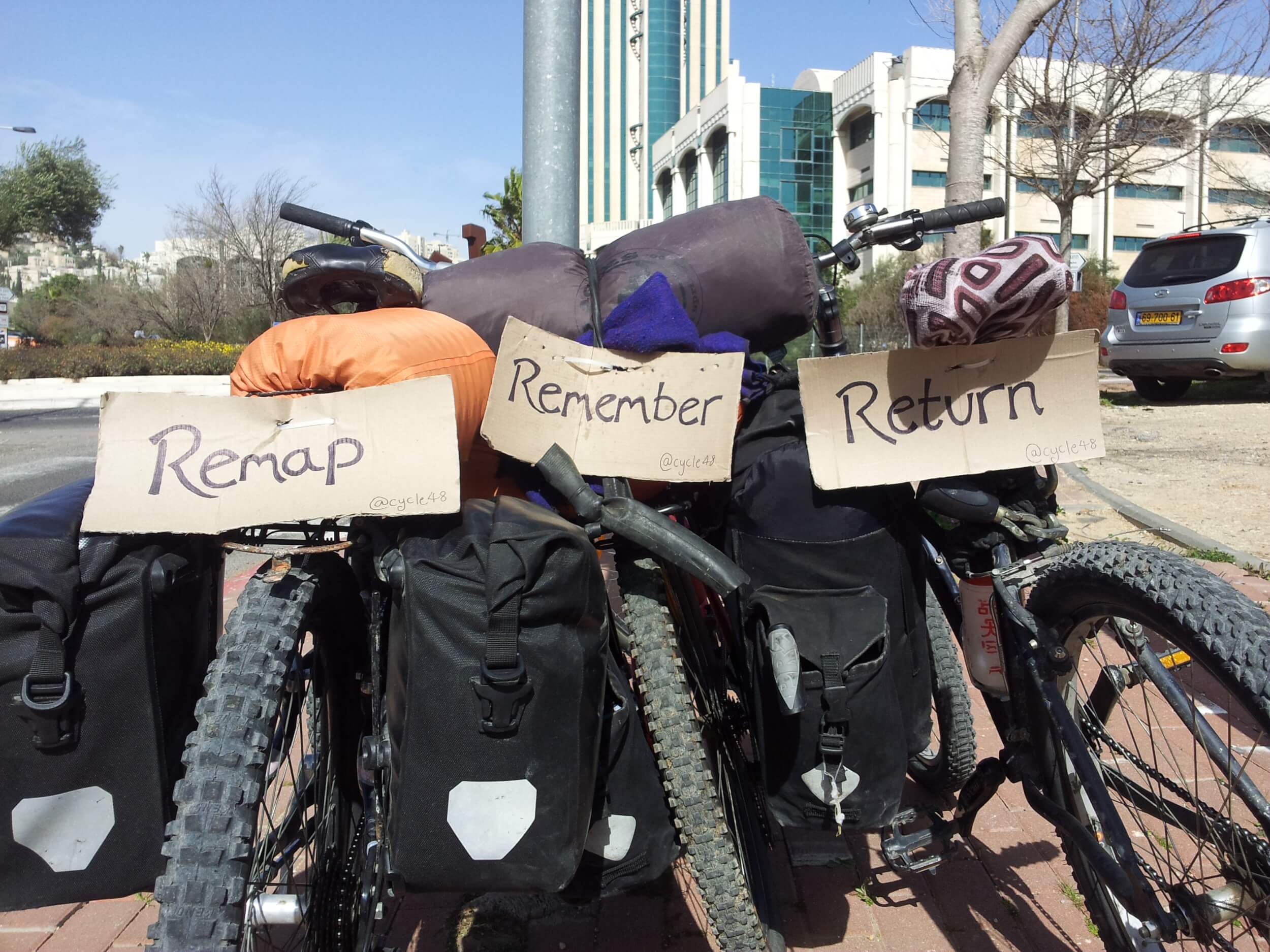
Last week Sara Moon, Bella Crowe and Ruth Kappe left Aida Refugee Camp in Bethlehem, and joined the Jewish National Fund cycle trail from Jerusalem to Tel Aviv in order to uncover the hidden stories related on its path. Along the way they engage Israelis on their understanding of the Nakba and what it continues to mean today. Their organization, Cycle ’48, is an ongoing project remapping erased histories on two wheels.
“Orders came to evacuate one village, to destroy another village. We were told that we had to expel them, the Palestinians. Expel them to Gaza. To leave no one… We didn’t let them come back. Those were the orders from our command. We did some really ugly things… War is ugly.”
Any Israeli institution with public funding that mentions, teaches, or mourns the the Nakba (Arabic for “catastrophe”) can be fined, and individuals can be sentenced to prison for their involvement. Recently this law threatened to cause trouble for the Israeli non-profit organization Zochrot as they prepared for their second annual “48 mm—International Film Festival on Nakba and Return” in Tel Aviv.
The policy of ethnic cleansing ever since 1948, and in particular since 1967, is a consensual issue in Israel and thus leaves very little hope for peace and reconciliation. This strategy is marketed differently domestically and externally: It is based on the need to ‘preserve Jewish identity’ to the Israeli public and abroad as ‘Israel’s need for security’. These concepts are used widely across the political spectrum in Israel and provide the ambiguous framework for the Israeli ‘national consensus’. They also underpin the political instruments which deny the rights of the indigenous people of Palestine and to bring about its goal of maintaining a Jewish majority. The problem with Israel thus is not a policy here or there, but its overall strategy that has not changed.
Until Operation Protective Edge, most of the “messaging” regarding the Israeli-Palestinian conflict, certainly that which broke through the mainstream media, came from the Israeli side. That now has changed. Hamas not only confronted the Israeli Occupation but has also seized the political initiative from it. In stark contrast to Abbas, who has declared security cooperation with Israel to be “sacred” and who passively allows Israel to maintain its massive matrix of Israeli highways in the occupied territories spelling the end of the two-state solution, Hamas has sent a clear and forceful message to Israel: We won’t submit even if you kill us. Deal with us justly – or disappear.