
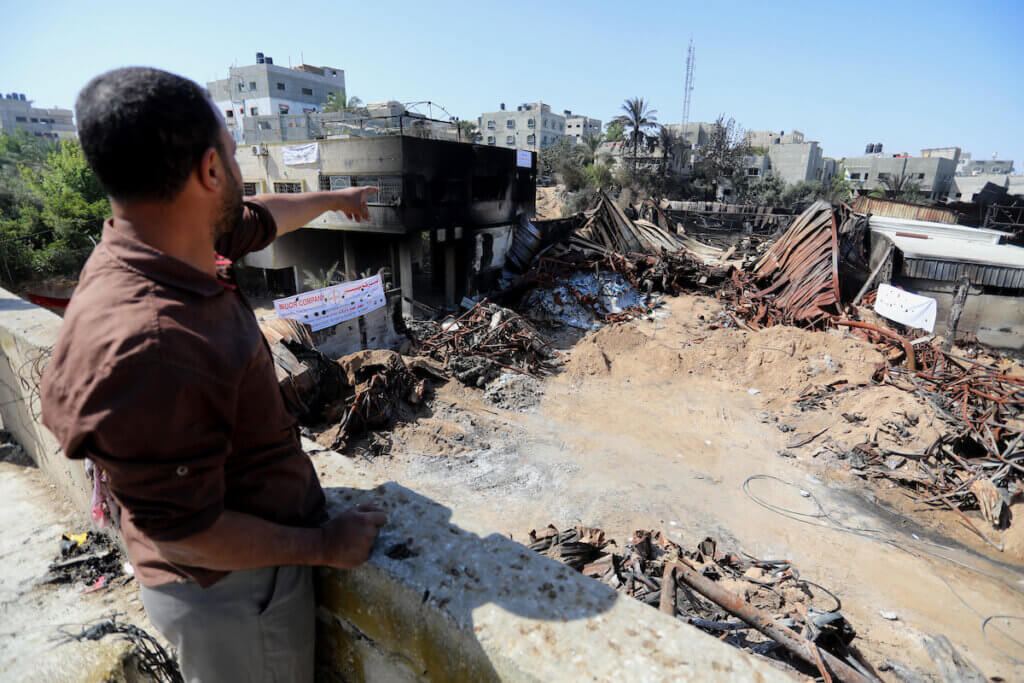
Ibrahim Atta looks out at a dusty field of grasses on a hot Gaza afternoon in early fall and declares this land was once a fertile “piece of heaven.” Twenty years ago, the 56-year-old Palestinian was a farmer, earning an income from selling produce grown on this nine-acre family plot.
Today Atta is no longer able to safely access the farm. The last time he tried to reach the land was in 2015. Israeli forces positioned on the other side of the fence “fired two tear gas bombs just under my feet,” Atta said. “I left and have not gone again. I just look at it from a distance and can’t get close, they may kill me.”
Atta is one of many farmers in the Gaza Strip whose land is not accessible because it is located near a fence that separates Gaza and Israel that was constructed around 20 years ago. While there is no agreed-upon buffer zone around the barrier, Israel’s military enforces a “no-go zone” up to 300 meters on both sides. In 2015, the Israeli military told Gisha, a group that advocates for Palestinian freedom of movement, that farmers are allowed to enter the buffer zone and get as close as 100 meters from the fence.
Yet Gaza’s Ministry of Agriculture says they have complaints of hostile actions taken on farmers who are well outside of these distances. It says that up to 25% of Gaza’s farmlands are no longer accessible.
A spokesperson for the ministry, Adham al-Bassiouni, said it “recorded attacks on farmers accessing their lands who were over 1 kilometer away from the fence in different areas in the Strip.” Farmers also complained of aerial spraying of pesticides over crops.
Atta’s farm is around 350 meters east of the fence. “I tried to follow my father by planting on land,” Atta said. “I have a family to support.”
In the years since the fence went up, Atta said, “My father tried hundreds of times to go to the land and use it to grow vegetables and field crops, to keep supporting the family, but he faced serious danger and harassment,” Atta said. “Once he was shot in the arm,” while attempting to access the land, he added.
“It was an orchard full of colors and different kinds of trees, oranges, lemons, olives, citrus,” he said. “The land used to be the family’s livelihood, we all were working there, my father and my two uncles, along with their sons.”

Al-Bassiouni said damage to the agricultural sector dates back to outbursts of violence during the second Intifada when farms became a dangerous location because they are located in the area of Gaza that is closest to Israel.
“Since the year of 2000, Israel practices the most aggressive policies against the agriculture sector and farmers, it is leveling their lands, killing the crops, and shooting at farmers when they go to their lands, terrifying them and keeping them away from their lands,” al-Bassiouni said.
Successive cycles of violence have decimated tracks of rich soil and greenhouses. Arable lands located on the eastern and northern borders were usually the first locations struck during confrontations with Israel. Al-Bassiouni said after the 2014 hostilities between Israel and Hamas there was major damage. At the end of that war, Gaza’s farming industry was reduced by one-third.
According to the World Bank, the latest hostilities in May left Gaza’s agriculture sector with up to $45 million in physical damages and another $15 million in economic losses.
“The ministry sends many appeals to the United Nations, the Red Cross, and many other international organizations to urge Israel to stop its practices against lands and farmers, but all for nothing,” al-Bassiouni said.
Aside from physical damage to croplands, Gaza has lost most of its trading partners. After Hamas came to power, farmers were devastated by the 2007 blockade when Egypt and Israel closed the borders. During this period, Gaza’s GDP per capita fell threefold, and the once-thriving agriculture industry came to a screeching halt.
“This sector—and all sectors in Gaza—can’t be revived if the siege persists,” al-Bassiouni said. “It must be broken, otherwise our farmers and traders will keep losing jobs, lands, resources, and of course livelihoods.”
Tareq S. Hajjaj
Tareq S. Hajjaj is a journalist and a member of the Palestinian Writers Union. Follow him on Twitter at @Tareqshajjaj.
1 of 2
Lest there be any doubt that American Zionist millionaires & billionaires play a key role in financing “Israel,” the fascistic, expansionist, racist, brutal occupier & ethnic cleanser of the indigenous Palestinians:
Philanthropist Michael Leven Donated to Canary Mission Blacklist (jewishcurrents.org)
“Philanthropist Michael Leven Donated to Canary Mission Blacklist,”
“The revelation makes him the third major American Jewish funder associated with the project. By Abby Seitz and Alex Kane, Jewish Currents, Oct.14/21EXCERPT:“IN 2018, philanthropist Michael Leven, a hospitality executive who has served on the boards of major Jewish organizations, made his customary series of donations to American Jewish organizations: $125,000 to Birthright Israel, $75,000 to Hillel chapters in Georgia & Pennsylvania, $70,000 to the American Jewish Joint Distribution Committee, & tens of thousands more to other groups. But alongside those gifts to some of the most respected organizations in the American Jewish community, Jewish Currents found in a review of Leven’s foundation’s tax records, was a donation of a different nature: a $50,000 grant to Canary Mission, the controversial website that targets supporters of Palestinian rights, & which many Palestinian rights advocates describe as a shadowy blacklist that chills free speech & encourages social media harassment. Leven confirmed in an interview with Jewish Currents that he sent money to Canary Mission, saying he hoped the grant would help ‘identify significant antisemites’ & ‘bring the knowledge of their antisemitism to the surface.'”Canary Mission is a deliberately opaque organization. It is anonymously run, with no staff or funding information listed on its website. Because it is not a registered nonprofit in the US, most of its funders retain their anonymity, shielding them from accountability for backing a student blacklist. But in recent years, reporting in The Forward has exposed some of the group’s funders by uncovering links between Canary Mission & an equally opaque Israeli nonprofit called Megamot Shalom. (cont’d)
2 of 2
“Adding an additional layer of obfuscation, the known donations to Canary Mission through Megamot Shalom, including Leven’s, were first sent to the Central Fund of Israel, a New York-based nonprofit that serves as a pass-through for donations to organizations serving Israeli settlements in the West Bank & other right-wing Israel advocacy organizations.”Launched in 2015, Canary Mission has compiled thousands of profiles of Palestinian rights supporters, most of them students & professors who have participated in Palestinian solidarity activism on American campuses. The profiles include photos of activists, screenshots from their social media, & documentation of protests & events they attended, as well as direct hyperlinks to their social media accounts & workplaces. Sometimes, the profiles document obviously antisemitic utterances, such as one Facebook user’s assertion that ‘Jews have manipulated the US into murdering the innocent.’ But frequently, the profiles criticize people for engaging in Palestinian rights organizing, like campus Boycott, Divestment, & Sanctions (BDS) campaigns, that many would argue are not in itself antisemitic.”Being featured on Canary Mission can prompt significant real-world consequences. The FBI has cited Canary Mission profiles in interrogations of American activists. Palestinian & Arab American activists can face especially harsh repercussions if they appear on Canary Mission: Israeli border agents have used profiles on the site as a reason to deny Palestinian Americans entry into Israel/Palestine, curtailing their ability to visit family. This past May, Canary Mission was used to help fuel a smear campaign against Emily Wilder, who was fired from her position as an Associated Press news fellow after stories about her college Palestine-related activism drawing from her Canary Mission profile ran in conservative outlets The Washington Free Beacon and Fox News.”