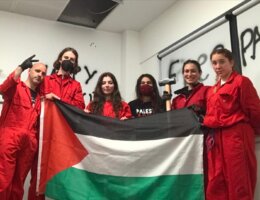
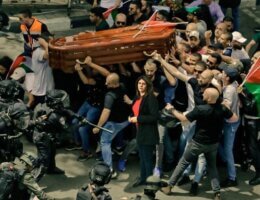
On June 1, the Israeli Knesset passed a preliminary reading of a bill pushed by Likud Party MK member, Eli Cohen, to ban the display of “enemy flags” across Israeli state-funded institutions. Although the bill refers to “enemy flags,” the only flag that is explicitly noted is the Palestinian one. The bill must pass three additional Knesset votes before it becomes law. For Palestinians, the bill is not merely an attack on their flag, but is symbolic of a continued and systemic assault on symbols which express Palestinian identity.
The battle between J Street and AIPAC to influence the Democratic Party is also opening space for Palestine solidarity to enter the mainstream.
“Is it time for this occupation to end? Morally speaking, how much should this military occupation go on, generation after generation?” Said Arikat asks the State Department after another humiliating incident: Israeli soldiers forced a Palestinian woman at a cagelike checkpoint to strip her three-year-old’s tshirt because it pictured a rifle.
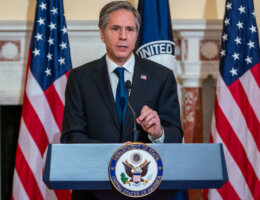
Secretary of State Antony Blinken continues to claim the facts “have not been established” in the killing of Shireen Abu Akleh.
While popular indie rock band Big Thief’s decision to play in Israel exemplifies the violent complicity of liberal Zionism, the recent Boston Palestine Solidarity Concert sets forth a bold new standard for musical solidarity with Palestine.
For everyone who fears that Israel will be able to sweep the killing of Shireen Abu Akleh under the rug, there is good news: two Senators from across the aisle sent Secretary of State Antony Blinken a letter yesterday demanding that the U.S. ensure a “full and transparent” investigation into the shooting of the Palestinian-American journalist on May 11 while she was reporting in the occupied territories. The matter is sure to come up on Biden’s trip to Israel, expected later this month.
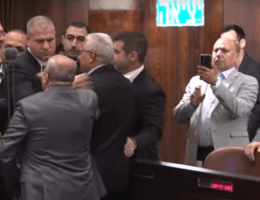
In a dramatic day for the Israeli parliament, legislators failed to renew the extension of an emergency order that affords Jewish Israeli settlers in the West Bank civil governance, while Palestinians in the same area are governed by military rule. This is one of the most blatant Apartheid laws, regularly renewed every five years since Israel began its 1967 occupation. When Palestinian lawmaker Mazen Ghanaim voted against it Nir Orbach of Prime Minister Naftali Bennett’s party charged at him and shouted that “the experiment with you has failed!” “You” is of course Palestinians in general, and the experiment is the idea of including Palestinians in government.
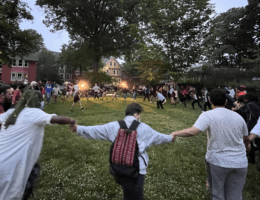
The Harvard College Palestine Solidarity Committee has campaigned for decades to bring conversations about justice in Palestine onto Harvard’s campus. The Harvard Crimson’s editorial endorsing BDS was a watershed moment that showed that our approach is working. The recent backlash against The Crimson and PSC has been immense, but it all speaks to the impact of our work.
Two Palestine Action activists have been imprisoned since May 15 as part of a concerted and intensified attempt by the British State to protect Israel’s arms trade in the country.