Nature. It’s something so simple, isn’t it? It’s all around us. The trees, the grass, the birds and maybe the occasional deer. If you’re lucky, you live in a place with some mountains, lakes, or an ocean. Even if you live in a crowded city, there’s almost always a quiet nature escape just a short drive, walk, or hike away.
There’s almost a guarantee that if you were feeling down, anxious, or depressed, and you went to a friend, family member, or even a doctor, one of their first instructions would be to get some sunshine and fresh air. Go be in nature, it’ll lift your spirits.
That is, unless you live in Palestine.
In a place with some of the most beautiful, and peaceful nature I’ve ever experienced, it should be easy to find an “escape”. In the West Bank, where I have lived for the past seven years, there’s no shortage of hills, ancient terraces, lush greenery, natural springs, and lovely walking trails where you could go to take your mind off of things.
Yes, the beautiful beaches of Palestine’s mediterranean coast, the red sea, the mountains of the north, and the sea of Galilee are all off limits to those living in the West Bank; but, the hills of the Jordan Valley, and the desert mountains of Jericho are still beautiful escapes nonetheless.
So, back to the doctor’s orders.
After some post-new year’s blues, my friends and I decided to take advantage of an unusually sunny and warm January day, and head outside of the city, to the hills between Bethlehem and Jerusalem. We were going to visit Ein Haniya, a beautiful spring on the outskirts of the village of al-Walaja. I’m ashamed to admit that after years of visiting al-Walaja for work, I had never actually been to the spring for enjoyment.
Our taxi dropped us off at a roundabout near the spring. He couldn’t go any further, because he didn’t want to get stopped at a permanent Israeli military checkpoint just down the road. So, as we walked up to Ein Haniya, our views of the lush green olive groves and terraces were quickly disrupted by large signs in Hebrew, Arabic, and English, with the logo of the Israel Nature and Parks Authority, along with fencing around the area, and a number of Israeli flags. We were told we were now entering a “Judean Mountains National Park.”
Above a list of rules and regulations, was a brief “Welcome” paragraph about the “park.” Along with a bible verse, and mentions of archaeological finds, conservation efforts, and “Mount Gilo ridge” (another term for the illegal Gilo settlement, we guessed), was a brief mention of al-Walaja.
There was no mention of the fact that these lands belonged to the people of al-Walaja, many of whom were displaced in 1948 and again in 1967 and now live in refugee camps. There was no mention of the fact that the fences, Israeli flags, and fancy nature reserve signs were all foreign to this land. The only thing native to this land were the trees and the spring itself, though there was no mention of the people who had frequented this spring for centuries and cultivated the trees around us. There was no mention that the olive groves surrounding us are now off-limits to their owners, who still live in the village just up the mountain. There was no mention of the fact that the spring will soon be completely cut off, not only from the residents of al-Walaja but from all Palestinians in the West Bank.
As all those thoughts flooded my mind, we were approached by a staff of the Israeli Nature and Parks Authority. He spoke to us, saying “Welcome!” and that we had to pay, and only had one more hour to visit the spring before it closed.
My friends, all Palestinians who were born and raised on this land, and had their own villages stolen from them before, were not feeling very welcome. Sensing our discontent, we were told that if we wanted to walk on the free trail, we could cross the road to the other part of the “Nahal Refaim” national park – another Hebrew name, erasing the real Arabic names of the place.
We didn’t have the energy to explain that it wasn’t about the money, but about the fact that the fences and physical and literal paywall surrounding the spring shouldn’t be there in the first place. That this was not “Nahal Refaim” national park. It was al-Walaja, and it belonged to the village and its people, no one else.
We decided to cross the road and walk down the trail to “Rephaim Stream” and “Lavan Spring.” My friend would later tell me the real Arabic words of those places as well. As we walked down the trail, we saw other signs for “Haniya Spring.” The Hebrew and English text were untouched, but someone had tried to scratch out the Arabic words. The attempted erasure was clear.
As we walked higher and higher, we realized that, though there was no physical border, we were now approaching the Israeli-made border with Jerusalem. It was our cue to stop. Two Palestinian refugees with West Bank IDs, and an American with a West Bank-only visa meant we could not risk going any further. After all, the last thing we wanted was for our nice nature walk to end up in arrest.
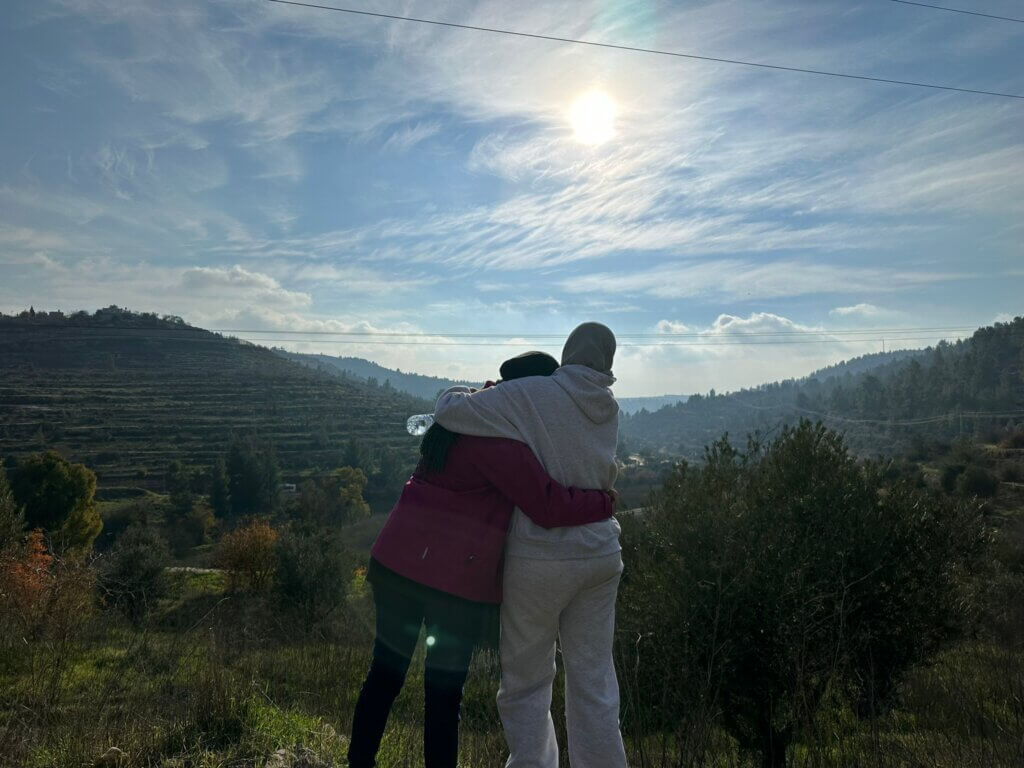
As we looked out at the view in front of us, we could see al-Walaja on the mountain across from us, entirely surrounded by Israel’s separation fence. Eventually, it will be turned into a wall, and the Palestinians who grew up going to Ein Haniya, playing in the spring, singing songs, picking local herbs, and making tea on fires will only be allowed to enter it with a fee, and only during the hours set out by the Israeli Nature and Parks authority. In a few years, the checkpoint will be moved even further into the boundaries of the West Bank, and Ein Haniyeh will no longer be left for anyone on this side of the wall.
I don’t want to say we didn’t enjoy our day- our few hours in nature before we headed back to the overcrowded city and refugee camp. We did. But as we left the sunshine, the fresh air, the sounds of the birds, and the sight of the little gazelle we spotted dancing across the mountain, all we could think about was the land that was lost, and the beautiful pieces of nature that we may never see again.