


Agriculture in the northern West Bank could be on the verge of disappearing under the weight of Israeli land confiscation and the destruction of water wells. The Atouf area, in the Tubas governorate in the northeastern West Bank, and long known as the region’s “breadbasket,” has been targeted by settler attacks on its water lines. The settler raids complement the Israeli army’s ongoing infrastructure projects in the area, which have plowed through Palestinian farmlands and demolished wells.
For four months, thousands of Palestinian farmers in the Atouf plain have been unable to access water for their crops after settlers began attacking and damaging water lines, according to local residents. In recent weeks, the Israeli army has bulldozed farmland in Atouf as part of a military road project, further damaging water lines in the process. The army has also issued demolition orders for wells on the plain and has already demolished several.
The northern West Bank has been at the center of Israeli military orders and settler activity in recent months after the Israeli government allowed settlers to return to sites where four Israeli settlements had been evacuated in 2005. In a first since the Second Intifada, the Israeli army took over a neighborhood in the city of Jenin for military purposes inside Area A, which is the part of the West Bank that is supposedly under the exclusive jurisdiction of the Palestinian Authority (PA).
Tubas has also seen its share of Israeli raids and settlement expansion, particularly given its strategic location overlooking the northern Jordan Valley. But the destruction of water sources on Tubas’s farmland carries deeper implications for Palestinian life in the area and across the West Bank, reaching beyond the issue of Palestinian geographic continuity and land ownership.
The plain of Atouf is shared between the villages of Atouf and Ras al-Ahmar, both extensions of Tammoun, the administrative center of eastern Tubas. Together, Tammoun, Atouf, and Ras al-Ahmar hold more than 85,000 dunams (8,500 hectares) of farmland, parts of which the Israeli government has confiscated over the years of occupation. As of early this year, some 30,000 dunams of land in Tammoun and its eastern villages were still being farmed by Palestinians, with hundreds of families depending on agriculture in the region.
Sameer Bisharat, former mayor of Tubas, told Mondoweiss that “70 to 80 percent of people in Tammoun and its surroundings depend partially or entirely on farming for their living, especially after Israel revoked working permits.”
“Israeli settlers from the surrounding outposts have been coming and damaging the water lines, emboldened by the fact that the Israeli army had begun building a military road across the plain last year,” Bisharat explained.
Palestinians in Tammoun tried several times to fix the damaged lines, but the Israeli army kept ordering workers to leave the area, Bisharat said. Then, over the past two weeks, the Israeli army began distributing demolition orders for water wells that farmers depend on for irrigation. Last week, it began demolishing several wells in the Atouf plain.
‘There is no tomorrow for me’
Durgham Muhammad, a full-time farmer in Atouf, owns 400 dunams (40 hectares) of farmland in the Atouf plain, including greenhouses, fields growing several crops, and a water well.
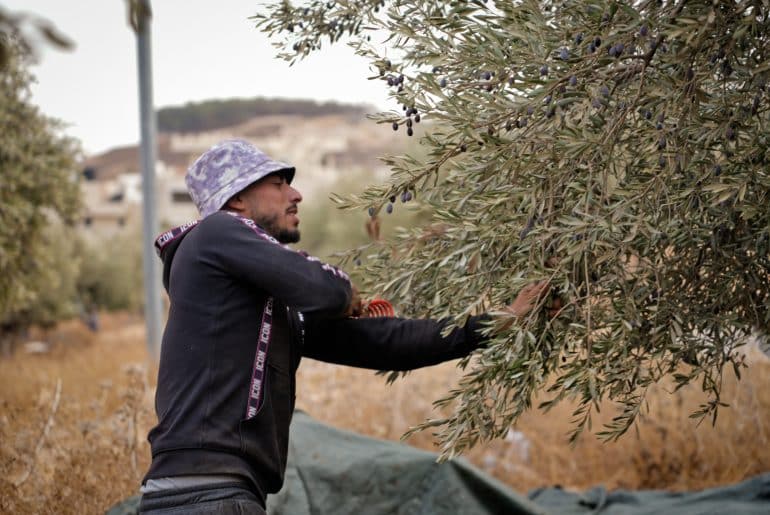
“I produce seasonal crops like wheat, tomatoes, onions, cucumbers, potatoes, lettuce, spinach, and various fruits,” he told Mondoweiss. “Like most farmers here, I sell them to vendors in the vegetable markets of Nablus, Beita, and Qabatia. I hire 30 farmers to help me, and their families depend on this land for their income.”
Muhammad used to irrigate his farm from his own well, with enough left over to sell to other farmers in the plain. But last week, he received a demolition order for the well.
“For the past four months, our work has practically stopped, and we are barely figuring out how to survive financially,” Muhammad noted. Although it has yet to be demolished, he cannot make use of the water well.
“What we are trying to do currently is get as much water as we can from the pipes to irrigate some of the crops and save as much of our produce as possible,” he said. “The most difficult part is that even this is temporary, because the military road is going to make all 400 of my dunams inaccessible, which means I will lose my only source of income, and I have no other profession.”
“When I think about it, I realize there is no tomorrow for me, and I can do nothing about it,” he added. “It drives me to the brink of madness.”
For Khalil Tafakji, a Palestinian geographer and expert on Israeli settlements, the Israeli takeover of the Atouf plain and eastern Tubas is unique because it doesn’t correspond to any previous settlement expansion plans.
“I studied the military road project, which also includes a military fence, based on the maps,” he told Mondoweiss. “It crosses the northern West Bank from east of Tammoun and Tubas, through east of Qabatiya and Jenin, and ends at the northernmost point of the Green Line in the West Bank, several kilometers west of the Allon Road, which has long marked Israel’s plan to annex the Jordan Valley.”
What this means, Tafakji says, is that the project “doesn’t serve any current settlement expansion purpose,” and is “ purely military.” Unlike other cases, he added, “the destruction of water sources and agriculture in the area doesn’t have an obvious Israeli objective.”
“I can’t help but believe that in this case, at least, the destruction of the agricultural economy in the West Bank is itself the Israeli purpose,” Tafakji explained.
Israel has confiscated at least 52,000 dunams (approximately 5,200 hectares) of land in the occupied West Bank since October 7, 2023, according to the Palestinian Colonization and Wall Resistance Commission.
Qassam Muaddi
Qassam Muaddi is the Palestine Staff Writer for Mondoweiss. Follow him on Twitter/X at @QassaMMuaddi.

It’s all part of the plan to eliminate Palestinians:
More than 100 Palestinian detainees have died in Israeli prisons since October 7th—nearly half the total of the previous 56 years.
The Torture Regime
Some serious questions –
What do “settlers” do all day when they’re not destroying the land they covet so much?
What will Israel do if they ever succeed in driving the indigenous population out of the West Bank and find they have created a desert and call it peace?
Tamir Pardo, a former head of the Mossad security agency, told Israeli television after touring West Bank villages, “My mother was a Holocaust survivor, and what I saw reminded me of the events that happened against Jews in the last century.”
Jonatan Shimshoni, a retired Israeli brigadier general, put it this way: “Israel is now using its power to start ridding the West Bank of Palestinians.” Even Israel’s president, Isaac Herzog, condemned settler attacks as “a wave of terrible violence that is being carried out by an anarchist mob.”
Opinion | Israeli Settlers Are Out of Control – The New York Times
“Israel’s slow strangulation of Palestinian agriculture” The massive list of Israel’s war crimes just grows and grows. With NO consequences for the apartheid, genocidal, sadistic Israeli government, military, illegal land thieves.
Keep contacting U.S. Reps, joining together with others who protest Israel’s continuous heinous behavior.
Trump to Netanyahu: ““What the fuck are you doing?” the US president shouted at the Israeli prime minister during the phone call on Monday, according to Axios, a US website that has frequently published reports on high-level conversations between the two leaders.
The report, which has been contested in Israeli media, cited a US official summarising Trump’s remarks to Netanyahu: “You’re fucking crazy. You’d be in prison if it weren’t for me. I’m saving your ass. Everybody hates you now. Everybody hates Israel because of this.”
Today:
Panic, chaos after deadly Israeli drone attack on Gaza Cityhttps://www.aljazeera.com/wp-content/uploads/2011/10/2011102385745841734_8.jpeg?resize=96%2C96&quality=80
By Hani Mahmoud
Reporting from Gaza City
Drones have hit the seaport area in western Gaza City, killing at least six Palestinians. Among those killed one child who happened to be at the place of his family.
A seventh body is also at al-Shifa Hospital, and according to civil defence sources, it’s unrecognisable. They haven’t been able to identify the body because it looked like the missile hit him directly and left the body shredded.
The attack happened at about 6pm [15:00 GMT], at a cafe. The explosion was so massive that it shook buildings across the surrounding area and could be felt as far away as Gaza City centre.
This area is particularly busy at this time of the year, with temperatures high; many living in tents come out in the evening to get some relief from the heat and cool off by the sea.