Key Developments (March 31 – April 3)

- Four Palestinians were killed between March 31 and April 3.
- On April 1, Israeli forces shot and killed 23-year-old Mohammad Raed Nayef Baradieya near Beit Ummar in the district of Hebron. Baradieya was allegedly responsible for a ramming attack which injured two Israelis, and is a member of Unit 101 of the Palestinian Authority’s National Security Forces.
- Also on April 1, Israeli forces in Jerusalem shot and killed Dr. Mohammad Khaled Al-Usaibi, 26, near Bab Al-Silsila (Chain Gate) in the Old City of Jerusalem. Israeli police attempted to frame his killing as self-defense by claiming that al-Usaibi had reached for a policeman’s weapon. However, Palestinian eyewitnesses affirm that the young doctor from the Bedouin town of Hura in the Naqab was killed as he attempted to intervene while soldiers harassed a young Palestinian woman after prayer.
- On April 3, two Palestinian resistance fighters were killed during an Israeli invasion on Nablus and identified by the Ministry of Health as Mohammad Nasser Al-Said and Mohammad Abu Bakr Aljuneidi. The two men were killed during armed confrontations with Israeli forces at approximately 7:41 a.m., and were reportedly part of the Lions’ Den armed resistance group operating out of the Old City of Nablus. The organization mourned the two fighters on its Telegram channel and reported that Israeli forces were confronted with live ammunition and homemade explosive devices.
- The Israeli Knesset approved the final reading of the Combating Illegal Weapons Bill, which proposed to establish “special cause for search of illegal weapons without need for warrant,” specifically mentioning “Arab society” as the community that would be targeted as a result of a “wave of violence and crime.”
In-Depth
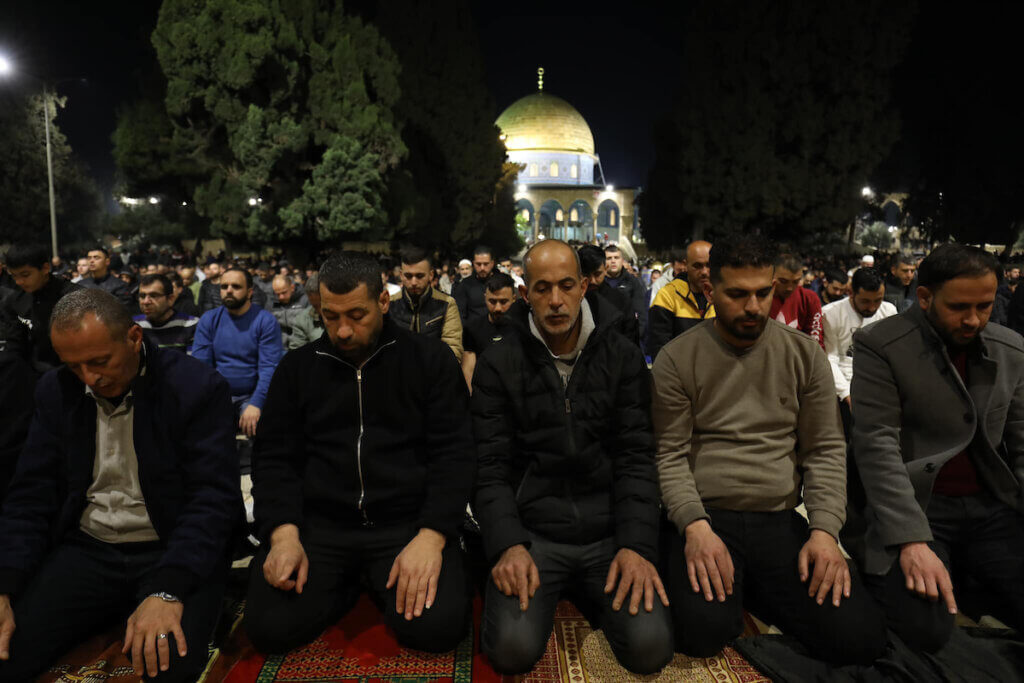
It has become political common sense in the past few years to expect a volatile month of repression and revolt during Ramadan. While the nature of the Israeli provocations in Jerusalem is by now expected — whether it’s the regular settler incursions into the Al-Aqsa compound or the “Flag March” — the Palestinian response to these attempts at spatial domination has been a lesson in channeling religious belonging into anticolonial struggle.
When in the summer of 2017 Israeli police attempted to set up metal detectors outside the entrances to the al-Aqsa compound, the Bab al-Asbat uprising followed one of several popular uprisings to take place in Jerusalem in the past decade. Crucially, it took place during Ramadan, a period in which youth are out in the streets until the late hours of the night, creating conditions ripe for confrontation with Israeli forces. This gave rise to a kind of public sphere, a temporary commons that emerged during the holy month, where religious prayer became a means of confronting colonial authority. It extended to other cities across the West Bank during subsequent revolts sparked by settler or police provocations at Al-Aqsa, most notably during the Unity Intifada of 2021.
Jerusalem became the primary mover of a cycle of popular struggle whose peaks would often coincide with the holy month, due in part to the fact that Ramadan has in recent years also happened to coincide with annually scheduled settler incursions and Jewish holidays. Typically, this also meant that Israeli repression during this month would escalate, and restrictions on Palestinian movement would tighten. But while periods of Palestinian upheaval became more or less the norm, last year’s Ramadan was the subject of dejection among Palestinian Jerusalemites, as Israeli settlers were able to invade the al-Aqsa compound throughout the month, and Palestinian attempts to prevent them were met with arrests and beatings.
What is, of course, missing in this narrative is what was happening before and after that month in 2022 — a wave of Palestinian armed operations targeting the Israeli army in the West Bank and targeting Israelis in Israeli cities. This heralded the rising tide of Palestinian armed resistance.
Ramadan this year has echoes of 2022. Palestinian armed resistance has not abated, remaining in the backdrop as Israeli authorities have tightened restrictions on Palestinian movement in al-Aqsa, forcing worshippers out of the Mosque and preventing them from engaging in overnight prayer, and on April 1, Israeli authorities shot and killed a young Palestinian doctor who was reportedly attempting to prevent a Palestinian woman from being harassed by Israeli soldiers after prayer. All the while, the Israeli campaign of assassinations of armed resistance fighters continues, most recently with the assassination of two Lions’ Den fighters during an Israeli military invasion of Nablus.

The fate of the month is yet to be decided. Resistance to Israeli restrictions in Jerusalem is muted so far, as the Israeli regime attempts to atomize Palestinian society by launching a war against the commons created during the month. This war concentrates in Jerusalem, the remaining site of Palestinian collectivity not yet marred by the formal collaborationism of the PA. In doing so, Israel is playing with fire, but it can’t help but do it anyway because allowing the Ramadan commons to continue to emerge in the city carries too many risks, not least of which is that Palestinians would further solidify their presence in the city in light of the commitment of the Israeli fascist right to lay claim to the Al-Aqsa compound. For that reason, the Ramadan onslaught is well underway
Important figures
- Since the start of the year, 95 Palestinians have been killed by Israeli settlers and the Israeli army, of whom were children and minors (18% of killings).
- Jenin and Nablus comprise 62% of all killings at the hands of settlers and the military.
- Since the beginning of the year, Israeli forces and settlers displaced 401 Palestinians, amounting to almost half the number of Palestinians displaced during the entirety of 2022.