
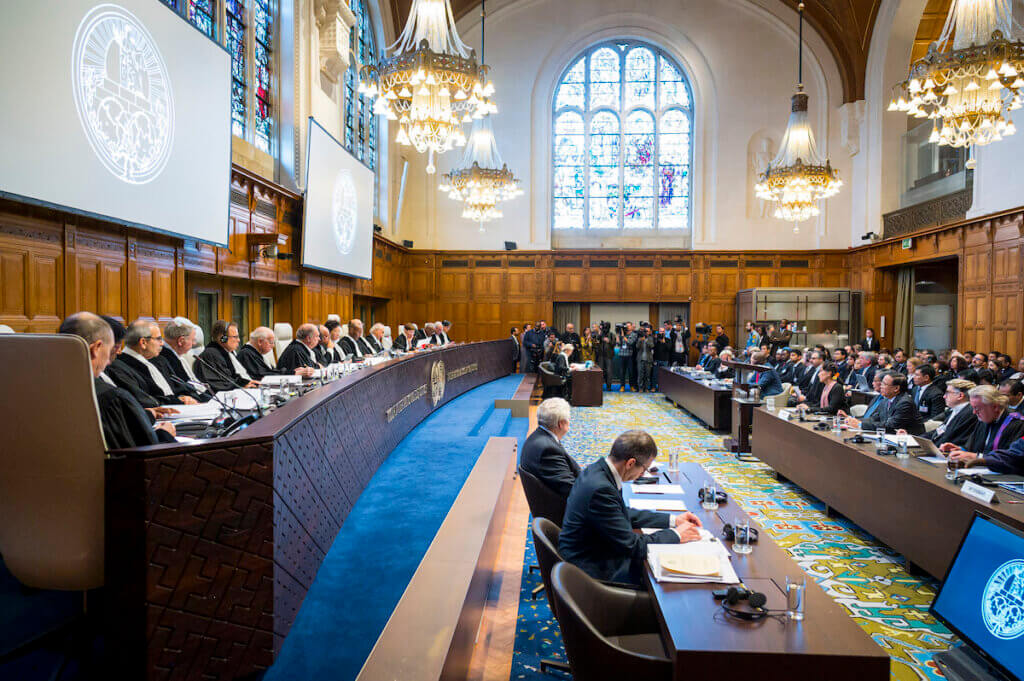
Few people have as much reason to be as cynical about the international legal system as the Palestinians. Under the protective cloak of the United States, Israel has systematically and consistently defied international law in its treatment of the Palestinian people with virtually no consequences.
It is, therefore, easy to see why some might hold out little hope for the case coming before the International Court of Justice this week charging Israel with the crime of genocide. But in fact, this case holds promise in a number of different ways, and it has already had an effect on Israel.
It is important to make clear that there is little chance that this case will be a magic panacea that will bring an end to Israel’s brutal campaign in Gaza. There should be no illusions on that score, and of course, that is the most important potential outcome. That it is almost impossible will still be a reminder of the desperate need for a better international legal system with the power to coerce states into following the law, especially regarding charges as grave as genocide.
Still, given the abject failure of international law to provide any meaningful protection for the Palestinians for so many years (on this topic, I cannot recommend strongly enough the excellent book by Prof. Noura Erakat, Justice for Some: Law and the Question of Palestine), the hope that something significant can come from South Africa’s decision to file this complaint at the ICJ could potentially mark a long term reversal in Israeli impunity.
What is happening this week at the ICJ?
The initial hearing is not going to determine definitively whether Israel is committing genocide in Gaza. The issue before the court this week is whether there is sufficient evidence to move the case forward, whether South Africa has legitimate standing to bring the case, whether the case is based on plausible treaty rights and obligations, and most importantly, whether to grant the provisional measures South Africa is seeking.
It is very likely that the Court will find that the legal questions of standing and legitimacy merit moving the case forward. That is particularly so because the Court does not have to rule definitively on those questions in order to move the case forward. They can decide later that, for some reason, South Africa does not have standing or that the ICJ doesn’t have jurisdiction over this case. By the time the case is fully adjudicated—a process that is likely to take months or years—the court could decide that the case for genocide is not conclusive. It is perhaps the most difficult charge to prove in international law because it depends on intent, which is always hard to prove. What makes Israel so unusual is that their leaders, as the South African petition details, have made a shocking number of statements that bolster the case for genocidal intent.
Those are the long-term questions. Right now, the lower threshold—a plausible argument that genocide is occurring—means that the question before the court can be dealt with more quickly.
The request for “provisional measures” is somewhat more complicated. South Africa has petitioned the Court to order Israel to cease its military operations in Gaza; enforce laws barring incitement to genocide by its politicians, military leaders, diplomats and citizens; do all it can to restore access to food and water to everyone in Gaza; preserve evidence around the case; submit reports to the court on its compliance; and avoid any actions which might in any way worsen the conflict the ICJ is deciding upon.
The Court could decide to grant some, all, or none of those measures. If it orders any of them, it is a virtual certainty that Israel will refuse to abide by the orders, just as Russia did in 2022, when the Court ordered it to stop its invasion of Ukraine pending its decision on, ironically, Russia’s use of charges of genocide by Ukraine as a pretext for its invasion. It’s a very safe bet that barring some incredible circumstance, the United States will back Israel’s refusal to comply.
If the Court does grant the provisional measures South Africa requested—especially the most important one, that Israel stop its bombardment of Gaza— the court is likely to do so relatively quickly. Recent rulings in similar cases have seen such rulings come down between two weeks and one month after the hearings. In this case, the hearing itself was scheduled comparatively quickly, so it is reasonable to hope the ruling will come relatively soon as well.
Does the case matter on the ground?
While it is extremely unlikely that Israel will heed any of the Court’s rulings that it doesn’t like, the very existence of the case has already brought about an Israeli response. Israel is talking a good deal more about pulling back on some of its offensive, and while the killing continues unabated, the fact that Israel is doubling down on its propaganda is a beginning.
On Wednesday, the day before the hearing began, Israeli Prime Minister Benjamin Netanyahu stated plainly that “Israel has no intention of permanently occupying Gaza or displacing its civilian population.” It’s an obvious lie, but it still represents a recognition that the genocidal rhetoric he and other Israeli leaders have engaged in since October 7 is now causing trouble for them.
At this writing, eleven UN member states, plus the Organization of the Islamic Conference (OIC) have come out in support of South Africa’s case. Those states are: Bangladesh, Bolivia, Jordan, Malaysia, Maldives, Namibia, Nicaragua, Pakistan, Palestine, Turkiye, and Venezuela. That’s a diverse set of countries, and some of them—particularly Jordan, one of the first Arab states to sign a peace treaty with Israel and NATO member Turkiye—will have a significant impact on Israel in the region and will concern the United States.
The Deputy Prime Minister of Belgium Petra De Sutter has stated that she is working to get her country to support South Africa, and we even saw the right-wing Foreign Minister of the United Kingdom, former Prime Minister David Cameron, forced to admit that Israel may be committing war crimes.
This is the beginning of real international pressure on Israel, and it can grow. Already, support for the South African case is coming from Asia, Africa, and Latin America. If European countries, even a few, get added to that list, it is a damning indictment of Israel’s actions.
More to the point, it can have real repercussions. Israel and the U.S. are party to the Convention on the Prevention and Punishment of the Crime of Genocide. This means that an eventual finding of genocide would require all parties to take action against Israel and its leaders who committed the act. The U.S. and Israel may not comply, but other countries could, and this will significantly impact both Israel’s and the U.S.’ standing in the diplomatic community.
Moreover, even a finding on the provisional measures that grants some of what South Africa has been requesting will have a profound impact on Israel’s position. It will increase existing pressures on businesses to pull out and divest from Israel. It will cast a pall over Israel in international forums. It will strain Israel’s relations even with friendly states in Europe and the Arab world. It could very well be the straw that forces reconsideration of the Abraham Accords, although the Biden administration is certain to pull out all the stops to prevent that.
In a more general sense, it is hard to imagine anything that could lend more fuel to the Boycott, Divestment, and Sanctions (BDS) movement. It will accelerate boycotts and divestments, but, crucially, it opens the door to sanctions. South Africa can certainly inform Israel of what that pressure can lead to.
The possibility of sanctions against Israel resulting from this is not wishful thinking. The Genocide Convention obligates all parties to act on a finding of genocide. Even if that ruling comes a year from now, parties to the Convention are bound by treaty to punish the offenders. There has never been a better opportunity to finally see international consequences for decades of Israeli criminality.
That possibility is also a political one. If the ICJ does grant some or all of the provisional measures, the Palestinians and their supporters will have the opportunity to press the public case against Israel. This can accomplish a great deal. By making the case that the court found that there was at least a reasonable argument that Israel is committing the crime of genocide, the debate in the court of public opinion is strengthened.
Certainly, Israel and its supporters, especially in the White House and Congress, will argue that the court is biased against Israel and will support Israel’s defiance. But even they will be nervous, because they will be formally implicated in any crimes Israel has been found to commit. Doubtless this is a big reason why the Biden administration has been so concerned about the recent statements of Israeli leaders when they showed virtually none at the beginning of Israel’s onslaught against Gaza.
Even if the ICJ does not grant any of the provisional measures but does allow that a sufficiently plausible case for genocide exists the political benefit will still be available.
Much will depend on how Palestinian leadership and activists respond to this. The potential for a dynamic shift in the status quo is here. The idea that the self-proclaimed “Jewish state” could be guilty of genocide after using the genocide against the Jewish people to excuse its crimes for decades can be devastating if it is handled correctly. Israelis and their supporters bristle at the very suggestion that Israel could ever be guilty of war crimes, let alone a crime as big as genocide. It may take time, but a finding against Israel here will open more eyes about Israel’s behavior, even while those dedicated to pure tribalism dig their heels in deeper.
This case threatens to change the debate, to dramatically alter Israel’s image in the world, and, perhaps most decisively, completely transform the way Israelis and their supporters see themselves. It is an opportunity to strengthen the bond between justice for Palestine and the broader struggle against bigotry and hate in all its forms, be it racism, anti-Arab or anti-Palestinian hate, Islamophobia, misogyny, or antisemitism.
That’s the potential international justice holds, and for the first time since the Zionist immigration started, there is some real hope in the international justice system for a free Palestine. And who better to have started this ball rolling than South Africa?


UPDATE: Colombia and Brazil expressed their support of South Africa late Wednesday. – https://www.reuters.com/world/middle-east/israel-face-gaza-genocide-charges-world-court-2024-01-11/