

Casualties
- 37,877 + killed* and at least 86,969 wounded in the Gaza Strip. Among the killed, 28,152 have been fully identified. These include, as of May 1st, fully identified 7,779 children, 5466 women, and 2418 elderly. In addition, around 10,000 more are estimated to be under the rubble.*
- 554+ Palestinians killed in occupied West Bank and East Jerusalem. These include 135 children.**
- Israel revised its estimated October 7 death toll down from 1,400 to 1,140.
- 670 Israeli soldiers have been admitted killed since October 7.***
* Gaza’s branch of the Palestinian Ministry of Health confirmed this figure in its daily report, published through its WhatsApp channel on July 1st, 2024. Some rights groups estimate the death toll to be much higher when accounting for those presumed dead.
** The death toll in the West Bank and Jerusalem is not updated regularly. According to the Palestinian Ministry of Health on June 30, this is the latest figure.
*** These figures are released by the Israeli military, showing the soldiers whose names “were allowed to be published.” The number of Israeli soldiers wounded, according to declarations by the head of the Israeli army’s wounded association to Israel’s Channel 12, exceeds 20,000, including at least 8,000 permanently handicapped as of June 1. Israel’s Channel 7 reported that according to the Israeli war ministry’s rehabilitation service numbers, 8,663 new wounded joined the army’s handicap rehabilitation system since October 7, as of June 18.
Key Developments
- Israel has killed 159 Palestinians and wounded 592 across the Gaza Strip since Thursday, June 27. This raises the death toll since October 7 to 37,877 and the number of wounded to 86,969, according to the Gaza health ministry.
- U.S. amends ceasefire deal proposal, Hamas says it is ready to negotiate any proposal that guarantees a permanent end to the war, while Netanyahu insists on continuing the war.
- Gallant says the Israeli government will soon decide how to “change the security situation” on the Lebanese border.
- Israeli opposition leader Lapid says that opposition is having talks with Likud members to bring down Netanyahu’s government “in order to save the state.”
- Tens of thousands of Israelis protest in 80 locations to demand resignation of Netanyahu government and prisoner exchange deal with Hamas.
- Some 60,000 Palestinians forced to flee their homes in the Shuja’iyya neighborhood in Gaza City under Israeli airstrikes as Israel continues its attack on the neighborhood for the fifth day in a row.
- Israeli army admits 33 wounded soldiers over the weekend, including 22 in the Gaza Strip, as fighting with the Palestinian resistance continues.
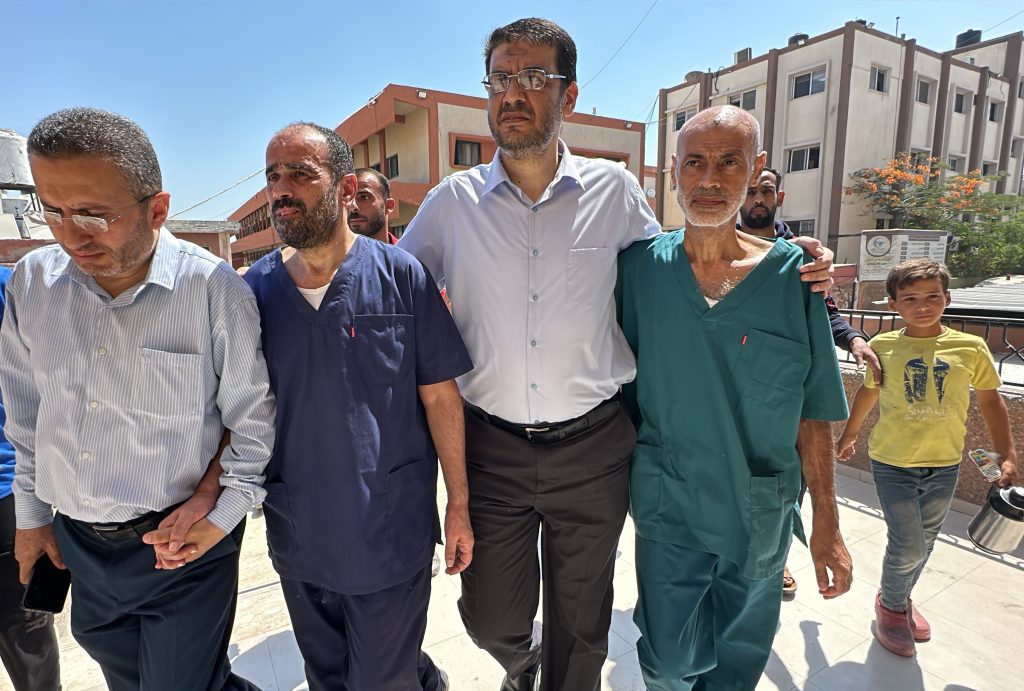
- Israel releases 50 Palestinians from Gaza, including the director of al-Shifa Hospital, Dr. Muhammad Abu Salmiyah, detained since last November.
- Benny Gantz and Itamar Ben-Gvir separately criticize the Israeli prison services and the Israeli intelligence for releasing al-Shifa Hospital’s director.
- Ben-Gvir responds to critics of reducing food for Palestinian detainees, saying Palestinian prisoners should be “shot in the head.”
- Israeli forces kill three Palestinians in an airstrike on Tulkarem, including a woman and a teenager, during a raid late on Sunday, June 30.
- Israeli forces raid Tulkarem again early on Monday, July 1, destroying the main water pipeline to Nur Shams refugee camp and several streets.
Netanyahu insists on continuing the war
Israel’s Prime Minister Benjamin Netanyahu said on Sunday during the weekly Israeli government meeting that Israel would continue “to fight until achieving our goals; destroying Hamas, returning our hostages, ensuring that Gaza will no longer be a danger, and returning the residents to the north.”
Netanyahu added that Israel hadn’t changed its position on the prisoners’ exchange proposal put forward by U.S. President Biden earlier in June, adding that it was Hamas who refused the deal.
Last week, Netanyahu said in a lengthy interview with Israel’s Channel 14 that he was “not ready to end the war,” and that he aimed at a partial deal that would release some of the Israeli captives, and then continue the war.
Meanwhile, the U.S. proposed an amendment to its own deal proposal. The amendment is to the proposal’s article eight, which stipulates the beginning of negotiations between Israel and Hamas during the second phase of the ceasefire over the specifics of the prisoners’ exchange and the ceasefire. Hamas has demanded an explicit mention of a permanent end to the war. According to official sources quoted by CNN, the amendment introduces “a new language to breach the gaps.”
Tens of thousands protested in 80 locations in Israel on Saturday and Sunday, demanding the resignation of Netanyahu’s government and a prisoners’ exchange deal. The protests’ organizers also announced their plans to mobilize 1 million Israelis and start a series of strikes in the coming weeks.
Meanwhile, Israeli opposition leader Yair Lapid, said that the opposition was holding talks with some members of Netanyahu’s Likud party to bring down the government.
In the meantime, Israeli forces continued their second invasion of the Shuja’iyya neighborhood for the fifth day in a row, forcing some 60,000 Palestinians to flee their homes under Israeli artillery shells and airstrikes. Israeli forces also attacked the al-Mawasi coastal area between Rafah and Khan Younis, which the Israeli army had told Palestinians to flee to as “a safe zone” at the beginning of its assault on Rafah in early May. Local sources reported that Israeli strikes caused the tents of displaced families in al-Mawasi to catch fire.
The Israeli army has announced during the past week that it is close to concluding its operations in Rafah as it continues to close the city’s border crossings, preventing all aid from entering the strip, which has accentuated the spread of starvation, especially in the north of the strip, according to the WHO.
Israeli war minister seeks to ‘change security situation’ on Lebanese border
Israel’s war minister Yoav Gallant said that his government is “very close to making a decision on changing the security situation in the north by diplomatic or military means.”
Gallant’s statements came as the specter of an all-out war between Israel and Hezbollah continues to loom following an unprecedented escalation in threats in the past two weeks.
Several countries have called on their citizens to leave Lebanon and to avoid traveling to it while both sides continued to exchange cross-border attacks. On Saturday, Israel bombed several locations in the south Lebanese towns of Houla, Idaiseh, and Kufr Kila.
Hezbollah, for its part, attacked Israeli positions in the occupied Shebaa farms and near the Lebanese border with rockets. On Monday, the Israeli army admitted that 18 soldiers were wounded in a drone attack by Hezbollah on a military position in the occupied Golan Heights.
Israeli leaders slam release of al-Shifa director
On Monday, Israeli forces released 50 Palestinians from the Gaza Strip who had been detained during the current war, including the director of the Israeli-destroyed al-Shifa hospital, Dr. Muhammad Abu Salmiyah, who was detained by Israeli troops in November.
According to testimonies by survivors from al-Shifa and other released detainees, Dr. Abu Salmiyah was arrested after he refused to make public claims that Hamas fighters were using al-Shifa for military purposes. Testimonies of fellow detainees indicated that Dr. Abu Salmiyah was beaten and humiliated during his detention.
Upon his release, Abu Salmiyah said to Al Jazeera that Palestinian detainees were suffering very hard conditions due to the lack of food, humiliation, and mistreatment by Israeli forces.
In reaction, Israel’s security minister Itamar Ben-Gvir said that Dr. Abu Salmiyah’s release was a “security neglect” by the Israeli intelligence and prison services. Benny Gantz, the opposition leader, also criticized the release of Dr. Abu Salmiyah and 50 other Palestinians, calling it “an operational and moral mistake.” In response, the Israeli public broadcasting service said that the release of the detainees on Monday was because Israeli jails were full.
The detention conditions of Palestinians, especially from Gaza, continue to be the subject of warnings by human rights groups. Earlier in June, Palestinian attorney Khaled Mahajneh managed to be the first Palestinian lawyer to enter the Sde Teiman detention center in the Naqab and spoke of how prisoners were subjected to brutal forms of torture and humiliation, including sexual abuse of Palestinian detainees by Israeli soldiers.
On Sunday, Al Jazeera broadcast footage it had obtained of Palestinian detainees in Gaza being used as human shields by Israeli soldiers. The footage showed Palestinian detainees forced by Israeli soldiers to enter buildings ahead of them, with their hands cuffed behind their backs, some semi-naked, with hanging cameras. One detainee is seen forced to enter a tunnel opening and walking deep into the tunnel while tied with a rope and holding a camera.
Last week, Israeli media reported a significant decrease in food quantity given to Palestinian prisoners. Israeli security minister Ben-Gvir commented that it was part of Israel’s “deterrence” strategy.
On Sunday, Ben-Gvir commented on the reports about the food decrease for Palestinian prisoners by saying that the prisoners “deserve to be shot in the head,” adding that Palestinian prisoners would continue to receive “the bare minimum” until the final passing of a bill presented by his party at the Knesset which would legalize the death penalty for Palestinian detainees.
Israel kills three Palestinians, destroys infrastructure in Tulkarem
Israeli forces killed three Palestinians in an attack on the refugee camp of Nur Shams in Tulkarem on Sunday. The victims were a 15-year-old teenager, a 46-year-old woman, and a 23-year-old man who was a leading member of the local resistance group.
Israeli forces began its raid on Nur Shams late on Sunday, during which they conducted an airstrike on a house in the crowded Manshiyyeh neighborhood, killing Said Jaber, 23, a leading member of the Tulkarem Brigade, a local resistance group. Jaber had previously survived an Israeli drone strike and was wanted by the Israeli army. The strike also wounded five civilians, two of them critically.
On Monday, Israeli forces raided Nur Shams again before dawn, placing snipers on high buildings and opening fire in the camp’s streets, killing a teenager, Ali Sarhan, 15, and a woman, Nisreen Dimeiri, 46.
Israeli forces “bulldozed the streets and destroyed the main water pipeline that brings water to the camp, which left all residents without water,” Hussein Sheikh Ali, a resident of Nur Shams, told Mondoweiss.
“Although the occupation forces withdrew from inside the camp around noon, their snipers still surround the camp from all sides, and residents are all indoors, fearing to go out and get shot,” he said. “Classes were suspended in all of Tulkarem, businesses were closed, and daily life was completely interrupted.”
With the killings in Tulkarem on Sunday and Monday, the number of Palestinians killed by Israeli forces or settlers in the West Bank rose to 556 since October 7.


How might it all end? Nicholas Kristoff writes in yesterday’s New York Times that the West Bank is on the verge of exploding.
“Israel’s “state-backed settler violence,” as Amnesty International describes it, is enforced by American weapons provided to Israel.”
But in terms of the long view this statement was the most interesting:
“Israeli officials are right to despair about the lack of credible Palestinian leadership, but there is a step they could take to address that. Israel could release Marwan Barghouti, the most popular Palestinian leader, from prison. Barghouti has spent more than two decades in prison for murdering Israelis, and Israel regards him as a terrorist. But he favors a two-state solution and he has enough legitimacy that he just might be able to deliver a peace deal. As a result, some serious Israeli commentators favor his release….“He is the only one who can extricate us from the quagmire we are in,” wrote Alon Liel, a former director general of Israel’s Foreign Ministry…The United States should push for Barghouti’s release and also press Israel harder to clamp down on illegal settlements and settler thuggery. For the same reason we oppose Palestinian terrorism, we should stand against Israeli terrorism.”
https://www.nytimes.com/2024/06/29/opinion/israel-gaza-west-bank.html
Alon Liel’s essay from last August:
I was Israel’s most senior diplomat. I urge Australia to recognise the state of Palestine
https://www.theguardian.com/commentisfree/2023/aug/09/alon-liel-former-israel-senior-diplomat-ambassador-i-urge-australia-to-recognise-the-state-of-palestine
Remember Fahamiya Khalidi? She’s the 82-year-old woman with Alzheimers whom the Israelis imprisoned as an “unlawful combatant.” A lawyer finally got her out. Her caregiver is still in prison.
If they say she’s an unlawful combatant, then anything they say about anyone they imprison is likely to be a lie.