

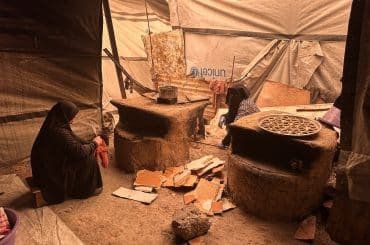
Normality has been redefined in Gaza. Calling home a makeshift tent is now normal, and so is shuttling between displacement centers and queuing for hours to receive food and basic necessities. It is normal for a child to spend three hours a day in a long line to fill up a small gallon of water, and it’s abnormal to see that same child stand in line for school. It’s also normal for an entire family to go two days without food.
Few in Gaza think things will ever go back to how they were before. The daily habits they’ve acquired tell as much.
Muhammad Abdul Aziz, 43, lives in Gaza City in a tent on a plot of land hosting 20 other tents. They house families who returned to northern Gaza from the south and found their homes leveled.
Abdul Aziz lives a daily routine that is more psychologically exhausting than physically. While he endures the daily struggle to find water and food for his children, and the pain of carrying gallons of water for long distances, the sight that truly drains him is watching how his children react when they’re thirsty and water isn’t available. “The first thing I think about every day when I wake up is how I will provide food and water for my children today,” Abdul Aziz says. “And it’s the last thing I think about before I close my eyes.”
Abdul Aziz describes a typical day as a displaced person in Gaza City.
He begins his mornings by walking long distances to fetch water for the tent. “I try to get priority in the water queues,” he explains. “I go to the only water point in the area early in the day, because if I don’t get it, my family and I will spend the day without water.” He notes that waiting in line can take hours to fill a single gallon.
Over recent weeks, water has been distributed in Gaza through charities that deliver it to designated collection points. A few places sell water, but most displaced families cannot afford the prohibitive costs associated with buying it on the black market.
“By the time we secure the water, it’s 10 or 11 a.m., so we start looking for something to eat,” Abdul Aziz continues.

Abdul Aziz’s family has been out of flour for over a week now. He is waiting to receive his aid from UN programs, which have announced that they have run out of food. “I’m trying to get flour from somewhere else as I wait for the UN program, but I can’t find anything in the markets,” he says. “I was forced to buy spoiled flour a few days ago because my children hadn’t eaten anything for three days. They couldn’t eat the bread we made from it. The smell of the bread was so bad that no one could.”
“When we do eat, I pretend I’m full and leave food for my children. My children notice and try to share some of their food with me, but I leave it for them and keep my hunger in silence,” he says.
Whenever he’s able to secure at least one meal for his family on any given day, Abdul Aziz feels a little more relaxed. He can start thinking about finding a power source to charge his mobile phone and recharge his small car battery, which he would be able to use for a few hours to light his tent.
He also needs to keep his phone charged so he can stay informed about when food parcels are scheduled to be delivered. Organizations will usually send text messages when aid is due for drop-off, but charging his phone and battery costs him 6 shekels a day ($1.80).
Abdul Aziz says that the psychological toll of securing food is more exhausting for him than the physical difficulties entailed in actually getting it.
“I tried to find work,” he said. “I could spend days searching for a job. But when I found that my children were suffering from severe back pain from carrying water for long distances, I decided to stay home and care for my children, because if they got sick, I would not be able to find treatment for them. There aren’t any hospitals.”
‘We are all martyrs in advance’
The situation is not much different for people who live in the remains of their old homes. That cohort is surprisingly large, but many of them prefer to stay in the destroyed husk of what was once their home rather than live in a tent. Even those whose homes have been completely leveled often prefer to set up camp beside the rubble. But regardless of their housing situation, they face the same struggles in obtaining food and water.
Amir Aliwa, 34, lives in the Zeitoun neighborhood east of Gaza City in the remains of his old home. He says that even simple things like finding candy for his children regularly end in failure. He and his family of five live in a home with his extended family, including his parents, married siblings, and their own families.
“It’s scary outside. If you drop a can of beans, several people will attack you and claim it as theirs.”
Amir Aliwa, Gaza City.
“The conditions we live in have made our homes uninhabitable,” Aliwa says. “The children cough from the smoke emitted during cooking over firewood. And we struggle daily to obtain the most basic of life necessities.”
Amir describes how the chores the children of the household have been given are to roam the streets searching for wood, plastic, or cardboard that can be used to light or stoke fires. “The children have started complaining of suffocation,” Aliwa says. “But there is no other way to feed them when food is available.”
Aside from the suffering that comes along with deprivation, Aliwa also says that scarcity has driven people to desperation, making venturing outside on your own a dangerous affair. “It’s scary outside,” he explains. “If you drop a can of beans, several people will attack you and claim it as theirs.”
Aliwa explains that all these behaviors, considered foreign to Gaza, were imposed on them by Israel’s policy of deliberate starvation. They had never experienced life like this before, but hunger will change people dramatically, Aliwa says.
“Our lives were full of family visits and celebrations before the war. No one went hungry or died of hunger,” he adds. “Now, we have no life. We are all martyrs in advance. Our sentences have just been postponed for the moment.”
Ahmad Jalal gathered interviews for this report.

I live in comfort very far away from this never-ending horror, but I will never forget what Israelis have done. They have appropriated and perverted Judaism for their malevolent cause which will end up harming worldwide Jewish communities that the Apartheid state cynically claims it represents. I will also remember the western politicians, media and talking heads that have provided cover for what any reasonable, ethical person can see is a genocide, or even this century’s first Holocaust.
I will also remember those courageous and moral Jewish individuals and organizations that have protested against Israel for industrially slaughtering Palestinian children in their name. I will also remember the full-throttled support that mainstream Jewish organizations have provided to the Apartheid state, as well as their activism in attacking principled young people for standing up for human rights.
Targetting civilians through violence or starvation for political ends is a textbook definition of terrorism
Israel Really Is As Evil As It Looks
Caitlin Johnstone
May 07, 2025
“Israeli snipers routinely, deliberately shoot children in the head throughout the Gaza Strip.
Israel created an AI system for the IDF to target suspected Hamas fighters when they go home to their families and mockingly called it “Where’s Daddy?”, because they are killing the fighters’ children.
Israel has targeted healthcare facilities and ambulances in Gaza hundreds upon hundreds of times.
They’ve been documented entering the hospitals they attack and systematically destroying individual pieces of medical equipment in order to make them unusable.
IDF soldiers constantly post photos and videos to their social media accounts showing themselves mockingly dressing in the clothes of dead and displaced Palestinian women and playing with the toys of dead and displaced Palestinian children.
The IDF has admitted to running a popular Telegram channel called “72 Virgins” which posted extremely gory and sadistic snuff films of people in Gaza being butchered by Israeli forces.
After destroying buildings full of civilians, the IDF has been known to send in sniper drones to pick off the survivors, including children.
Israel has murdered a historically unprecedented number of journalists in its Gaza onslaught, and has been knowingly attacking humanitarian aid workers.
Israeli soldiers rape and torture Palestinian prisoners to death, including doctors. On the rare occasions that anyone is ever arrested for these abuses, Israelis have riots — not to oppose the abuses, but to oppose the arrests of the perpetrators.”
https://www.caitlinjohnst.one/p/israel-really-is-as-evil-as-it-looks
This is a very moving piece. Now let’s see Mondoweiss do a companion article about the day-to-day agony of the Israeli hostages’ families wondering if they’ll ever see their loved ones again, or whether the latter’s captivity, which is the direct cause of the Gazan people’s plight, will continue until they have all died.