

Today, there are essentially two Gazas. One is ruled by Hamas as the de facto governing body in the Strip, and makes up about 47% of the territory. The remaining 53% is under the total military control of the Israeli army.
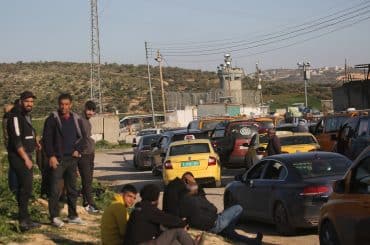
Separating these two zones is an invisible border that’s being called “the Yellow Line,” splitting Gaza roughly in half down the middle. Even though Israel has been placing yellow cement blocks all across Gaza to demarcate the line, it’s supposed to be temporary. But what makes it very real is the number of people who are being killed near it.
According to the ongoing ceasefire agreement brokered by U.S. President Trump, this “temporary” withdrawal line is supposed to be moved back after the end of the ceasefire’s first phase, which is approaching its one-month mark. Negotiations are underway to advance to the second phase, but recent statements and reports indicate that the current division of Gaza could be permanent. There’s also something else to consider, and it’s even more troubling: what if the partition of Gaza is the point?
What’s on either side of the Yellow Line?
The Yellow Line runs down Gaza from north to south, splitting it in two halves. West of the line is the area from which the Israeli army has withdrawn, including the major destroyed urban centers where most of Gaza’s displaced population is concentrated. It’s also where Hamas’s armed elements have reemerged in public, and have been attempting to reimpose order and the rule of law in the Strip.
East of the line is the area controlled by the Israeli army, covering most of northern Gaza, all of Rafah, and the eastern parts of the whole territory. According to the ceasefire deal, the Israeli army will be stationed in this area until the completion of the first phase, and is expected to withdraw further back in the second phase of the deal. Eventually, it is supposed to make a full withdrawal from the entire Strip.
In order to get there, the second phase will include talks over the definitive end of the war, including Hamas’s handover of control of Gaza’s administration to another body and the disarmament of its armed wing. Hamas has already committed to the first condition, alongside all the other Palestinian factions, who have agreed to the formation of a technocratic committee of politically unaffiliated Palestinians who would rule Gaza under a “Board of Peace” headed by Trump.
As for the second condition — disarmament — Hamas has said that it would not give up its weapons before a Palestinian state is established. But just yesterday, senior Hamas leader Musa Abu Marzouk indicated flexibility on the issue when he said that Hamas would be willing to negotiate over the handover of weapons that are able to strike beyond Gaza’s borders, but that it would retain the possession of its light arms to maintain security.
The reality is that Trump’s entire “20-point” framework is vague on details, and maybe intentionally so. The plan is ostensibly divided into three overall phases, and the steps toward completing each phase leave many questions unanswered. Short of any enforcement mechanisms, conditioning later Israeli withdrawals on the verification of Hamas disarmament, the plan is riddled with pitfalls where Israel could claim that Hamas has “violated” the terms of the agreement, hence postponing its withdrawal from Gaza indefinitely.
We’ve seen some of this already. Last week, the Israeli army resumed its bombing of Gaza for several hours, killing 100 people in a single day following the death of an Israeli soldier.
Israel says that the unconditional disarmament of Hamas is its precondition for moving on to the second phase of the ceasefire. The problem is that it’s not really clear what disarmament means. Nothing in Trump’s plan specifies the steps by which Hamas would disarm, and it isn’t clear if disarming includes light weapons, according to what timetable, and to what party it would hand them over.
Israel has chosen to define disarmament as a process that could take years. Israeli Defense Minister Israel Katz has stated that disarming Hamas entails dismantling all of its military infrastructure, including its massive tunnel network and manufacturing workshops. What makes this even more complicated is that the full extent of this infrastructure is the product of pure speculation, and Israel has been unable to dismantle it during two years of full mobilization of its forces. This leaves Israel the opportunity to claim, at any moment, that Hamas hasn’t fully disarmed.
Dividing Gaza is the point
This ambiguity is intentional. It leaves both Israel and the U.S. the freedom to interpret the meaning of the plan to suit their respective interests. For the moment, those interests seem to be the prolongation of Gaza’s de facto segregation.
But if the vagueness of Trump’s terms is intentional, then the partition of Gaza is the plan.
Recent statements from U.S. officials suggest that’s where things are headed. During his visit to Israel two weeks ago, U.S. Vice President JD Vance said that Palestinians should be able to move into a “Hamas-free zone” in southern Gaza “in the next couple of months.” During the same visit, Jared Kushner said that no reconstruction will take place in any area still controlled by Hamas.
And just last Sunday, the Times of Israel reported that the U.S. is planning on building a “new Gaza” in the area controlled by Israel, with plans envisioning the construction of some six residential areas. The Times of Israel reported that representatives from donor countries who have pledged to fund reconstruction, mostly Gulf states, have expressed skepticism that such a plan would work
Given the current stagnation, the intentional ambiguity of Trump’s plan is laying the groundwork for the Yellow Line to become permanent. What we’re seeing before us is the quiet rollout of a plan to divide Gaza’s territory in a way that fulfills goals Israel has been saying it wants to do for months — to draw Palestinians to specific areas, depopulate Gaza’s main urban centers, and place the entire Strip under U.S. control to pave the way for mega-investments.

The problem for Trump and his envoys is that the SCOTUS has already ruled that the treaty power of the President has to comply with the prohibitions of the US Constitution and the Bill of Rights:
“It would be manifestly contrary to the objectives of those who created the Constitution, as well as those who were responsible for the Bill of Rights — let alone alien to our entire constitutional history and tradition — to construe Article VI as permitting the United States to exercise power under an international agreement without observing constitutional prohibitions. In effect, such construction would permit amendment of that document in a manner not sanctioned by Article V. The prohibitions of the Constitution were designed to apply to all branches of the National Government, and they cannot be nullified by the Executive or by the Executive and the Senate combined.” Reid v. Covert, 354 U.S. 1 (1956). Full Stop.
We’ve seen Biden and Trump both refuse to obey the law, by denying equal protection for US citizens stranded or attacked in Gaza, the West Bank, or East Jerusalem. They evacuated Jews from an Israeli port after October 7th, but not the US citizens who were Palestinian. See for example: CAIR, Law Office of Maria Kari Sue State Department for Abandoning Palestinian-Americans in Gaza Genocide. The Constitution and Bill of Rights doesn’t permit Trump to disarm citizens in the USA. He has done nothing to stop US citizens serving in the IDF or the GHF Security Guards from murdering civilians in Gaza, e.g. see Daniel Raab. So it’s hard to understand why US citizens who live in Gaza, the West Bank, or East Jerusalem can be ordered to lay down their arms, when they are still being attacked and murdered everyday. Neither the Constitution nor the Bill of Rights gives Trump the prerogative to do that sort of thing.
What Israel is doing in Gaza really does fall under the category of colonialism, there are so many points of comparison between current events and what happened in Algeria, Germany in Namibia, France in Vietnam, and so on ad nauseum. This recent essay might convince those hesitant to make the analogies:
Gaza.Two Centuries of Colonial Campaigns Continued….Since 7 October 2023, one investigation after another has shown that the Israeli state has been using techniques of dehumanisation on the people of Palestine: torture, rape and humiliation, collective punishment, displacement, internment in camps and forced disappearances, in conjunction with the mass bombing of the civilians confined in the Gaza strip. These acts of violence are anything but incidental; they are part of a system, inscribed in a coherent global history of the counter-insurgency doctrines of Western colonialism….Information gathered by attorney and scholar Janan Abdu made it possible to document from May 2024 the systematic organisation of collective punishment in Gaza and an “endless series of torture, humiliation and killings” at Sde Teiman, the secret military prison in the Negev desert…. The thousands of Palestinians arbitrarily detained since October 2023 under the Israeli law on the “detention of illegal combatants” enacted in December of that same year, were subjected to attacks by dogs, beatings and sexual assaults…Since then, similar accusations have been leveled against many Israeli internment sites such as Ofer, Ananot, Ketziot, Megiddo, Damon and Nitzan…….These forms of violence are of course reminiscent of those perpetrated by the French Army in Algeria or by the US Army in Vietnam, but their systematic use against civilians may be found throughout history on every colonial battleground.
https://orientxxi.info/dossiers-et-series/gaza-two-centuries-of-colonial-campaigns-continued,8589
This took years of hard work to negotiate in Northern Ireland. It will take a huge effort just to get Israel to negotiate in good faith, since it has no experience in this area.
israel – USA = partners in crime.
The likelihood of Israel pulling back from the Yellow Line is is exactly the same as Hamas disarming.