
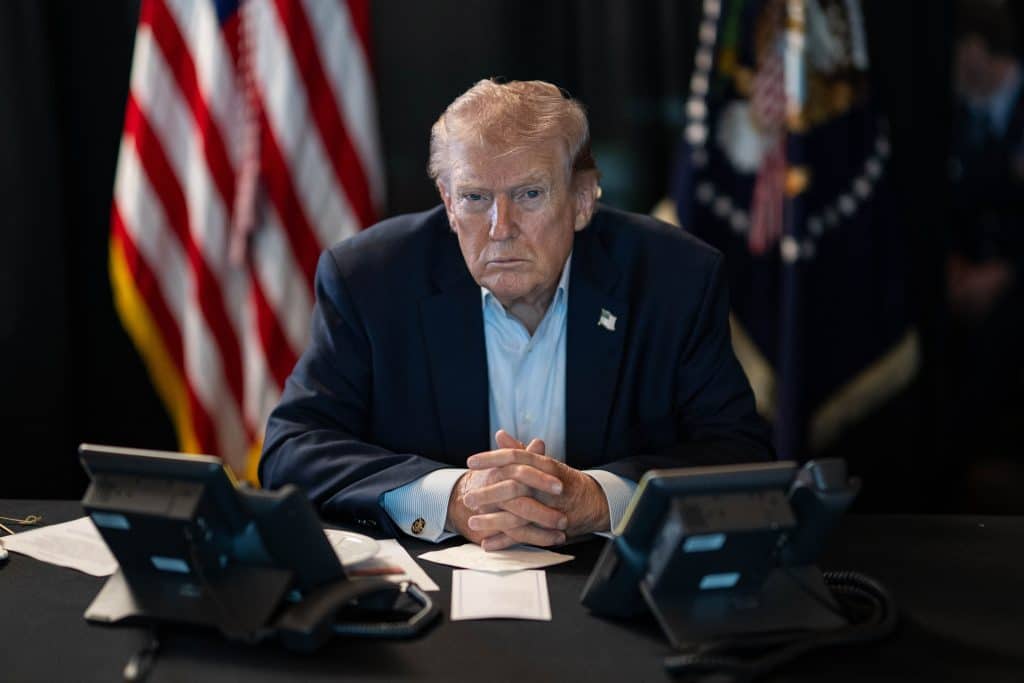
On Sunday morning, as Christians across Iran and the world marked Easter, Donald Trump posted a profanity-laced ultimatum on Truth Social. “Tuesday will be Power Plant Day, and Bridge Day, all wrapped up in one, in Iran,” he wrote. “Open the Fuckin’ Strait, you crazy bastards, or you’ll be living in Hell — JUST WATCH!”
The post was the latest in a week of escalating threats — to bomb Iran “back to the Stone Ages,” to destroy its power plants, bridges, and “possibly all desalinization plants” after a ten-day deadline issued on March 26 expires at 8 p.m. ET on Tuesday. Over a hundred international law experts have already warned that targeting civilian infrastructure constitutes a war crime under the Geneva Convention. Trump, characteristically, appears neither to have read their letter nor to care.
The language is Trump’s own: crude, performative, calibrated for the scroll. But the logic it serves is not his. It belongs to a longer and more deliberate tradition of strategic thought — one that was articulated, with far greater sophistication, more than three decades ago. It has been advancing, precedent by precedent, toward exactly this moment, and to understand how threats of destroying Iranian civilian infrastructure not only became thinkable but inevitable, one must return to the man who first laid the intellectual groundwork for it in the contemporary age: Eliot Cohen.
A professor of strategic studies at Johns Hopkins and later Counselor of the State Department under Condoleezza Rice, Cohen was one of the most consequential war intellectuals of his generation. One of his more memorable and deliberately irreverent lines, first appearing in an article in Foreign Affairs in the aftermath of the First Gulf War, compared airpower to modern courtship, because it appeared “to offer gratification without commitment.” The Gulf War had produced a euphoria among politicians, commentators, and generals due to the emergence of airpower as an instrument of surgical precision, coming at negligible cost and with minimal political consequence. Smart bombs had entered the popular imagination, and press briefings started to feature grainy cockpit footage of missiles threading through ventilation shafts. The message of it all was unmistakable: war had been technologically redeemed.
Cohen’s essay dispelled this fantasy, not to restrain the conduct of war, but to liberate it. His first and most fundamental argument was that war is cruelty, and no degree of technological sophistication changes that. But where a humanitarian critic might have drawn from this the conclusion that force should be constrained, Cohen drew the opposite: the pretense of constraint, far from a moral achievement, was a strategic weakness. The rhetoric of proportionality, the careful press briefings about minimizing civilian harm, the development of so-called nonlethal weapons — all of this he dismissed as a form of self-deception actively undermining the capacity to wage war effectively. And in a world where the laws of war weakened those who practiced it, he argued that adversaries willing to be more honest about what war requires would be handed the decisive advantage.
The importance of Cohen’s intervention was not that it warned against cruelty, but against the squeamishness that prevented its effective deployment. To defeat an enemy, in Cohen’s formulation, was to break them — to reach into the depths of their society, their command structures, and their collective will — in order to shatter what holds them together.
This was not an observation about war’s regrettable side effects. It was a prescription. Cohen held up the model of William T. Sherman’s scorched earth strategy in his March to the Sea during the American Civil War, which aimed to systematically devastate the civilian foundations of the Confederacy’s capacity to fight, as a model to be emulated. The kind of war that wins is the one that refuses to look away from its own cruelty.
When Trump threatens to destroy Iran’s power grid and water desalination plants, an infrastructure upon which millions of civilian lives depend, he is speaking, whether he knows it or not, in the language codified by Cohen.
There’s a second argument in Cohen’s essay that is relevant here, and it followed naturally from the first. Cohen endorsed, without apology, the killing of the enemy leadership as the logical endpoint of airpower doctrine, recalling the American assassination of Japan’s Admiral Yamamoto in 1943. He also cited General Michael Dugan, dismissed as Air Force Chief of Staff for publicly suggesting that the most effective use of airpower against Iraq would have been to strike Saddam Hussein and his inner circle directly. For Cohen, Dugan’s sin was his political indiscretion. He said out loud what the logic of airpower quietly demanded: find the men in the room and put a bomb through the ceiling.
How Israel refined the Cohen doctrine
These two ideas — that war must be waged with unflinching cruelty against the full depth of the enemy’s society, and that leadership decapitation is airpower’s natural culmination — did not remain academic propositions. They germinated over the course of three decades in the operational doctrines of the states most invested in aerial warfare. Cohen was not a detached analyst watching from the outside in all of this, but a signatory to the Project for the New American Century, an advocate for the Iraq War, and a central node in the ideological network through which Israeli strategic thinking entered and reshaped American foreign policy. Neoconservatism was simply the mechanism through which Israeli operational logic, with its appetite for targeted assassination and the deliberate targeting of adversary societies, made its inroads in American strategic culture. Cohen was one of this mechanism’s chief engineers.
Israel innovated and refined these ideas with particular intensity. The killing of Hezbollah’s Secretary-General, Hassan Nasrallah, in a strike on September 27, 2024 — alongside the systematic elimination of Hezbollah’s senior military council and the targeting of Iranian Revolutionary Guard commanders — represented the most complete realization of Cohen’s call.
But the decapitation campaigns are only half the picture. Cohen’s deeper argument about how war must strike at the depths of the enemy’s society and how showing restraint in carrying out this task was a source of weakness found its fullest expression in Israel’s conduct across Gaza since October 2023. Hospitals were reduced to rubble, journalists were killed in their press vests, paramedics were targeted in marked ambulances, and entire neighborhoods were erased.
The groundwork for the Gaza genocide was laid in prior decades, and every step of the way, the window for what was permissible gradually widened. The Gulf War made airpower politically safe. Kosovo removed the requirement for a ground component in 1999. The drone campaigns of the Obama era normalized extrajudicial killing in countries with which the United States was not formally at war.
Each step felt incremental, and each, in retrospect, was a precedent. The intellectual scaffolding that Cohen and his fellow neoconservatives had erected always provided the necessary justification: war is cruel, and to pretend otherwise would be dishonest.
Israel’s genocidal war in Gaza tested the outer limits of this architecture and found that it held. American weapons continued to flow, diplomatic cover was maintained, and the vocabulary of self-defense was deployed with mechanical regularity, even as the gap between the language and the reality became grotesque. What Gaza demonstrated was not merely that airpower was an extension of the cruelty of war — Cohen had said as much in 1994, meaning it as an encouragement — but that the political culture surrounding airpower had evolved to absorb almost any level of cruelty, provided it was administered from a sufficient altitude and narrated with sufficient confidence.
And so we arrive at Trump’s deadline: “Power Plant Day, and Bridge Day, all wrapped up in one.” The threat to destroy civilian infrastructure that sustains millions of lives is not an aberration, but the next room in a long corridor of precedent, each section built to make the next step feel less dramatic than it is.
In many respects, Trump is the ideal subject to see through Cohen’s doctrine to its logical conclusion, given his attraction to force as spectacle, his indifference to consequence, and his susceptibility to narratives of easy victory. Israel spent two years constructing this narrative precisely: that Iran is brittle, its defenses are hollow, and one more push will tip the balance.
Cohen’s courtship metaphor applies with full force — not to airpower alone, but to an entire political culture in which the distance between impulse and act has collapsed, and the spectacular gesture has replaced the slow, accountable work of genuine strategy.
The deepest irony is that Cohen saw all of this and wanted it to happen. His essay was not a lament but a call to shed the inhibitions that prevented the waging of war with the ruthlessness it required. Cohen helped build the intellectual infrastructure that made Gaza permissible and that now makes the destruction of Iran’s civilian foundations thinkable. And in Trump — posting threats to annihilate a nation’s power grid on Easter Sunday, ending with “Praise be to Allah” — it has found a leader who requires no encouragement at all.
Whether Trump executes his threat in a single spectacular blow or continues to administer it in doses — a bridge here, a power station there — the repercussions will not respect the boundaries of any one theater of war.
The closure of the Strait of Hormuz has already removed a fifth of global oil supply from the market, triggered energy emergencies from Manila to Islamabad, and pushed the world closer to a stagflationary crisis not seen since the 1970s. All the while, Iran’s retaliatory strikes on Gulf refineries and desalination plants are turning Washington’s regional allies into the collateral damage of a campaign they were told would make them safer. Cohen’s courtship metaphor promised gratification without commitment; what it delivered, in the end, was cruelty without limit — and a world in which the consequences of that cruelty fall not on the men who authorized it, but on everyone else.
Abdaljawad Omar
Abdaljawad Omar is a writer and Assistant Professor at Birzeit University, Palestine. Follow him on X @HHamayel2.


Abby Martin Went To Israel. IT’S WORSE Than You Think
Apr 7, 2026
You DEFINITELY won’t see this on the BBC or CNN
https://www.youtube.com/watch?v=hLQbPCvV8W8
How is the war going? There is a consensus that we’ve actually killed off the more moderate Iranian leaders and they’ve been replace with more hardline people. Should we laugh or cry? Let’s hear from Danny Citrinowicz, who was an Iran specialist for Israel:
Iran regime collapse could unleash nightmare scenario for Israel.…Should the Islamic Revolutionary Guard Corps (IRGC) dramatically eclipse clerical authority, Tehran might abandon Khamenei’s comparative caution, embracing aggressive postures regarding both nuclear advancement and direct confrontation with Israel….Another crucial reality: despite Israel’s recent campaign, Tehran retains substantial missile inventories plus nuclear infrastructure theoretically enabling enrichment of remaining uranium stocks to 90% weapons-grade purity – a dramatic leap toward bomb production….This proves especially perilous because Tehran’s leadership, despite its dogmatism, has maintained relatively methodical, cautious strategic decision-making. Regime transformation scenarios raise alarming prospects of more extreme factions – the Revolutionary Guards foremost – seizing these capabilities and deploying them without hesitation….Post-Khamenei realities could confront Israel with complex, dangerous circumstances – potentially worse than present conditions.
Iran Regime Change Could Worsen Nuclear Threat to Israel | Israel Hayom
And let’s hear from Robert Pape, an expert on air war at the University of Chicago:
The War Is Turning Iran Into a Major World Power……A fourth center of global power is quickly emerging — Iran….The strait had long been an international waterway through which ships from all countries could travel. But the joint military campaign that the United States and Israel began waging against Iran this year has prompted Iran to create a selective military blockade of the strait….If disruption to the energy supply persists, the effects will be widespread. Higher insurance and freight costs will raise prices. Trade balances will worsen. Currencies will weaken. Inflation will rise. Energy dependence will begin to shape policy. Governments will prioritize access to energy. Diplomatic choices will narrow. Actions that risk further instability will become harder to sustain. A 1970s world in which oil shocks lead to years of stagflation will no longer be a distant memory but a nearing reality…..Again, Iran will benefit…. This is a transformational war, and if these changes continue for even a few years, the global order will change irrevocably.
Opinion | The War Is Turning Iran Into a Major World Power – The New York Times
Thank, Bibi and Donald.
In the Gulf War the U.S. deliberately attacked civilian infrastructure, but in those days our rulers were smart enough not to brag openly about their war crimes.
https://www.hrw.org/reports/1991/gulfwar/CHAP4.htm
Former Ambassador Charles Freeman and Prof Mearsheimer were both on Judge Napolitano’s incredible program “Judging Freedom” this morning. Both claim Israel’s directed war in Iran with Trump following orders. Both claim the U.S. and Israel blowing up international agreements and the Nuremberg trials.
Important listens:
https://www.youtube.com/watch?v=k7sUSP9uoU8
https://www.youtube.com/channel/UCDkEYb-TXJVWLvOokshtlsw